

AI and Astronomy
- 14th Sep 2026
- Author: Ed Kellond-Turner
For most of us, the phrase ‘artificial intelligence’ means one of two things: generated images where people have three arms and strangely warped faces, or murderous robots who have decided humanity needs to be wiped out. There are a lot of negative connotations linked to AI, but in the right hands it can be an incredible tool that can help better our understanding of the universe. Hopefully today I can demystify AI and show you just how important artificial intelligence is for astronomy.
What is AI?
NASA defines artificial intelligence as "computer systems that can perform complex tasks normally done by human reasoning, decision making, creating, etc". Essentially, AI is a computer that acts like a human, though it's a bit more nuanced than that.
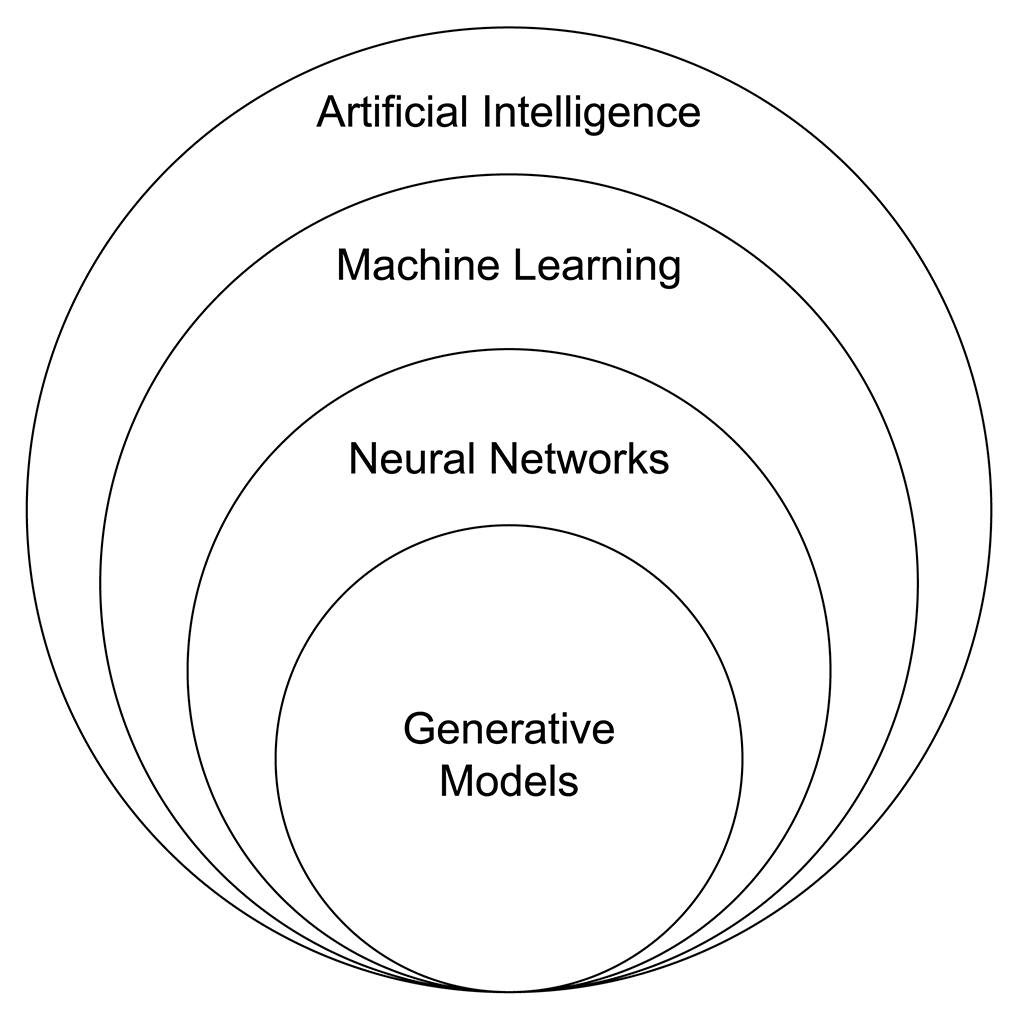
The diagram to the right shows that AI can be broken down into several subsections:
- Machine learning teaches computers to learn from data and make smart choices. This can be through supervised learning, where the AI is trained on data and correct answers, or unsupervised learning, where the AI finds patterns in data. The more data the AI is trained on, the more accurate it becomes.
- Neural networks, also known as deep learning, attempt to mimic the neurons in the human brain with multiple layers to make decisions and predictions.
- Generative models can generate text, images, videos, and audio. This form of AI is the most accessible to the general public, and also receives some of the most criticism.
Most of us are using AI every day in some way or another. If you've ever talked to a digital assistant, like Siri or Alexa, AI is incorporated in answering your request. Recommendations on streaming platforms come from analysing the user behaviour of millions of subscribers to suggest your next watch. Even banks use AI to protect your money, analysing your usual spending behaviours and flagging any possible fraud. I think it's fair to say that in modern society, the use of AI is now almost unavoidable.
Missions Utilising AI
-
![The Perseverance rover, on Mars]()
NASA/JPL-Caltech/MSSS Perseverance Rover
Ordinarily, Mars rovers rely on human "drivers" to plan their routes across the Martian surface in search of ancient life. This is a slow process, with rovers only moving up to 100 metres at a time, hampering the amount of science that can be collected. The Perseverance rover tested the use of AI analysis of satellite photography to plot a route, managing to self-drive almost 250 metres. To date, around 90% of the driving done by Perseverance has been autonomous. This success lays the foundations for future missions that target worlds further than Mars, so must be able to work autonomously.
-
![Hera Along With Milani and Juventas at Dimorphos]()
ESA - Science Office, CC BY-SA 3.0 IGO Hera
Hera is a planetary defence mission currently on its way to Dimorphos, the same asteroid that DART impacted in 2022. The spacecraft uses AI to 'steer' itself through space similar to self-driving cars. Hera has a number of sensors that build up a model of its surroundings, allowing the spacecraft to make decisions autonomously. The onboard AI was tested during a flyby of Mars, where the sensors identified and tracked several surface features on the red planet.
-
![Satellites in Orbit]()
ESA Earth Observation Satellites
Earth observation satellites use machine learning to detect patterns in data, finding relationships that would be impossible, or too time-consuming, for a human to detect. This analysis can assist meteorologists with tracking extreme weather such as hurricanes and heatwaves, help farmers with crop growth, and allow scientists to monitor the causes and effects of climate change.
-
![The Chandrayaan-3 lander deploying the rover.]()
ISRO Chandrayaan-3
AI usage was embedded in the Chandrayaan-3 mission from the start. AI algorithms were used to optimise the design of the spacecraft, as well as assisting with the safe landing on the Moon. AI then assisted the mission's rover in its exploration, and finally AI analysed the data that was gathered by the mission. There may be a time when we see an increased success rate of lunar landings by employing AI assistance.
-
![James Webb Space Telescope]()
NASA James Webb Space Telescope
Webb is an incredible telescope, currently beaming back around 50 gigabytes of data every day, or around 35 Netflix films. This is simply too much for astronomers to decode, so AI is used to analyse the data and highlight key finds. Additionally, AI models denoise JWST images to create clearer pictures, and sift through data to reveal distant exoplanet atmospheres.
-
![Nancy Grace Roman Space Telescope]()
GSFC/SVS Nancy Grace Roman Space Telescope
NASA's newest space telescope, Roman, will have a field of view 100 times larger than Hubble, exploring how celestial objects form. This produces a lot of data, with 1.4 terabytes being generated every day, or around 250 Netflix films, so AI can make this data deluge more manageable. Additionally, Roman will hopefully discover up to 100,000 new exoplanets over its life, and using AI allows the telescope to analyse the brightness of every star in its view simultaneously.


Is it Okay to Use AI for Space Exploration?
You now know how scientists and astronomers are already using AI to advance our goals in space exploration. But should we be using AI? It's true that we are able to collect and analyse much more data than ever before, leading to more and more discoveries. The rate of new discoveries is astonishing, and as we aim to create more complicated spacecraft and larger telescopes, the need for AI assistance will only become more apparent.
But using AI can produce harmful effects, such as jobs being lost as people are replaced by machines, and the environmental impact that is at the forefront of protests against artificial intelligence. With AI being easily accessible to the general public and businesses, both of these factors are exacerbated. However, with proper policies in place to protect people and the planet, it would be foolish to ignore the benefits of AI entirely.
A key take away is that artificial intelligence doesn't replace human oversight. Instead, it allows for larger scale missions at a lower budget, makes huge data dumps from telescopes more manageable, and can keep astronauts safe in low Earth orbit and beyond. In each of these cases, whilst AI may do the heavy lifting, there will always be a human eye watching over the process.
A parallel can be drawn to the Industrial Revolution, when the steam engine made many jobs obsolete. Jobs evolve overtime, but we must make sure we don't hurtle blindly into the future, leaving society, and the environment, behind in the process.
Image credits / references
(Banner) Artist's impression of the Perseverance Rover on Mars. Credit: NASA/National Space Centre
(1) Artificial Intelligence relation to Generative Models subset, Venn diagram (link), The Original Benny C, CC BY-SA 4.0
(2a) The Perseverance Rover on Mars. Credit: NASA/JPL-Caltech/MSSS
(2b) Artist's impression of Hera arriving at Dimorphos. Credit: ESA - Science Office
(2c) Artist's impression of Earth observational satellites in orbit. Credit: ESA
(2d) Artist's impression of Chandrayaan-3 on the surface of the Moon. Credit: ISRO
(2e) Artist's impression of the James Webb Space Telescope. Credit: NASA
(2f) Artist's impression of the Nancy Grace Roman Space Telescope. Credit: GSFC/SVS
