

Rocket Revolution
- 4th Oct 2026
- Author: Chloe Hopkinson
Happy World Space Week 2026!
This World Space Week the theme is Rocket Revolution, when we can celebrate our expanding knowledge of the universe thanks to the rapid transformations and advancements in rocket technology.
What better way to celebrate this theme than to commend the rockets we have here at the National Space Centre, shining a spotlight on their achievements, revealing how they came to be here, and sharing why they are so important to us.
Wooden Pigeons and Chinese Fire Arrows
Before we delve into the spacecraft at the National Space Centre, let's rewind in time to find out about the origins of these revolutionary rockets.
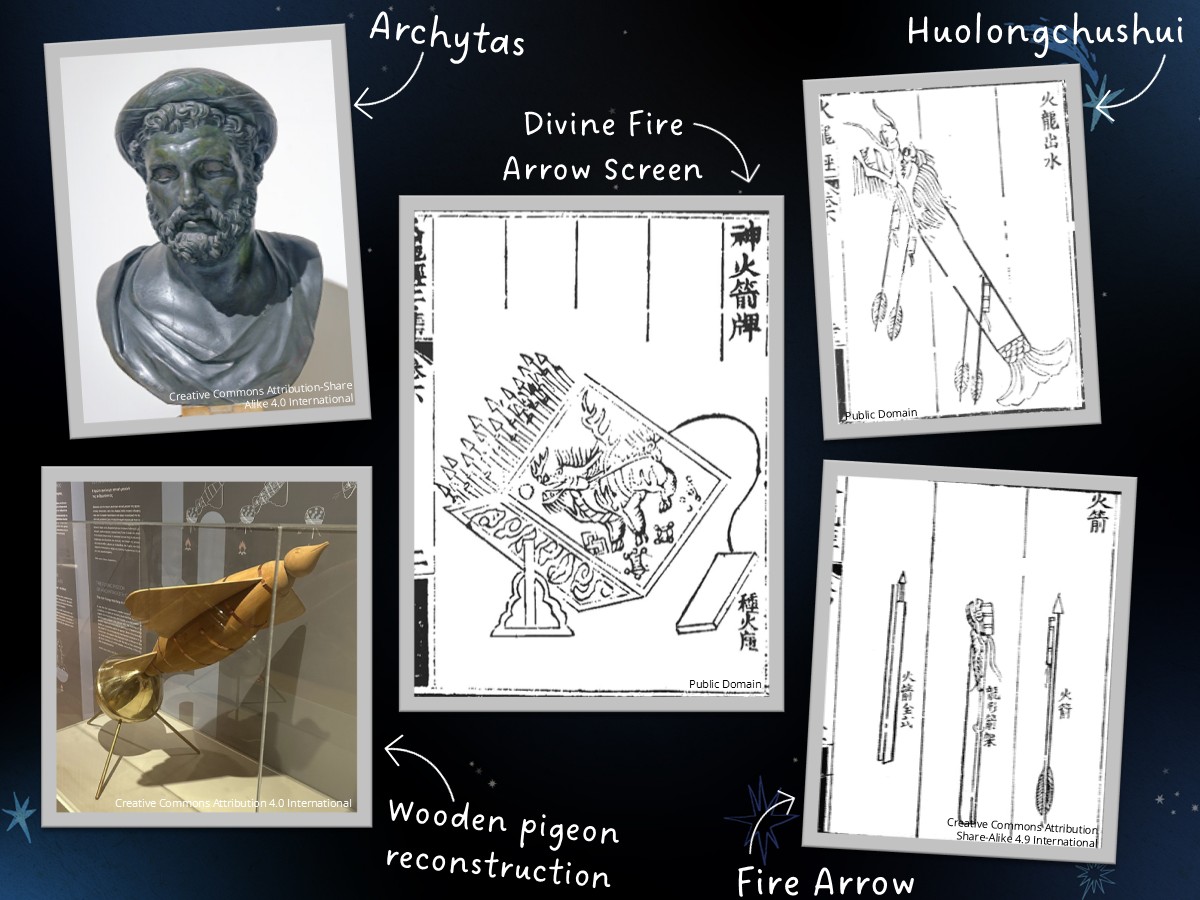
The first recorded example of a flying device is from 400 BC, when Archytas of Tarentum, a Greek philosopher and mathematician, is said to have flown a wooden pigeon using a jet of air that was enclosed inside the bird.
More recently, although recently here is almost 800 years ago, it is understood that a truer idea of a rocket may have originated as early as 1232 in China. Chinese armies would attack invaders with a bombardment of flaming arrows falling from the skies. These arrows of fire were essentially bamboo tubes filled with gunpowder and the Chinese army could fire up to 100 fire arrows at once from a “divine fire arrow screen”!
A few years later, the Chinese developed the first multi-stage rocket: the Huolongchushui, or “fire dragon out of water”. This is reminiscent of the weapon used in Kung Fu Panda 2 by Lord Shen, and by Mulan when she attacks the Huns in Disney’s Mulan. The dragon-shaped tube was a rocket itself, but after firing, three more fire arrows shot out of its mouth!
Congreve Rockets
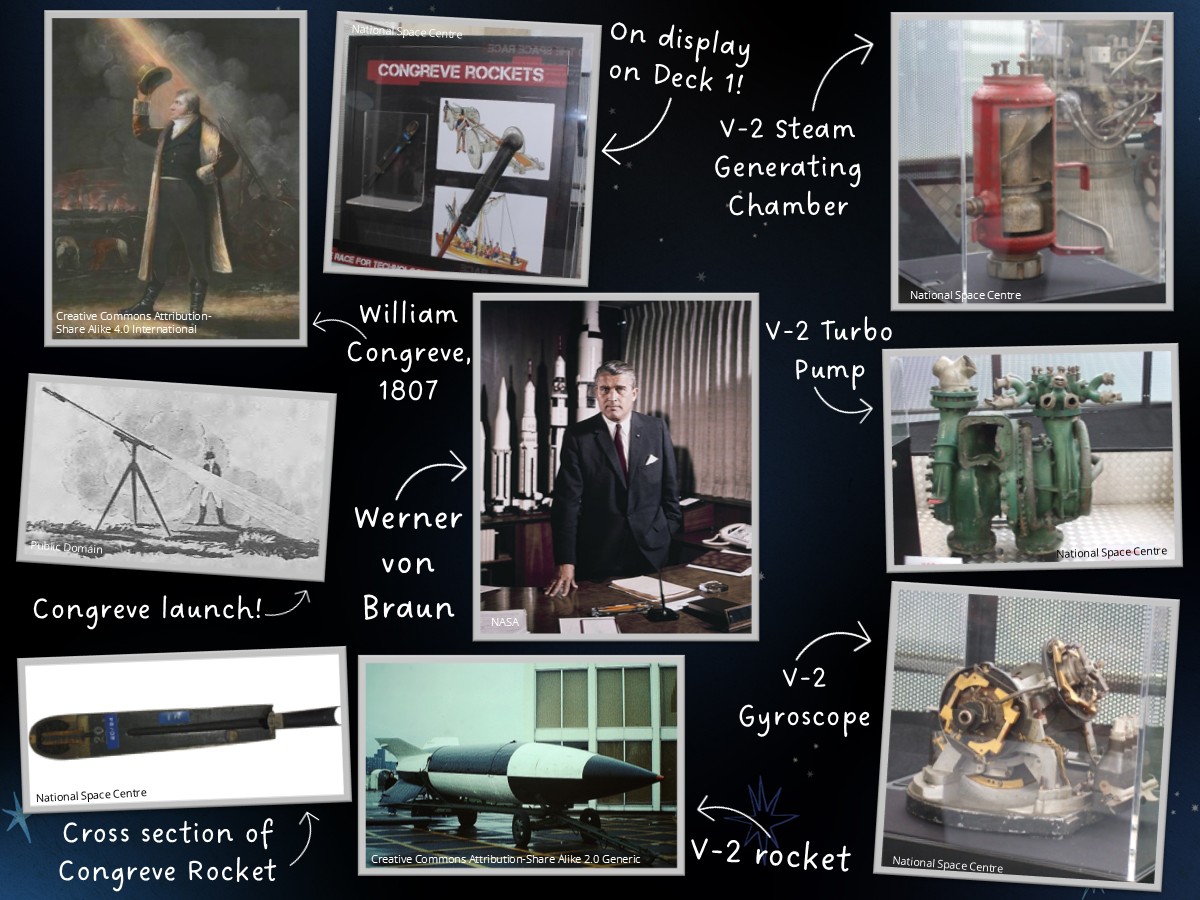
Fast forward to the 19th century, when William Congreve set out on a mission to design a rocket for use in the British military. These rockets were used in battle, so much so that they inspired the lyrics “the rockets’ red glare” in The Star-Spangled Banner, the national anthem of the United States. Congreve Rockets, like the one on Deck 1 in the National Space Centre’s Rocket Tower, on loan from the Royal Artillery Museum, were made up of an iron case containing a black gunpowder-like substance that would ignite and propel the rocket across battle fields.
V-2 Rocket
Hit fast forward again and pause right around World War II. The German V-2 rocket was the world’s first long-range guided ballistic missile and was used as a weapon against London, scattering the ground with 20-metre-wide craters. The V-2 rocket became the first human-made object to reach space on 20 June 1944.
After the war, the United States, Soviet Union, and Britain competed to secure V-2 technology and the scientists who developed it. Lead engineer, Wernher von Braun, surrendered to the Americans and later played a key role in the U.S. space programme, while Britain and the Soviet Union used captured V-2 technology to advance their own rocket development.
Ruhrstahl X-4 Missile
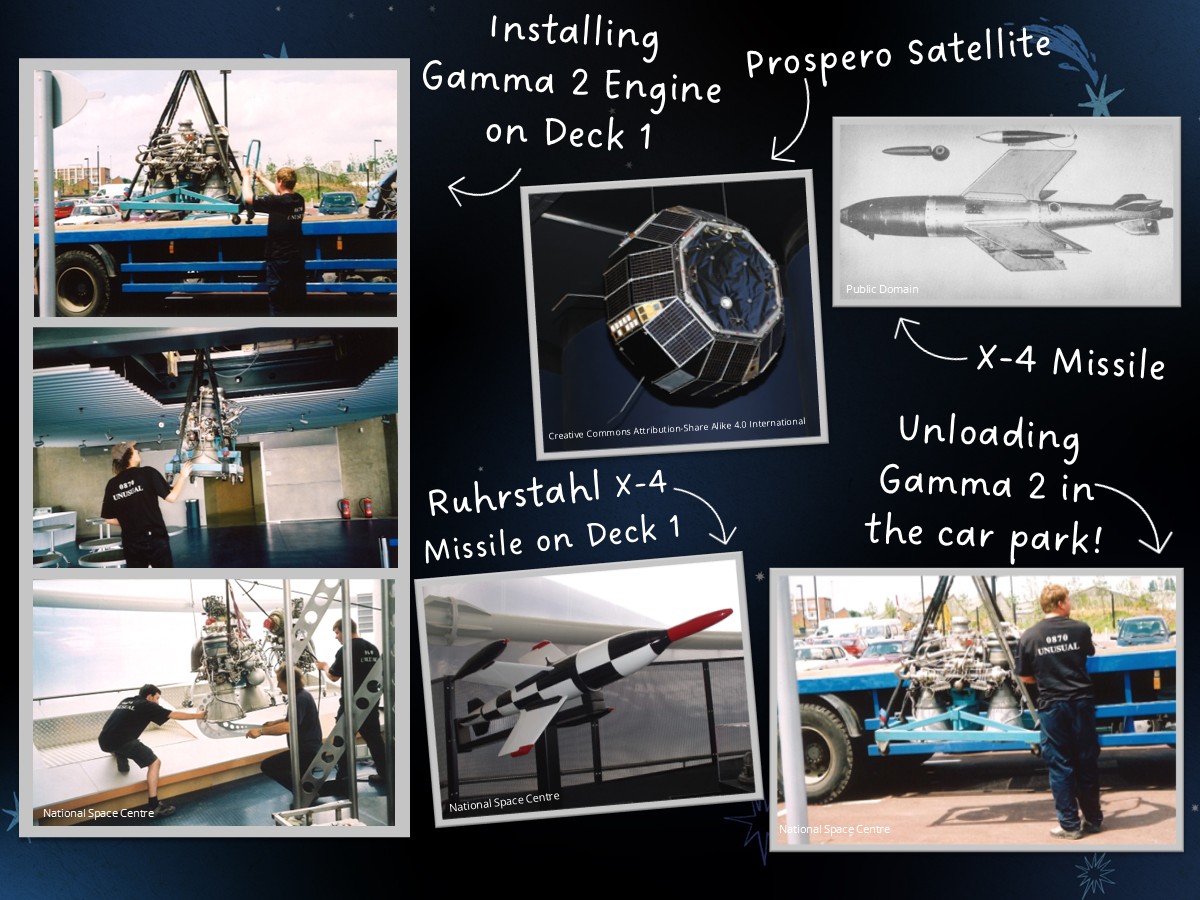
Nestled alongside the V-2 components at the National Space Centre is the Ruhrstahl X-4, another German missile from the Second World War. To stop British forces disrupting radio signals, this missile was developed with a wire-guided system, meaning it was controlled through signals via wires, allowing the aircraft pilot to steer the missile with a joystick.
Gamma 2 Engine
The Gamma 2 Engine was developed by Armstrong Siddeley in Coventry, a British engineering company renowned for luxury vehicles and aircraft engines, to power the second stage of the Black Arrow rocket. Black Arrow, nicknamed “The Lipstick Rocket” because its main body resembled a bright red lipstick, was Britain’s satellite launch vehicle. It flew four times from Woomera, Australia, between 1969 and 1971, successfully placing the British satellite Prospero into low-Earth orbit. To install the engine into the Rocket Tower, it was lifted through the ceiling of the Boosters Café and emerged onto Deck 1 above.
RZ.2 Engines
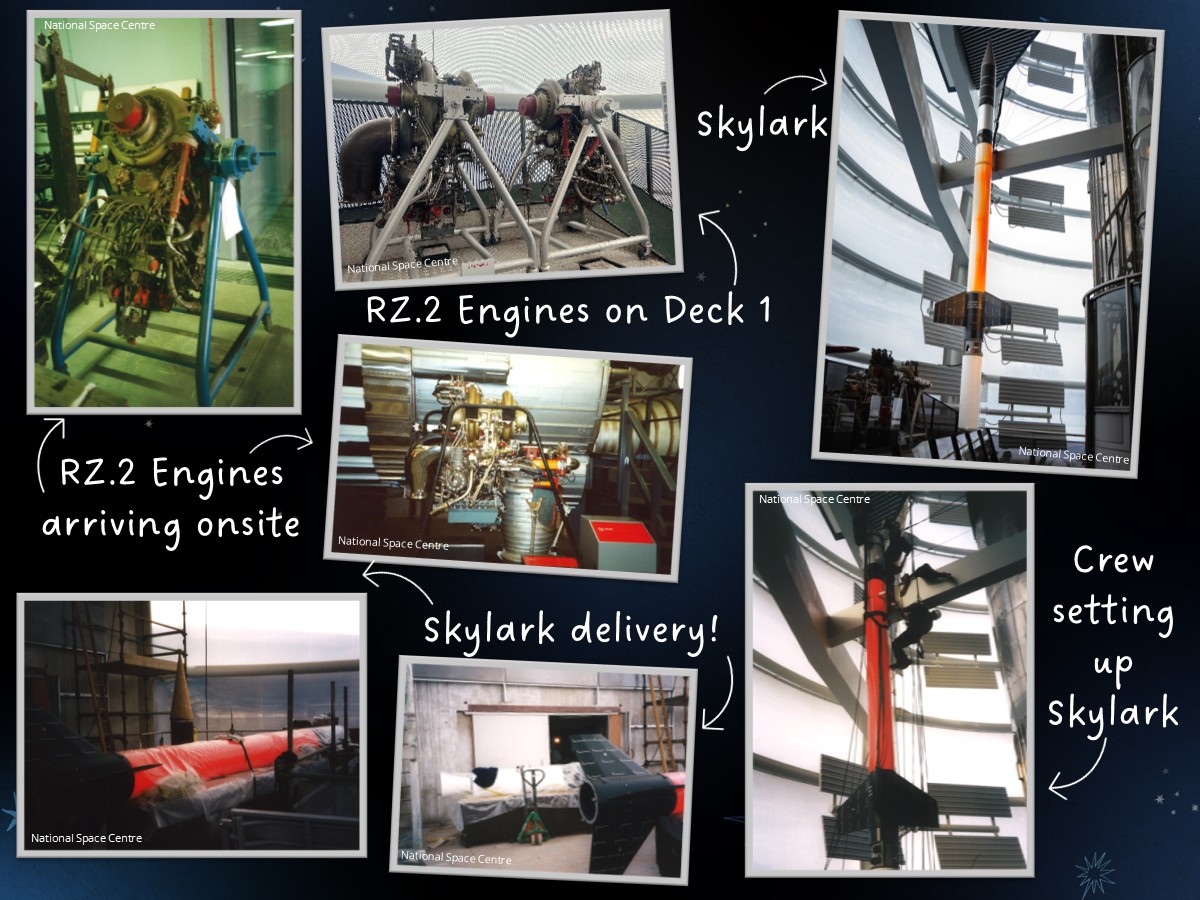
The Blue Streak Rocket was powered by the turbo pumps on two separate RZ.2 engines. Rolls Royce took the S-3D rocket motor technology, which was based on the German V-2 machinery, to produce the RZ.2 engines that were lighter and more reliable, a powerful driver for the British Blue Streak rocket. Keep on reading to learn about Blue Streak!
Skylark
Skylark on Deck 1 is often overlooked, perhaps because it lacks the size and visual impact of Thor Able and Blue Streak, but it played a vital role in British space research. Skylark sounding rockets were used between 1957 and 2005, launching mainly from Woomera, Australia, to study the upper atmosphere. Scientists used them to investigate micrometeoroids, solar radiation, cosmic rays and auroras, while the military gathered data on atmospheric conditions to improve missile technology.
The Skylark on display, on loan thanks to the Science Museum, is an authentic rocket, assembled from parts of several Skylarks after arriving incomplete. Some components came from rockets that were never launched after the programme was cancelled. Data gathered from Skylark missions helped pave the way for the development of the Blue Streak rocket.
Thor Able
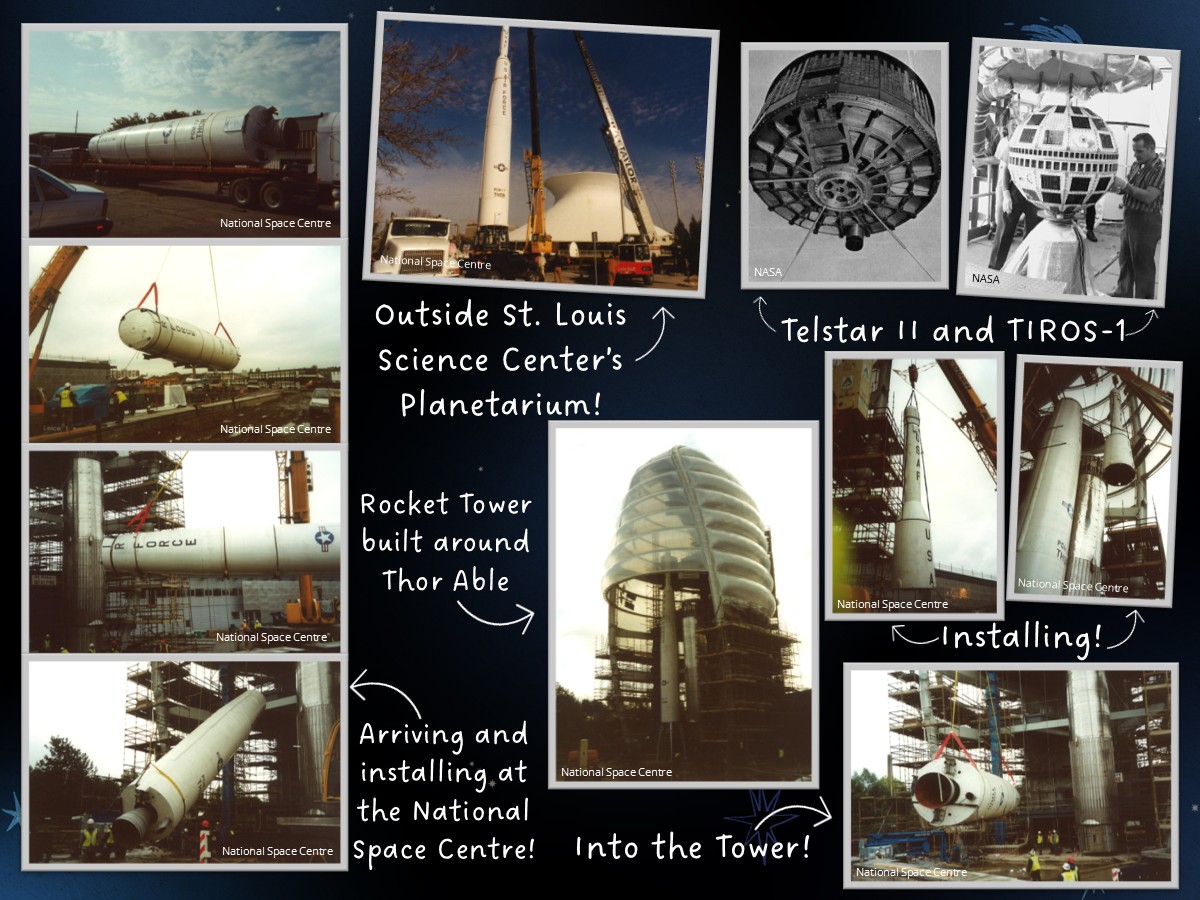
Nestled inside the iconic 42-metre-tall Rocket Tower is Thor Able, one of the National Space Centre’s most significant artefacts alongside Blue Streak. Thor Able was an American two-stage rocket first flown in 1958. Its first stage, Thor, began life as an Intermediate Range Ballistic Missile designed to carry nuclear warheads and was briefly deployed in Britain during the Cold War. The United States later adapted the missile for space exploration, replacing the warhead with the Able upper stage.
Thor Able played an important role in early biological spaceflight experiments. Mice were carried in its nose cone to test whether animals could survive launch conditions. The first mission carrying a mouse, Mouse-In-Able 1 (MIA 1), nicknamed “Minnie Mouse,” ended in failure when the rocket exploded shortly after launch. However, subsequent launches carrying MIA 2 and Wickie Mouse, showed, through electronic monitoring, that the animals survived the launch itself. Sadly, their nose cones landed in the Atlantic Ocean and were never recovered.
The rocket family later achieved major successes, launching satellites such as Tiros-1, the world’s first successful weather satellite, and Telstar, the first commercial communications satellite.
Before arriving at the National Space Centre, Thor Able stood for 27 years beside the Planetarium at the St. Louis Science Center, exposed to the elements. In 2000 it was strengthened and shipped across the Atlantic, arriving before the Rocket Tower was completed, as the tower itself had to be built around the rockets due to their immense size.
Blue Streak
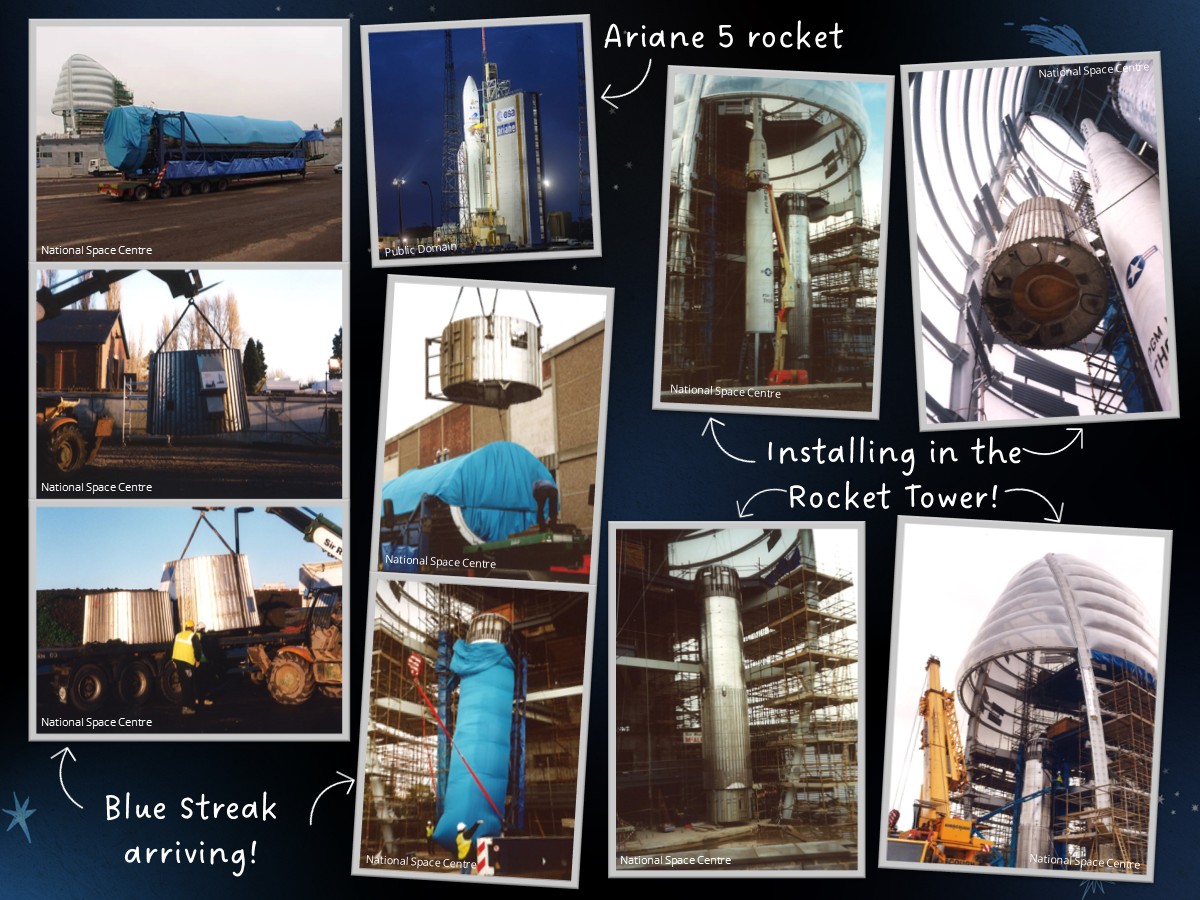
Like Thor Able, Blue Streak is a genuine rocket that never flew. Originally developed in the 1950s as a British ballistic missile, the project was cancelled due to rising costs. Rather than abandoning the technology entirely, the UK Government proposed using Blue Streak, alongside Black Knight, as part of a satellite launcher called Black Prince. In the 1960s, Blue Streak was selected as the first stage of Europa, Europe’s first satellite launch programme.
Blue Streak made its debut launch from Woomera, Australia, in 1964 and flew 11 successful voyages. However, despite these achievements, the Europa programme was unable to place a satellite into orbit. Growing technical difficulties and costs led the British Government to withdraw from the project, and the Blue Streak programme was cancelled in 1971.
The technology developed for Europa paved the way for a new and evolved European launch vehicle, the Ariane rocket. Ariane rockets have launched iconic missions including Rosetta, BepiColombo, and the James Webb Space Telescope.
The Blue Streak displayed at the National Space Centre is the 16th, and last one ever made. Rescued from the production line, it was stored by National Museums Liverpool and National Museums Scotland before being loaned to the National Space Centre in 2000. Despite its impressive appearance, the rocket is unbelievably thin (as thin as a drink can!) and must remain pressurised to prevent it from deforming due to changing air pressure.
Did you know?
The National Space Centre's iconic 42-metre-high Rocket Tower had to be built around the enormous rockets, Thor Able and Blue Streak!

From steam-powered wooden pigeons and fiery Chinese arrows to towering launch vehicles capable of reaching the furthest corners of the Solar System, the story of rockets is one of constant innovation. The rockets housed at the National Space Centre represent key chapters in that journey. Skylark expanded our understanding of Earth's upper atmosphere, Thor Able helped pave the way for weather forecasting and global communications, and Blue Streak laid important foundations for Europe’s future success in space.
While many of these vehicles began life as military weapons, their legacies extend far beyond conflict. They demonstrate how rocket technology has evolved into a powerful tool for scientific discovery and exploration. As we celebrate Rocket Revolution during World Space Week, these remarkable artefacts are a reminder that every giant leap into space is built upon decades of experimentation, ambition, and engineering achievement.
The rockets of the past continue to inspire the missions of tomorrow. Who knows what revolutionary rocket is coming next...
More images!
Browse some archive images of the Rocket Tower construction and getting the rockets into the building!
-
![Rocket Tower Construction]()
National Space Centre -
![Rocket Tower Rendering 1999]()
National Space Centre -
![Gamma Engine Install]()
National Space Centre -
![Skylark]()
National Space Centre -
![Thor Able Install 4]()
National Space Centre -
![Blue Streak Install 2]()
National Space Centre -
![Rocket Tower Construction]()
National Space Centre -
![Building Design NSC]()
National Space Centre -
![NSC Aerial]()
National Space Centre -
![Blue Streak Install]()
National Space Centre -
![Thor Able Install 3]()
National Space Centre -
![Skylark Install]()
National Space Centre -
![Gamma Engine Install 2]()
National Space Centre -
![Thor Able Install]()
National Space Centre -
![Blue Streak Install 5]()
National Space Centre -
![Thor Able Install 2]()
National Space Centre -
![Rocket Tower Construction]()
National Space Centre -
![Blue Streak Install 4]()
National Space Centre -
![Blue Streak Install 3]()
National Space Centre -
![Thor Able and Blue Streak Install]()
National Space Centre -
![Gamma Engine Install 3]()
National Space Centre -
![Thor Able Install 5]()
National Space Centre -
![RZ.2 Engine Install]()
National Space Centre -
![Skylark Install 2]()
National Space Centre -
![Building Design Concept]()
National Space Centre -
![Rocket Tower]()
National Space Centre -
![Top of Rockets]()
National Space Centre -
![NSC Build]()
National Space Centre -
![NSC Build Tower]()
National Space Centre


Full Credits / References:
(Banner image) Thor Able and Blue Streak, Credit: National Space Centre
(Collage 1) Archytas, Credit: Creative Commons Attribution-Share Alike 4.0 International; Wooden pigeon, Credit: Creative Commons Attribution 4.0 International; Divine Fire Arrow Screen, Credit: Public Domain; Huolongchushui, Credit: Public Domain; Fire Arrow, Credit: Creative Commons Attribution-Share Alike 4.0 International
(Collage 2) William Congreve, Credit: Creative Commons Attribution-Share Alike 4.0 International; Congreve Launch, Credit: Public Domain; Cross section of Congreve Rocket, Credit: loaned on permission of the Royal Artillery Historical Trust, National Space Centre; Congreve rocket on display. Credit: loaned on permission of the Royal Artillery Historical Trust, National Space Centre; V-2 Gyroscope, Credit: on loan from the Royal Air Force Museum, National Space Centre; V-2 Steam Generating Chamber, Credit: on loan from the Royal Air Force Museum, National Space Centre; V-2 Turbo Pump, Credit: on loan from the Royal Air Force Museum, National Space Centre; Werner von Braun, Credit: NASA; V-2 Rocket, Credit: Creative Commons Attribution-Share Alike 2.0 Generic
(Collage 3) Installing Gamma 2 Engine on Deck 3 (trio), Credit: National Space Centre; Prospero Satellite, Credit: Creative Commons Attribution-Share Alike 4.0 International; X-4 Missile, Credit: Public Domain; Ruhrstahl X-4 Missile, Credit: on loan from the Royal Air Force Museum, National Space Centre; Unloading Gamma 2 at the National Space Centre, Credit: National Space Centre
(Collage 4) RZ.2 Engines arriving onsite, Credit: on loan from National Museums Liverpool, National Space Centre; RZ.2 Engines on Deck 1, Credit: on loan from National Museums Liverpool, National Space Centre; Skylark delivery, Credit: National Space Centre; Skylark, Credit: National Space Centre; Crew setting up Skylark, Credit: National Space Centre
(Collage 5) Arriving and installing at National Space Centre, Credit: National Space Centre; Outside St. Louis Science Center's Planetarium, Credit: National Space Centre; Telstar II, Credit: NASA; TIROS-1, Credit: NASA; Rocket Tower built around Thor Able, Credit: National Space Centre; Installing, Credit: National Space Centre; Into the Tower, Credit: National Space Centre
(Collage 6) Blue Streak arriving at the National Space Centre, Credit: National Space Centre; Installing in the Rocket Tower, Credit: National Space Centre; Ariane 5 rocket, Credit: Public Domain
(7) Cartoon of Thor Able and Blue Streak, Credit: National Space Centre
(Carousel images) All images, Credit: National Space Centre
Blue Streak Missile Guidance Bay (nosecone) on loan courtesy of National Museums Scotland
Blue Streak Rocket on loan from National Museums Liverpool, World Museum
