

A Beginner's Guide to Space Rocks
- 22nd Jul 2026
- Author: John Statham
Our Solar System is full of some amazing space rocks from the size of planets right down to tiny meteorites (some so tiny that they end up as dust on the roof of your house), and, they are always on the move!
You might be an avid stargazer or just taking your first footsteps into the world of Astronomy and spotted some sky-bound objects. The Moon is perhaps the most obvious space rock that many of us will have seen, but some planets (Mercury, Venus, Mars, Jupiter and Saturn) can also be observed with the naked eye too - shining like bright stars and often visible even in light polluted skies. If you're lucky you might have caught some bright flashes of light streaking across the sky as space rocks burn up in our atmosphere during a meteor shower, or perhaps a comet that's travelled close to the Sun and displays with its signature tails.
With so many different types of space rocks, it can all get rather confusing so let me take you through the family of space rocks in our Solar System and some from beyond!
Birth of the Solar System
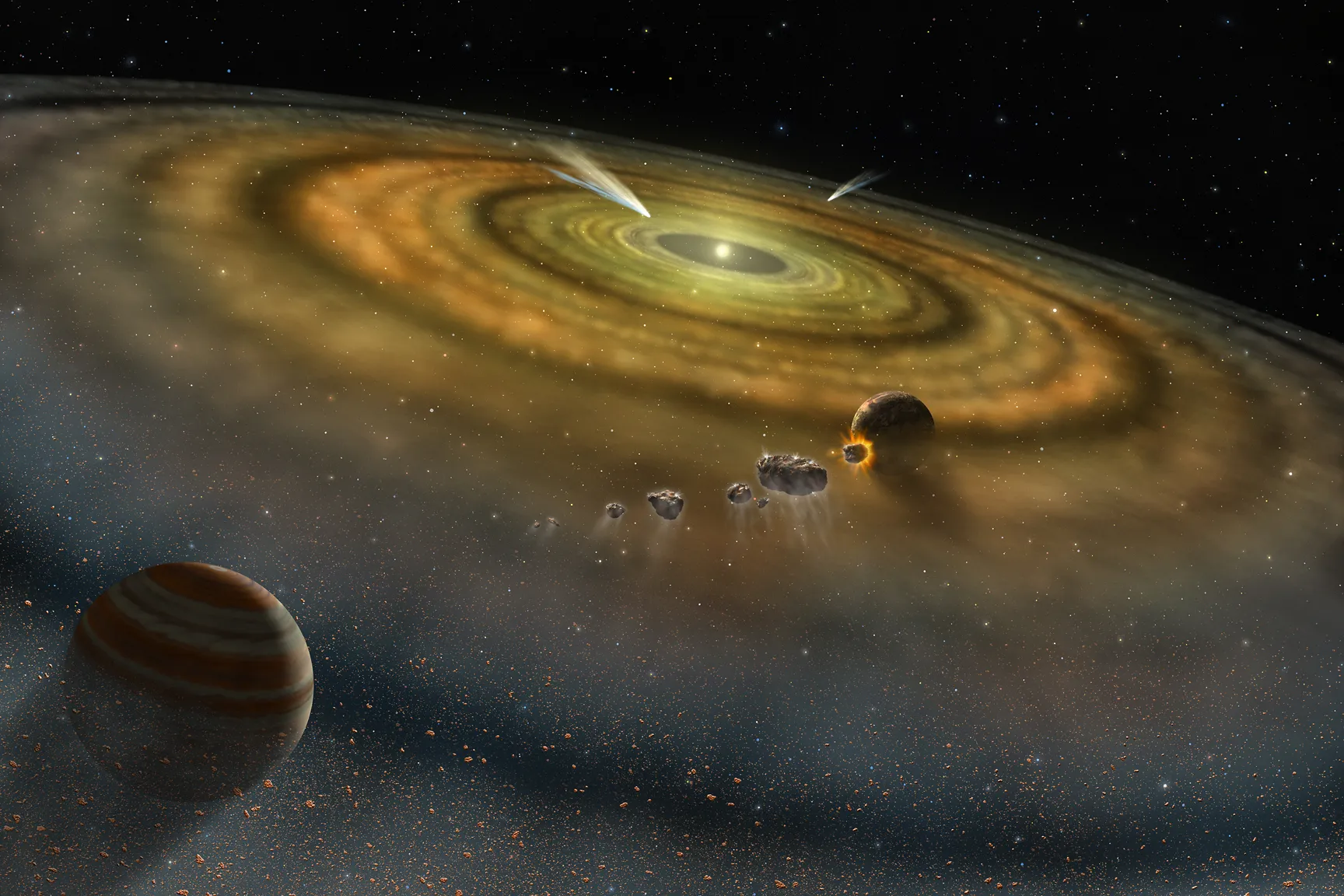
The fact is, the vast majority of space rocks in our cosmic neighbourhood came from the formation of the Solar System around 4.6 billion years ago. To begin with, there was a giant molecular cloud (the solar nebula), mainly made of hydrogen and helium (plus some other gases and dust). Around 4.6 billion years ago the cloud was subject to a gravitational collapse - so its contents started to be drawn closer and closer together. How? Possibly from a shockwave from a supernova that was in the neighbourhood. As the cloud collapsed it began to flatten and spin eventually forming a disk shape with most of the material being drawn to the centre, which formed the proto-Sun. A bit like a ball of pizza dough being spun out into a flat base.
The remaining material beyond the central star, then began to form planets, dwarf planets, moons, asteroids and comets through a process called accretion. In particular, the inner rocky planets formed from the heavier materials condensing and coming together over time, and the outer gas and ice giants formed as the lighter gases also condensed. And then much of the leftover material went into forming other space rocks like moons, asteroids and comets. The theory of the Solar System's formation is known at the nebula hypothesis.
After billions of years, the Solar System settled into state that we know today, but it's still active and changing. Planets and moons have been subjected to the onslaught of left over matter bombarding them: evidence of this can (crater impacts) be seen with our very own companion in space, the Moon.
Classification of Space Rocks
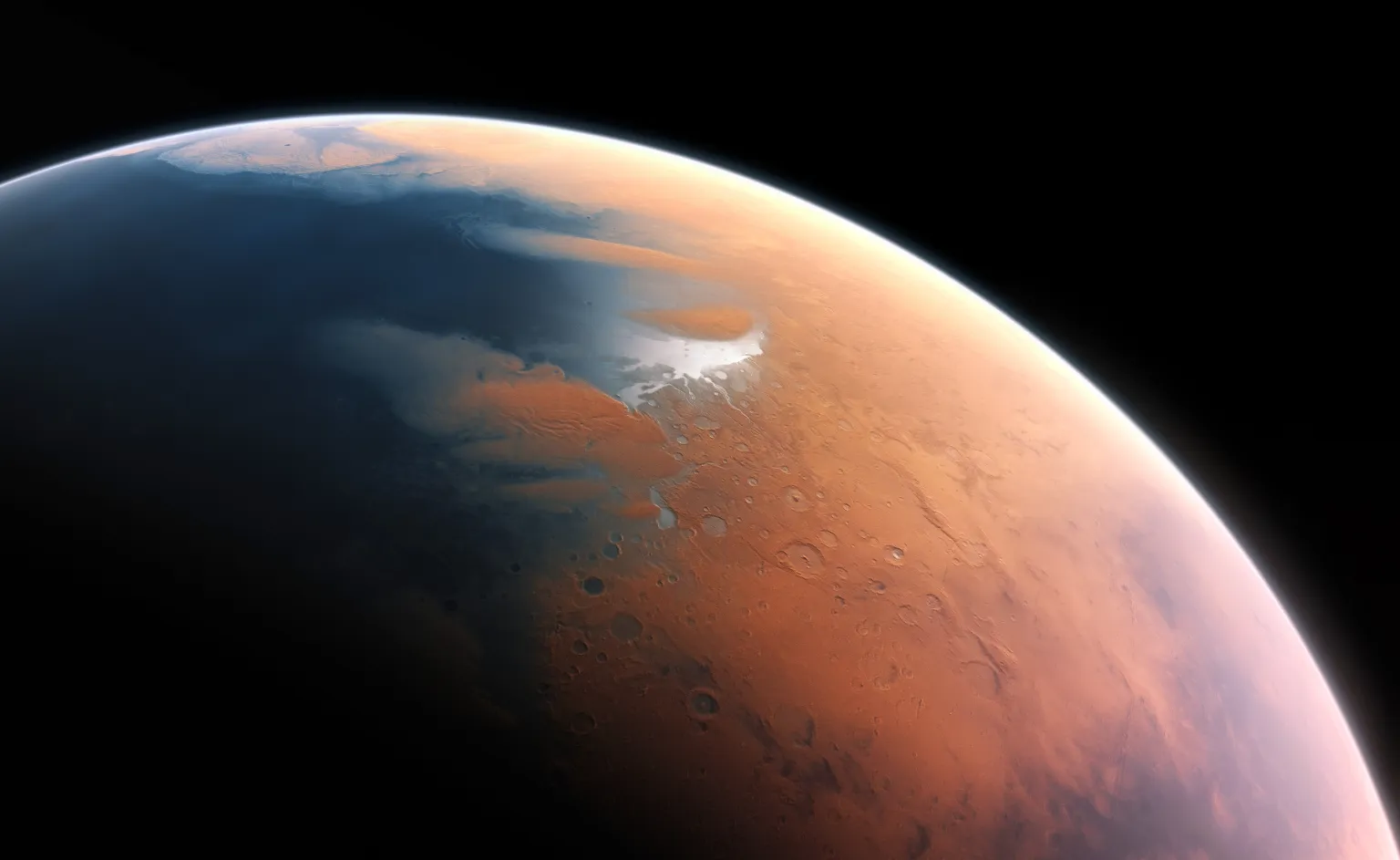
With so many different types of space rocks roaming around the Solar System, it's important to classify them for many reasons. In essence, the bodies that makes up our Solar System act like time capsules, so they can be studied and grouped depending on what they are made of, their structure and what their ancestry is. This helps teach us how the planets, moons, asteroids and everything else came to be, basically - how they formed.
For example, volcanic rocks and sedimentary rocks can tell different stories: one can show past melting and lava flows and the latter hints at the presence of water. Samples from meteorites and asteroids are made up of the leftovers from the building of our Solar System. Making comparisons, looking for differences and similarities within rocks from our planet, our Moon and Mars can show us whether they were subjected to the same geological processes.
Rocks speak their own language and can reveal evidence of water and organic material and whether there were ancient seas and rivers present of larger space bodies. This can be an indication of the possibility that life may have existed and can point scientists in the direction of possible landing sites on other worlds to collect more samples and to reveal more answer to our unanswered space questions.
Planets, Dwarf Planets, Minor Planets
Generally planets are objects which orbit around their star - in our case the Sun. But even planets can be broken down further into different types.
-
![Our Solar System]()
NASA/JPL Planets
We have eight main planets in our Solar System - typically split into the four, small, rocky inner planets (Mercury, Venus, Earth and Mars), the two gas giants (Jupiter and Saturn) and then the cold and remote ice giants (Uranus and Neptune) which are smaller than their gaseous cousins with interiors that aren't as rich in hydrogen and helium, but are bigger than the inner planets. All but Mercury and Venus have moons orbiting around them too.
-
![Dwarf Planets]()
NASA Dwarf Planets
Whilst dwarf planets orbit their star and have enough mass for their gravity to make them round, they don't fit the third criteria to be a planet which is to clear their orbital neighbourhood of other debris. Think about it like cars all going around the M25 motorway - to be a planet there can't be loads of other 'vehicles' travelling alongside you. Pluto is perhaps the most well know dwarf planet but there are several others!
-
![Ida and Dactyl]()
NASA/JPL Minor planets
Sometimes scientists used the term minor planet to encapsulate any object orbiting the Sun that isn't one of the main eight planets or a comet. This catch-all term includes dwarf planets, asteroids and other less common space rocks. Like the main planets, minor planets can also have moons orbiting around them - like the asteroid Ida that has a 1.4 km wide moon called Dactyl circling around it.


Asteroids, Meteors, Meteorites and Comets
What about the smaller space rocks - what's the difference between those?
-
![Asteroid Bennu]()
NASA/Goddard/University of Arizona Asteroids
Mainly found in the Asteroid Belt between the orbits of Mars and Jupiter, asteroids can range from just a few metres wide to several hundred kilometres. These space rocks are composed mainly of rock, and metals like iron and nickel. And of course, when we talk of asteroids, at some point the demise of the dinosaurs will rear its head – that particular asteroid was a whopping 10 to 15 kilometres wide!
-
![Fireball]()
Paola Castillo (public domain) Meteoroids
Smaller than a metre in diameter and as tiny as a grain of sand, meteoroids can be fragments of asteroids, comets and even planetary debris. When a meteoroid enters the Earth’s atmosphere, it produces a streak of light across the sky – this is a meteor or “shooting star.” If it survives and doesn't completely disintegrate before landing on Earth, it is then known as a meteorite.
-
![Artist's concept of comet 41P]()
NASA, ESA, CSA, Ralf Crawford (STScI) Comets
Classified as frozen bodies of ice, dust and minerals, comets are the rebels of the Solar System as their orbits are highly elliptical as they go around the Sun. As they approach the inner Solar System and near the heat of the Sun, they really come to life by developing a tail and coma of ice and gas from the solid matter that sublimates or vaporises straight into gas. The most famous one is Halley’s Comet which visits every 76 years and I will be a 100 when it appears again in 2061!


Belts of Space Rocks
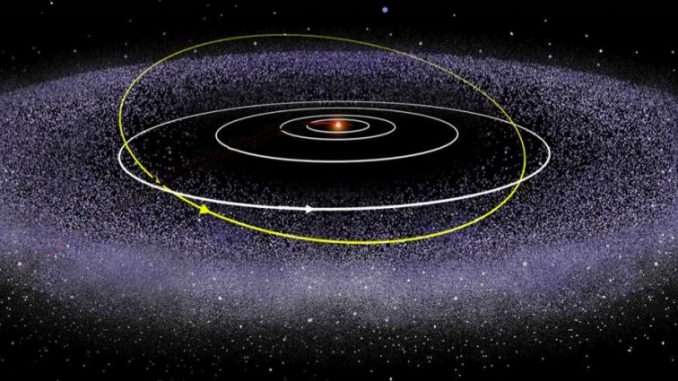
Comets tend to originate from the Kuiper Belt (and a region beyond known as the Oort Cloud). Similar to the Asteroid Belt, the Kuiper Belt is a donut-shaped region of space rocks beyond the orbit of Neptune and is filled with many icier objects left astray after the formation of the Solar System.
And despite what the sci-fi movies depict about how we would have to swerve this way and that as we pick our way through the Asteroid Belt, this is not the case. Stand on an asteroid and you probably wouldn’t be able to see another one as they are so far apart from each other. (And the space rocks in the Kuiper Belt, although more numerous, are even further spread apart).
Mysterious space rocks
Did you know that not all the space rocks we've discovered originated in our Solar System? We've had some visitors from beyond it!
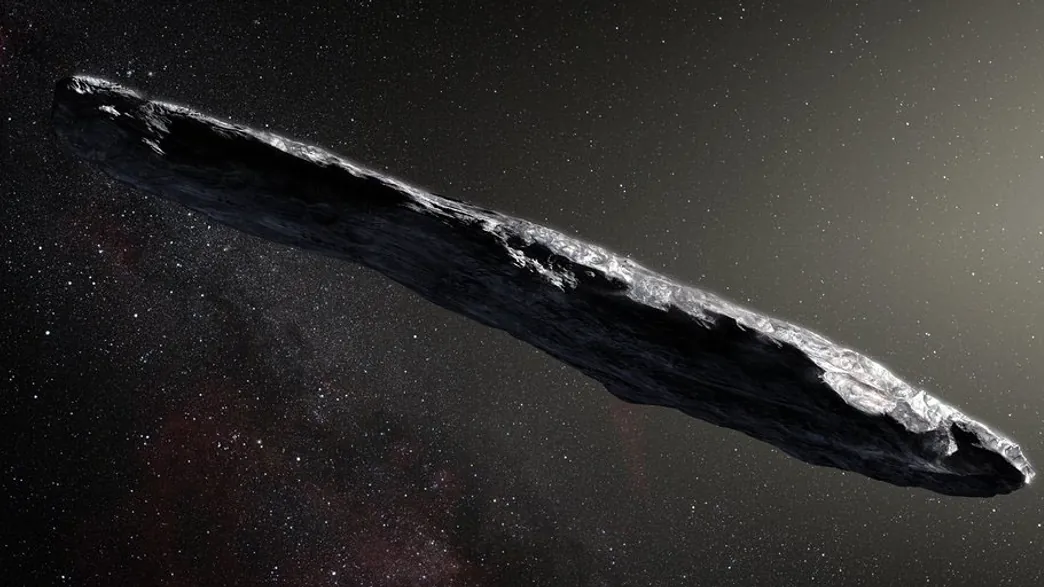
One such object called ‘Oumuamua, was discovered in 2017 by the Pan-STARRS telescope in Hawaii. Rather nicely it is named after the Hawaiian name for Scout. Long and flat (shaped like a cigar), it travelled into our Solar System, and just as quickly passed through and left. Scientists are still working out whether it was an asteroid or a comet, or something even stranger!
CNEOS 2014-01-08 was detected by American sensors and was moving faster than most objects that head for the Sun, which implies that it was an interstellar asteroid. There are probably a lot more that visit, but they are hard to spot because they tend to be small, dim and move very fast - spending little time near to our Sun.
Watching out for space rocks
Knowing about different types of space rocks helps us understand our Solar System better: where it came from and how it formed, how the planets came to be and how all the other stuff arrived at this point in time. By looking back at these celestial time capsules and seeing how they've changed over billions of years, we can build an understanding of what the future holds for our Sun and its huge family of orbiting objects.
And because the Solar System is dynamic and moving we need to be on the look out for space rocks that might pose a threat to Earth, like the 10-15km asteroid that collided our planet about 66 million years ago and led to the mass extinction of the dinosaurs!
To help prevent something like this happening again, space agencies around the world track the size and movement of space rocks especially those close to Earth and testing methods to deflect asteroids that could be a threat. In 2022, NASA's DART mission impacted an asteroid moonlet called Didymos to see how much it's course was changed. ESA followed up with the Hera mission which is due to arrive at Didymos in November 2026 to investigate the impact close up.
So now you are armed with lots of information to help you, the next time you gaze upwards on a dark clear night. And maybe it will lead you to delve deeper into the cosmos, but be warned, as the old adage goes, “the more you know, the less you know", but it's a fun learning nevertheless.
Explore a whole host of space rocks with us!
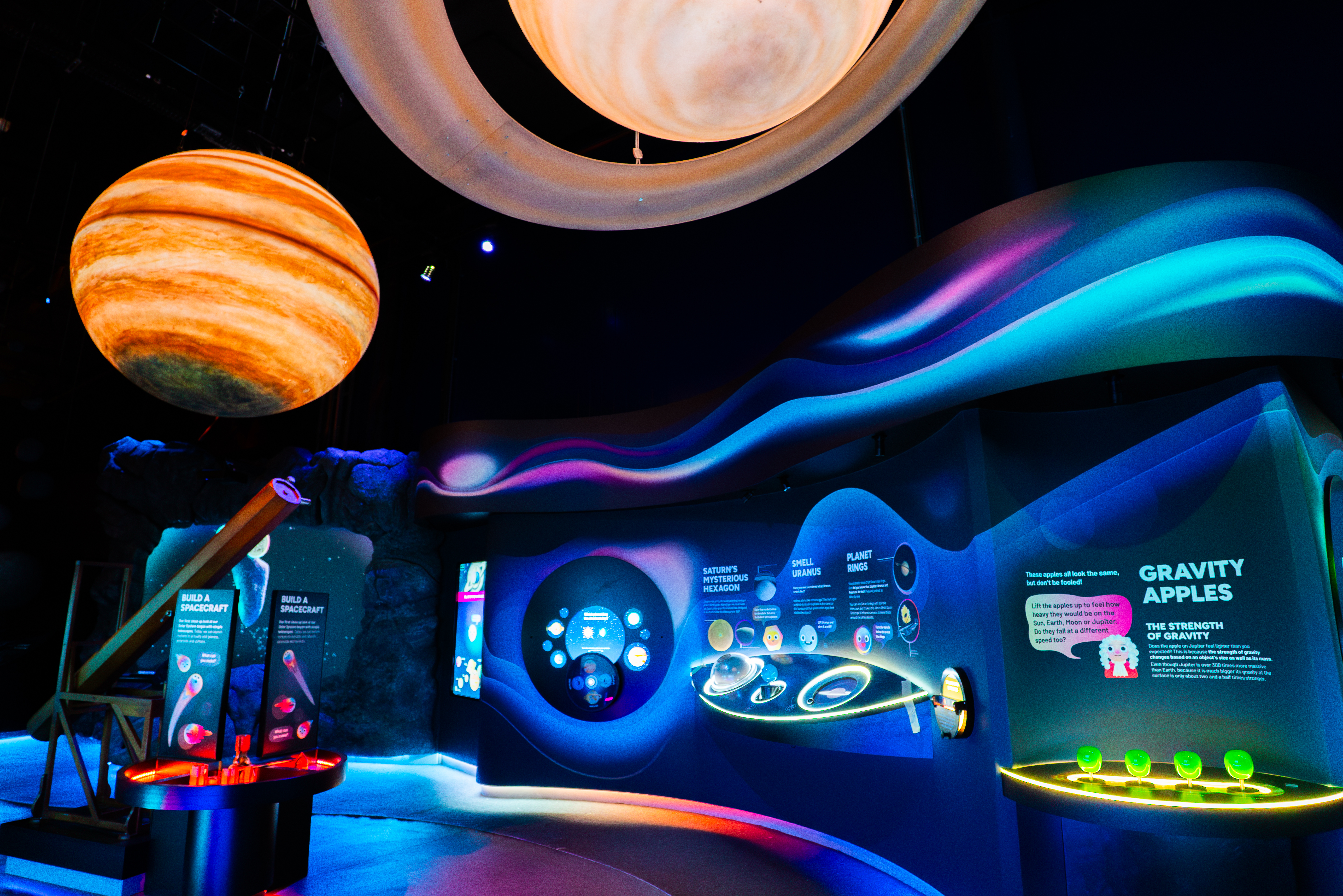
On 30 June, the National Space Centre opened its BRAND NEW Outer Solar System experience as part of the celebrations for the Centre’s 25th birthday. Part of the new exhibition contains a section on meteorites as well as looking at the mass extinction of the dinosaurs 66 million years ago. I have had a sneak preview and it was pretty impressive!


Full references / credits:
(Banner) Artist's concept illustrating an asteroid belt around a bright star. Credit: NASA/JPL-Caltech
(1) Artist's concept of a star system forming. Credit: NASA
(2) Artist’s impression showing how Mars may have looked about four billion years ago. Credit: ESO/M. Kornmesser
(3a) The main planets. Credit: NASA/JPL
(3b) Five dwarf planets. Credit: NASA
(3c) Asteroid Ida with it's moon Dactyl. Credit: NASA/JPL
(4a) Asteroid Bennu. Credit: NASA/Goddard/University of Arizona
(4b) Meteorite seen in the San Francisco Bay area, 2012. Credit: Paola Castillo (public domain)
(4c) Artist's concept of comet 41P. Credit: NASA, ESA, CSA, Ralf Crawford (STScI)
(5) The Kuiper Belt. Credit: NASA
(6) Artist's rendering of interstellar asteroid 'Oumuamua. Credit: ESO/M. Kornmesser
(7a, b, c, d) Our Solar System gallery at the National Space Centre. Credit: © National Space Centre
