

An Astronomical History of Halley’s Comet
- 10th Sep 2026
- Author: Chloe Hopkinson
Halley’s Comet, also known as 1P/Halley, is one of the most famous comets to appear in our night sky. It returns to the inner Solar System roughly every 76 years, when it is consistently visible to the naked eye from Earth.
Once deemed omens of disaster, turmoil and catastrophe, causing worldwide fear of plagues, wars and the deaths of kings, comets were long misunderstood. Nowadays, we know comets are just comets, and not premonitions of tragedy. But tales of the terror they once caused are well documented throughout history, from early rock carvings to stitching in tapestry.
This is the story of how Halley’s comet has woven its way through British and European history.

What is a comet?
But first, what is a comet? A comet is a large celestial object that is made up of dust, gas and ice.
These ancient bodies orbit the Sun and are the leftovers from the formation of our Solar System over 4.6 billion years ago.
Comets are best known for their long, streaking tails which form as they travel close to the Sun - the directions of which are influenced by their path but also the stream of charged particles emanating from the Sun known as the solar wind
The heating up of the comet’s materials results in the spewing of gas and dust which can stretch out for millions of miles!
1066: Battle of Hastings
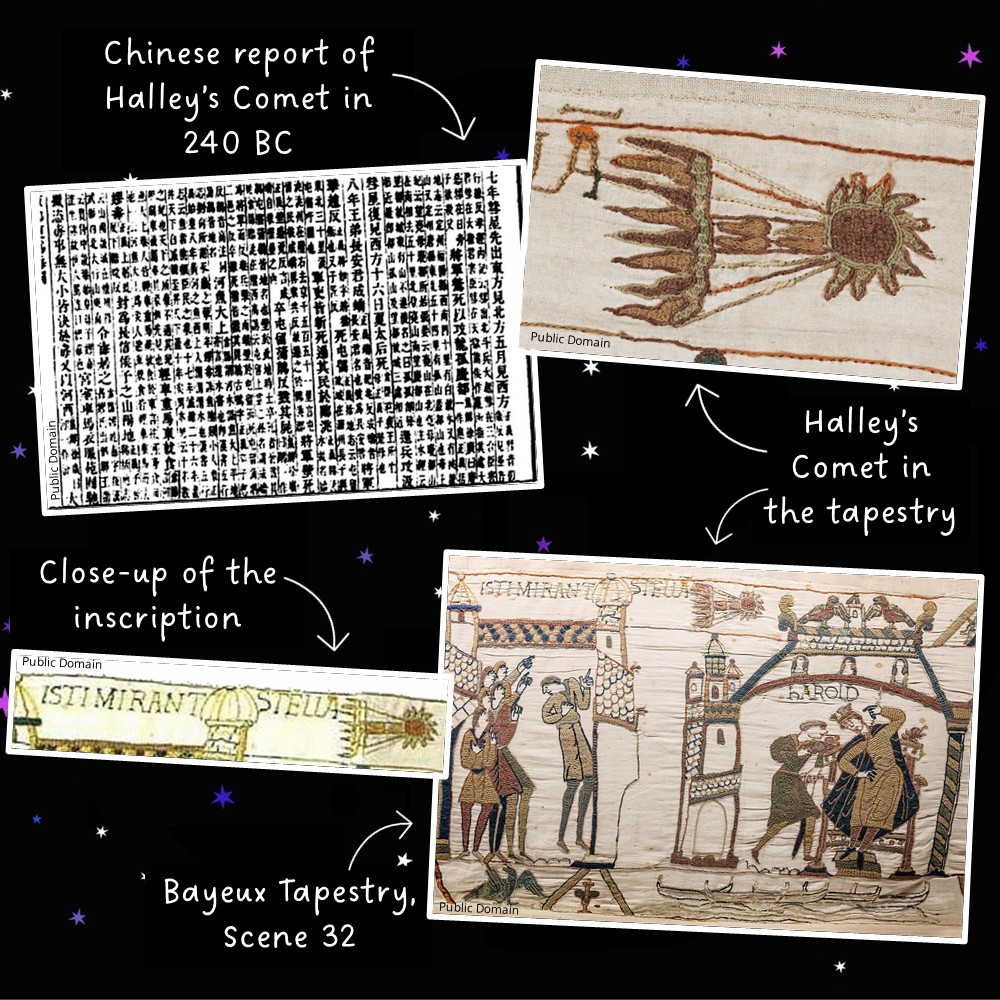
The superstitious nature of comets can be dated back to as early as the eleventh century BC, when Ancient Chinese emperors employed people to observe the skies for comets, as they thought the sighting of the phenomena would be sure to bring about chaos and commotion. They detailed how shortly after an appearance of a comet, there were droughts, plagues, and the deaths of royalty.
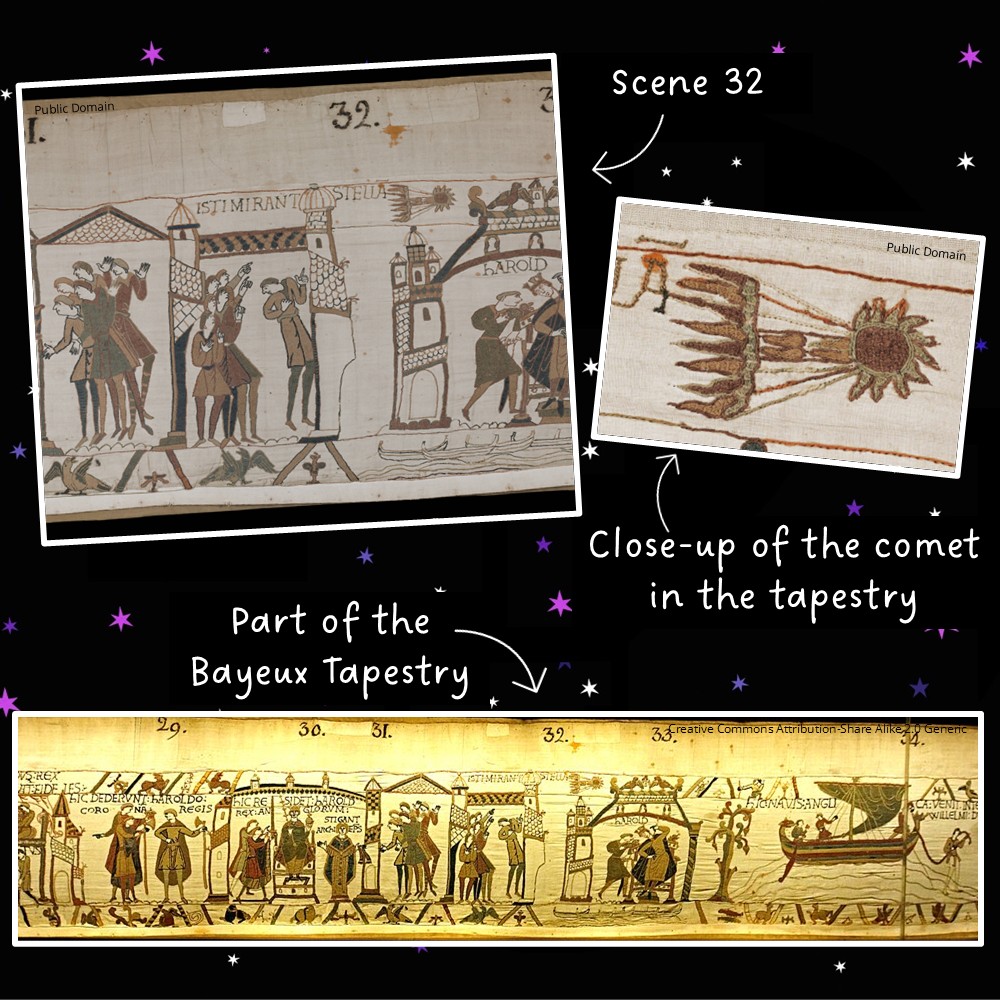
Fallacies regarding comets also prevailed throughout the Middle Ages, where a comet, which we now know was Halley’s Comet, was woven into the Bayeux Tapestry, commemorating the events leading up to the Battle of Hastings in 1066. It is easy to comprehend why this sighting in the night sky was deemed an omen. King Harold viewed it as a sign of danger, whilst Duke William believed it was a positive message from heaven, with William then defeating Harold’s army in the Battle of Hastings and crowning himself the King of England.
In the tapestry, you can see how the comet is clearly depicted with its large, bright tail jetting out from behind it. This is the earliest known picture of a comet in European art and is featured in Scene 32 alongside a Latin inscription “ISTI MIRANT STELLA”, which translates to “These men marvel at the star”.
Medieval astronomy is often overlooked even though it saw incredible advancements, including the calculation of Earth’s orbit around the Sun to precisely 365 days and six hours long to introduce the leap year we experience every four years, and determining the Moon’s orbital period to 27 days and eight hours around the Earth – accurate to within 17 minutes! However, the inscription of “star” in the tapestry highlights an exception to medieval astronomy development where they lacked the concept of a comet and instead viewed it as a signal of disaster from God.
1301: Giotto di Bondone
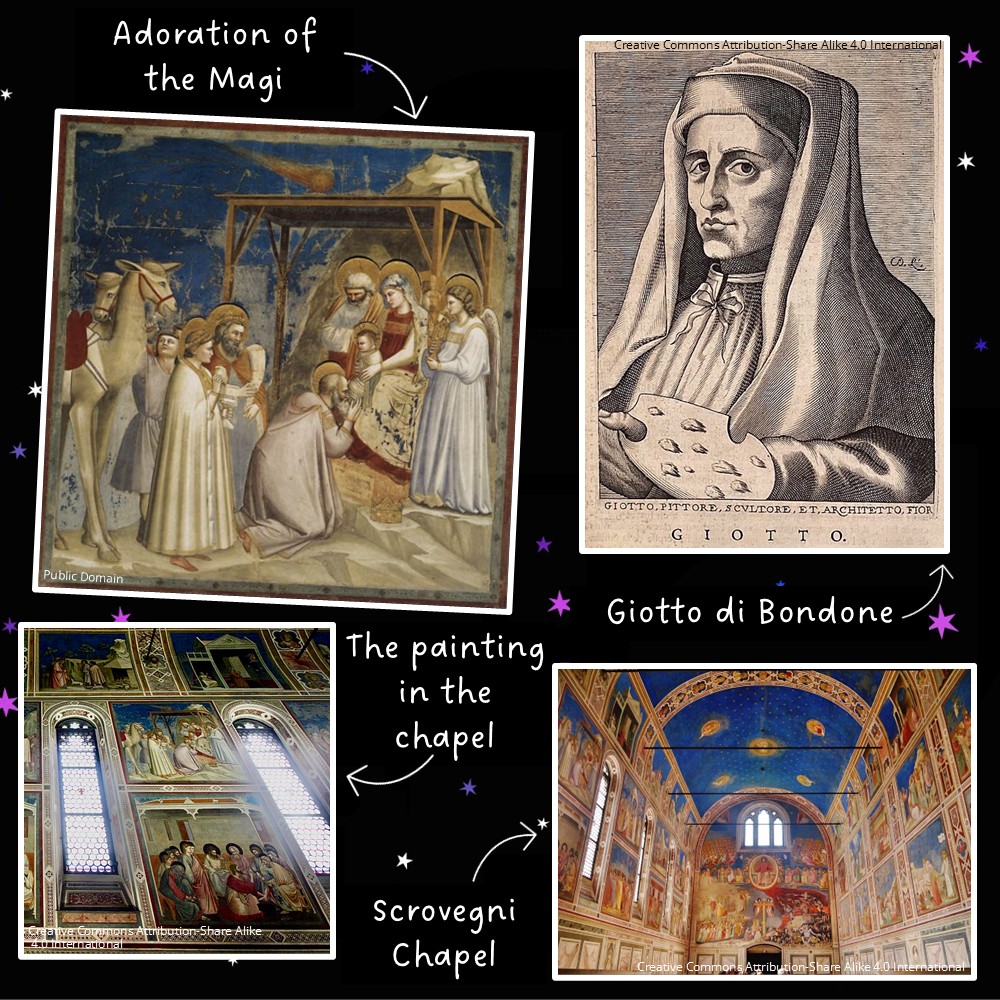
Another example of the comet’s depiction in art is in Giotto di Bondone’s painting from 1305, ‘Adoration of the Magi’, which is inside the Scrovegni Chapel in Padua, Italy. The painting is one of the most recognisable pieces of art in the world and is regarded as the first accurate depiction of an astronomical object in art.
The painting features the three Wise Men or Kings (the Magi) worshipping the baby Jesus alongside Joseph, Mary and the archangel Gabriel. The Star of Bethlehem in this painting is in the form of a shooting star.
The accuracy in which Giotto painted the comet suggests that he himself had actually witnessed it streaking across the sky, which would line up with the 1301 appearance of Halley’s Comet. Giotto carefully recreated the comet's appearance, showing a bright, dense centre and a tail that gradually faded as it stretched away, and even included the gentle colour changes along the tail.
There is some debate, however, about whether the 'shooting star' that Giotto witnessed was actually Halley’s Comet. There were two other comets that could have influenced the artist: C/1301 C1 and C/1304 Y1, also known as the ‘Christmas Comet’ as it was seen over Christmas Eve and Christmas Day. Theories point towards the Christmas Comet being most influential to Giotto as he was a devout Catholic and the sighting of this comet would have been more significant to him given the dates. Nonetheless, Halley’s Comet would have been the most remarkable visually out of the three options here, and given the precision of the comet’s picture, Halley’s Comet being the inspiration is still a convincing argument.
1577: Tycho Brahe
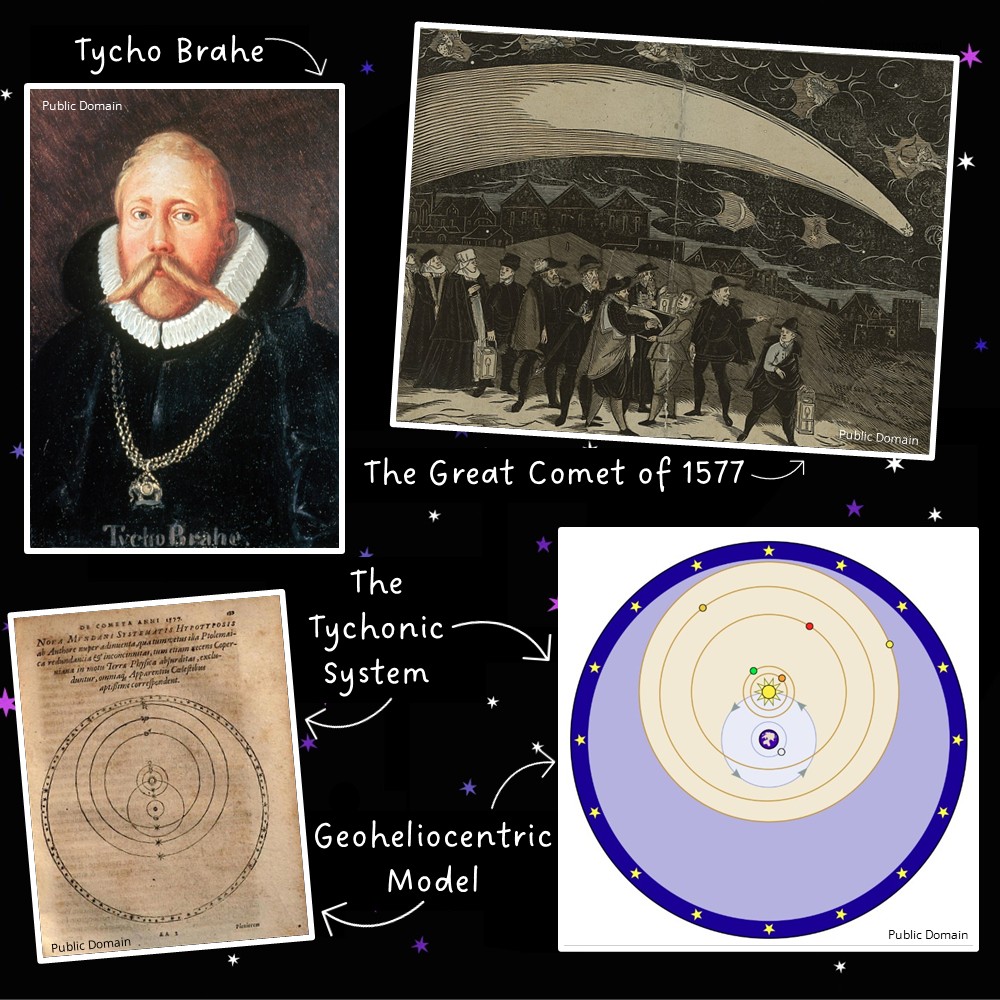
It wasn’t until 1577 that there was an actual understanding of what a comet is. Danish astronomer Tycho Brahe observed The Great Comet – an object as bright as Venus with a tail stretching over the sky at 40 times the diameter of a full Moon! Brahe saw the comet in Denmark and noticed that it appeared in almost the same place in the sky as it did for astronomers in other parts of Europe. If the comet had been in Earth's atmosphere, it would have looked like it was in different places depending on where people were standing. Since this didn't happen, Brahe concluded that the comet was much further away than the Moon – at least four times further!
This discovery changed how people thought about celestial objects and sparked new research into the fundamentals of physics. After his comet conclusion, Tycho Brahe suggested a new take on the model of the Solar System and the Universe. Dubbed the Tychonic System, he merged ideas of the heliocentric model and geocentric model of the Universe and proposed the geoheliocentric model. This perspective placed Earth at the centre of the Universe, with the Sun, the Moon and the stars revolving around our planet, but the five other planets (Uranus and Neptune had not been discovered yet) orbiting the Sun. It wasn’t until discoveries from other astronomers, including Galileo Galilei finding moons around Jupiter and William Herschel’s first attempts at mapping the Milky Way, that the geocentric model was proven to be false, and the heliocentric model was favoured.
Although we know today that the universe does not have an absolute centre due to relativity (where space and time are not fixed, but flexible and changing), the term “heliocentric” tends to refer to the model of the Sun being in the centre of the Solar System, with our planets orbiting around it.
1705: Edmund Halley
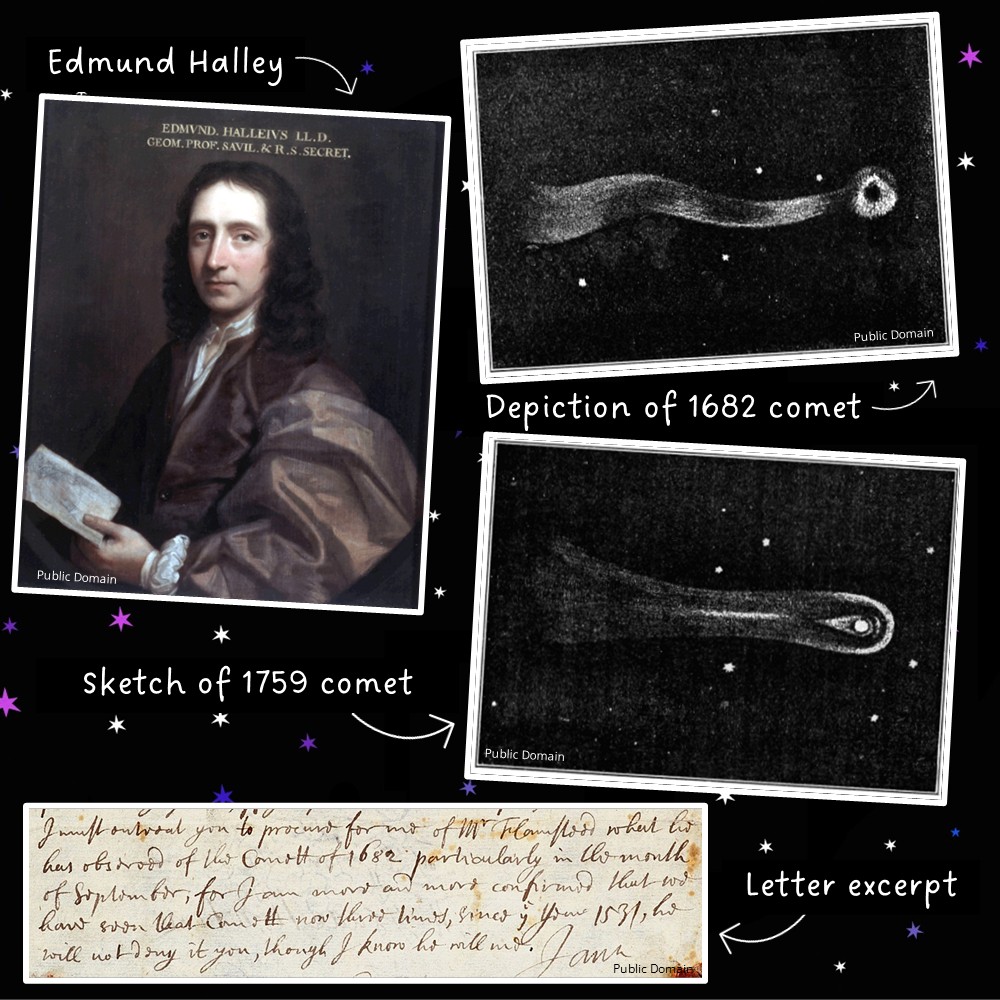
Looking at the name of this astronomer, you may have guessed that Halley’s Comet is named after this guy, and you’d be right! Edmund Halley was an English astronomer who used the theories of gravitation and planetary motions from his friend Isaac Newton, to calculate the orbit paths of several comets using data from comets that Halley witnessed himself, and also from the records of comets seen throughout history. He discovered that the comets described in records from 1531, 1607, and 1682 were actually the same comet repeating its orbit around the Sun. This repeating orbit is categorised as a periodic comet, typically having an orbital period of less than 200 years.
In September of 1695, Halley wrote a letter to Isaac Newton regarding his studies of the comet and its orbit. You can see an excerpt of the letter in the images to the left, where he writes:
"I must entreat you to procure for me of Mr Flamsteed what he has observed of the Comett [sic] of 1682 particularly in the month of September, for I am more and more confirmed that we have seen that Comett now three times, since Yeare [sic] 1531, he will not deny it you, though I know he will me."
Halley correctly predicted that this same comet would then return to the skies in 1758, which it did! Sadly though, Halley died before he could view the comet himself, but the comet was named in his honour and is classified as 1P/Halley – where “P” stands for periodic, and ‘1’ as this was the first to be given an official astronomical designation.
*[sic] - indication of an error / misspelling that is kept in to accurately reflect the original quote
1986: Giotto
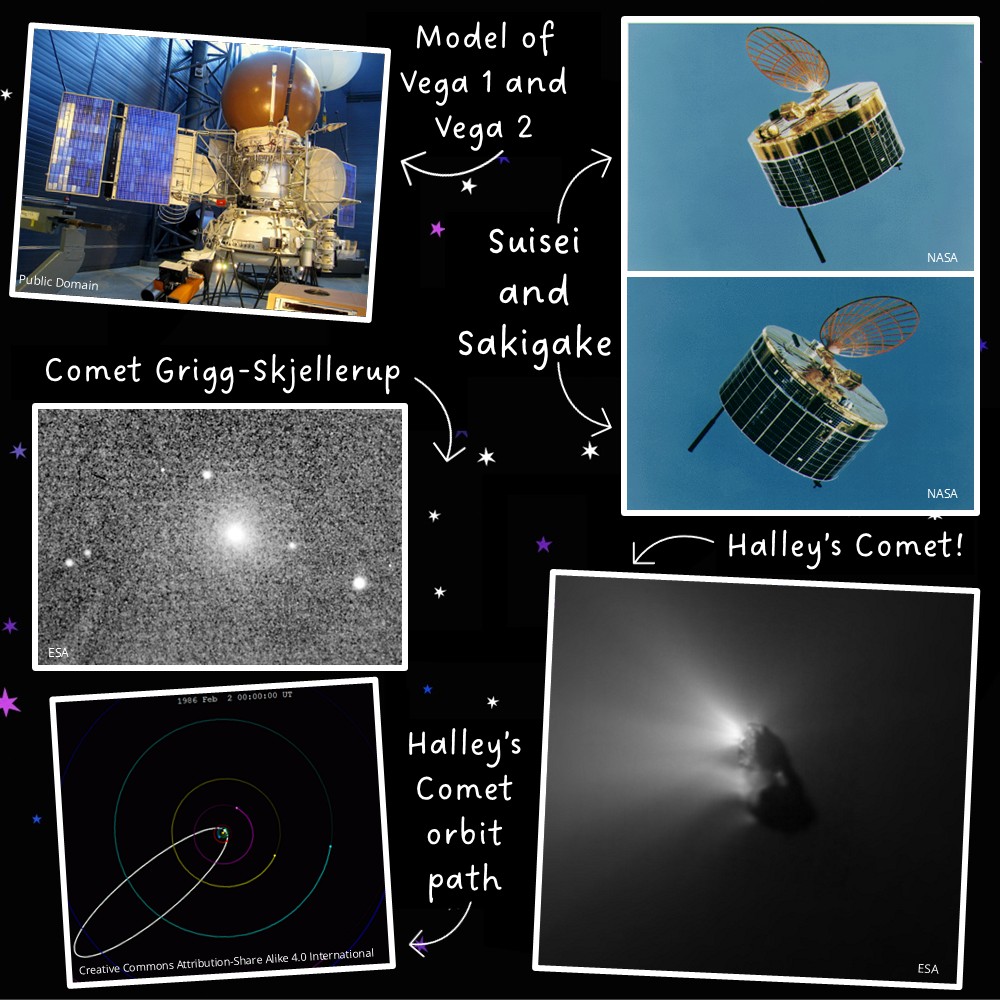
Using the accuracy of Halley’s work, scientists were able to work out when the comet would return to the inner Solar System, including an occurrence in 1986. The reappearance of Halley’s Comet provided an opportunity to study the comet closely. So closely in fact that a squad of spacecraft from across the globe, known as the Halley Armada, were launched to investigate the space rock.
A Soviet probe named Vega 1 (launched December 1984) returned images of the comet’s nucleus, followed by images from Vega 2’s (launched December 1984) flyby of the comet. Japan launched space probes Sakigake (launched January 1985) and Suisei (launched August 1985) to observe hydrogen emissions from the comet’s coma (a cloud of gas and dust that surrounds the comet’s nucleus). In July 1985, The European Space Agency (ESA) launched their first deep-space mission, a spacecraft named Giotto, to make the closest pass of the nucleus of the comet. The spacecraft was named after Giotto di Bondone, the Italian Renaissance painter who had observed Halley’s Comet in 1301 and painted it as the Star of Bethlehem in his painting ‘Adoration of the Magi’.
The Giotto spacecraft flew within 600km of Halley’s core and captured the first-ever close-up images of the nucleus, revealing, for the first time, the size and shape of a comet nucleus as well as uncovering the first evidence of organic materials. The spacecraft was not expected to survive after getting so close to the comet – it was thought that the spacecraft would have been damaged by flying particles of comet material. The spacecraft’s instruments persevered, and so a second flyby was planned for a different comet, named Comet Grigg-Skjellerup, which it also completed with success, and became the first spacecraft to visit two comets.

At the National Space Centre, we house a full-scale model of the Giotto spacecraft. You can find it hanging from the top of the Rocket Tower on Deck 4. The Giotto spacecraft was developed from the GEOS satellites and was built here in the UK by British Aerospace in Filton, Bristol.
Some of the instruments were also developed in the UK, including the Dust Impact System (DID) at the University of Kent, which measured the mass of dust particles that hit the spacecraft, and the Johnstone Plasma Analyser (JPA) at Mullard Space Science Laboratory in Surrey, which measured solar wind and charged particles surrounding the comet.
What did Halley’s Armada discover?
-
![Halley's Comet From Giotto]()
NASA/JPL-Caltech Composition:
The comet is made of water ice, methane and ammonia. Many other complex compounds, such as carbon monoxide, were additionally found.
-
![GIOTTO Halley From Vega 2]()
Public Domain Size:
The nucleus measures 15 km by 7.2 km by 7.2 km and resembles the shape of a peanut!
-
![Halley Features On Giotto]()
ESA Appearance:
The comet’s surface features hills, ridges, depressions and craters, and is very dark – it reflects only 4% of the light that shines on it and is comparable to coal.
-
![Giotto Approaching Halley]()
ESA Density:
The average density of the nucleus is about 0.55 g/cm3 which indicates the comet is made of a large number of small pieces held together by gravity, known as a rubble pile.
-
![Orbit Of Giotto And Halley's Comet]()
Public Domain Orbit and rotation:
One orbit around the Sun lasts approximately 76 years making it visible from Earth every three quarters of a century, and the comet rotates and completes one revolution in about 53 hours.
-
![Rocket Tower NSC]()
National Space Centre Compared to the National Space Centre’s Rocket Tower:
The Rocket Tower is 42m high, so we’d need to stack 357 towers on top of each other to match the diameter of Halley’s Comet!


2026: The comet returns!
You may have worked out the maths on this and realised I have completely lied to you with the above title. Halley’s Comet will not return to our skies until July 2061 (mark your calendars!). The appearance of the comet in 2061 will be one not to miss - it will be easily visible to the naked eye and will be brighter than it was in 1986. You'll spot it as effortlessly as looking at the stars, since it will appear as bright as the brightest stars in the sky.
What is actually returning to Britain for the first time in almost 1,000 years is the Bayeux Tapestry - the intricate 68.3m long piece of woven art that details the appearance of Halley’s Comet in 1066. This impressive and important piece of history, which curators think was most likely made in England, will be on display in the British Museum in London between September 2026 and July 2027 and you can view it online here!
As mentioned, the actual Halley’s Comet will be lighting up the sky in 2061, but before then, you can catch a number of meteor showers each year! You can find all the dates for upcoming meteor showers in 2026 here!

From stirring up fear in medieval kingdoms to revealing clues about the origins of our Solar System, Halley's Comet has transformed from a mysterious omen into one of astronomy's greatest success stories. The return of the comet in our skies has provided astronomers over time the chance to better understand the cosmos and mark milestones in science, exploration and discovery.
The legacy of Halley’s Comet extends far beyond astronomy. Woven into history, quite literally through the Bayeux Tapestry, Halley's Comet has become part of Britain's cultural heritage as well as its scientific story, linking the Norman Conquest, pioneering astronomers such as Edmund Halley, and modern space missions such as Giotto.
When it next arrives our skies in 2061, we'll be tilting our heads to the sky with wonder and excitement rather than fear and fright, following in the footsteps of our astronomical ancestors who have watched this comet for thousands of years.
Full Credits / References:
(Banner image) Halley's Comet photographed by William Liller from Easter Island on 8 March 1986, Credit: NASA
(1) Comet Diagram, Credit: NASA/JPL-Caltech
(2 - Collage) Chinese report of Halley's Comet in 240 BC, Credit: Public Domain; Halley's Comet in the tapestry, Credit: Public Domain; Bayeux Tapestry, Credit: Public Domain; Close-up of the inscription, Credit: Public Domain
(3 - Collage) Adoration of the Magi, Credit: Public Domain; Giotto di Bondone, Credit: Creative Commons Attribution-Share Alike 4.0 International; Scrovegni Chapel, Credit: Creative Commons Attribution-Share Alike 4.0 International; The painting in the chapel, Credit: Creative Commons Attribution-Share Alike 4.0 International
(4 - Collage) Tycho Brahe, Credit: Public Domain; The Great Comet of 1577, Credit: Public Domain; The Tychonic System, Credit: Public Domain; Geoheliocentric Model, Credit: Public Domain
(5 - Collage) Edmund Halley, Credit: Public Domain; Depiction of 1682 comet, Credit: Public Domain; Sketch of 1759 comet, Credit: Public Domain; Letter excerpt, Credit: Public Domain
(6 - Collage) Model of Vega 1 and Vega 2, Credit: Public Domain; Suisei, Credit: NASA; Sakigake, Credit: NASA; Comet Grigg-Skjellerup, Credit: ESA; Halley's Comet, Credit: ESA; Halley's Comet orbit path, Credit: Creative Commons Attribution-Share Alike 4.0 International
(7 - Collage) Installing Giotto in the Rocket Tower, Credit: National Space Centre; In the Rocket Tower, Credit: National Space Centre; At British Aerospace in Bristol, Credit: Aerospace Bristol
(8 - Composition) Halley's Comet from Giotto, Credit: NASA/JPL-Caltech
(9 - Size) Halley's Comet from Vega 2, Credit: Public Domain
(10 - Appearance) Comet features, Public Domain: ESA
(11 - Density) Giotto approaching Halley's Comet, Credit: ESA
(12 - Orbit and rotation) Diagram of comet orbit, Credit: Public Domain
(13 - Compared to NSC Rocket Tower) Rocket Tower, Credit: National Space Centre
(14 - Collage) Scene 32, Credit: Public Domain; Close-up of the comet in the tapestry, Credit: Public Domain; Part of the Bayeux Tapestry, Credit: Creative Commons Attribution-Share Alike 2.0 Generic
(15) Comet Halley, Credit: ESO
