

How to Name the Solar System
- 26th Feb 2026
- Author: Ed Kellond-Turner
So you've found a new celestial object in the Solar System. Congratulations! Now you just have to name it. Unfortunately, the International Astronomical Union (IAU) stands in your way, and they have a few rules about what objects in the Solar System can be called...

How the Planets Got Their Names
The more mythologically inclined of you may have noticed that the names of our Solar System's planets all have a common theme: they are all named for Roman and Greek gods and goddesses.
Mercury, Venus, Mars, Jupiter, and Saturn have been known since ancient times, so ancient astronomers in Rome linked them to some of their gods. For Uranus and Neptune, they've actually had a few names since their respective discoveries, including George's Star and Herschel for Uranus, and Leverrier for Neptune, before the Latin deity theme was finally adopted.
If you want to know more about the naming convention of the planets then you're in luck. David Southworth took a much deeper dive into planetary names, including the history and how the names differ across the world.
Naming the Moons
Not every moon is lucky enough to get a name, especially when it comes to planets like Saturn that have hundreds. Instead, these unlucky orbiting bodies are designated with letters and numbers, such as "S/2004 S 31", which is a satellite, discovered in 2004, around Saturn, and was the 31st such satellite discovered that year.
Those moons deemed important enough, including planetary moons, dwarf planetary moons, and asteroid moons, will be named usually with some relation to their parent body. However, this isn't always the case, as you'll see below:
-
![Mars Moons]()
NASA Mars
Mars has only two moons: Phobos and Deimos. In classical mythology, these were the twin sons of Ares and Aphrodite, and would accompany their father in his chariot as he rode into battle, representing panic and dread. As its unlikely Mars has more that two moons, we don't have to worry too much about naming conventions here.
-
![Jupiter Family Of Moons By Juno]()
NASA/JPL-Caltech/SwRI/MSSS/Kevin M. Gill Jupiter
Jupiter's moons get their names from lovers, favourites, or descendants of Jupiter or Zeus, who was the king of the gods in Roman and Greek mythology respectively. Additionally, moons orbiting with the planet's rotation (prograde) have names ending with an "a" or "o", and those orbiting in the opposite direction (retrograde) end with an "e".
-
![Saturn Moons]()
NASA, ESA, A. Simon (GSFC) and the OPAL Team, and J. DePasquale (STScI) Saturn
The first moons of Saturn were named after the brothers and sisters of the titan Cronus, with the largest simply being named Titan. Astronomers, however, quickly ran out of siblings, and so moved on to other related characters from Greek and Roman mythology, as well as giants from elsewhere, including Inuit, Gallic, and Norse mythologies.
-
![Uranus Moons]()
NASA, ESA, CSA, STScI, M. El Moutamid (SWRI), M. Hedman (University of Idaho) Uranus
Unlike the other planets, Uranus' moons do not get their names from mythology. Instead, they are named after characters from Alexander Pope's The Rape of the Lock, as well as characters from several plays by William Shakespeare, including A Midsummer's Night Dream, The Tempest, and Much Ado About Nothing.
-
![Neptune Moons]()
NASA, ESA, CSA, STScI Neptune
As Neptune is the Roman god of the sea, it makes sense that Neptune's moons would be named for other Greek and Roman gods associated with water, as well as mythical creatures associated with the sea. Similar to Jupiter, prograde moons generally end with an "a", retrograde moons end with an "e", and highly inclined moons end with an "o"
-
![Pluto Moons Family Portrait]()
NASA/JHUAPL/SwRI Pluto
Pluto has five known moons, all of which are named after figures from Greek and Roman mythology associated with the underworld, which was the domain that the god Pluto ruled over. It is surely just a coincidence that the largest moon, Charon, just so happens to sound pretty similar to Charlene, the wife of Charon's discoverer.


Naming Asteroids
The first asteroids discovered were originally considered to be planets, and so were named after Roman gods, such as Ceres, Pallas, Juno and Vesta. After more and more asteroids were discovered, these minor planets were also given a numerical designation for the order they were discovered in, for example 7 Iris and 128 Nemesis.
Nowadays, when an asteroid is first discovered, it is given an initial designation linked to the year, half-month, and sequence of discovery, such as 2024 YR4. After further observation and confirmation of its orbit, the asteroid can be proposed by the asteroid's discoverer to the IAU who have final say.
The IAU aren't very strict when it comes to naming asteroids. They can be named after places or people (8837 London or 5535 Annefrank), or possibly given joke names, like 88705 Potato, which looks like a bit like a potato, and 2309 Mr. Spock, which is named after the discoverer's cat, not the Star Trek character.
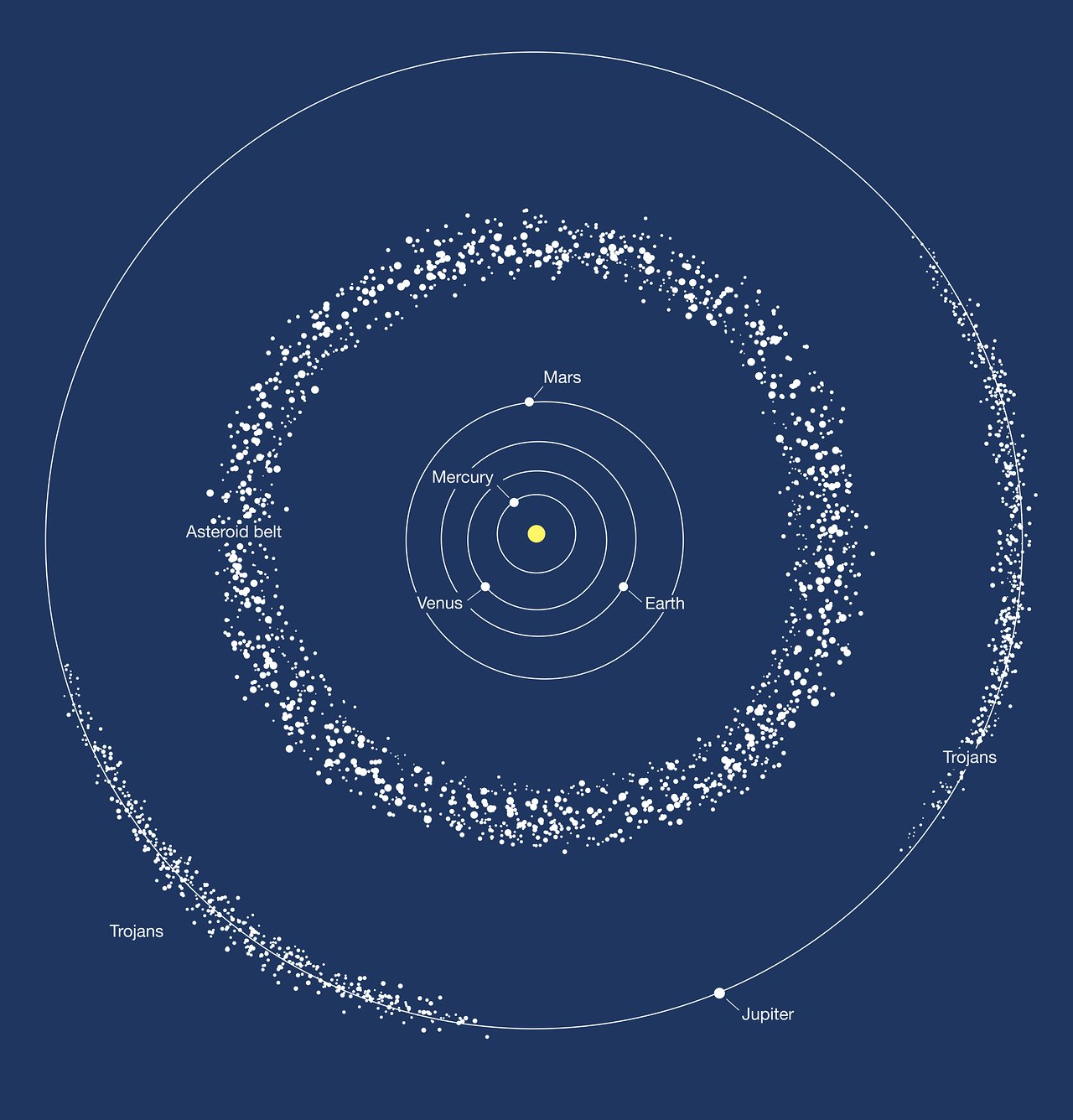
Trojan asteroids are trapped in the gravity of planets, orbiting before or behind their hosts, as seen in this image. Jupiter has the most, and they are named for famous heroes that took part in the Trojan war. Asteroids in the leading orbit are in the 'Greek camp', while trailing asteroids are in the 'Trojan camp', and are named appropriately. Each camp also has an asteroid named after a hero from the opposing camp, so there are spies amongst them! More recently, some trojan asteroids have been named after famous Olympian athletes, the Olympics of course beginning in ancient Greece.
Some personal favourite asteroid names are 9007 James Bond and 9951 Tyrannosaurus.
Surface Features
We have sent spacecraft to many places in the Solar System, and so we have obtained high-resolution imagery of features on the surfaces of planets and moons. Below are some examples of how certain surface features found on planets and moons get their names:
-
![Mercury In True Color]()
NASA/Johns Hopkins University Applied Physics Laboratory/Arizona State University/Carnegie Institution of Washington Craters on Mercury
Craters on Mercury must be named after artists, writers, and composers that were famous for more than 50 years and have been dead for more than three years.
-
![Radar Image Of Venus]()
NASA/JPL/USGS Features on Venus
Surface features on Venus are mostly named after historical and mythological women, including Aphrodite Terra, Atalanta Planitia, and Artemis Corona.
-
![Near Side Of The Moon]()
NASA/GSFC/Arizona State University Lunar Craters
Lunar craters are named after influential scientists, scholars, artists, and explorers. These include the astronauts who died in the Challenger disaster.
-
![Io Highest Resolution True Color]()
NASA/JPL/University of Arizona Volcanoes on Io
Volcanoes on Io are named for fire and thunder deities, including Prometheus who gave humans fire in Greek mythology, and Surtr, a leader of the fire giants of Norse mythology.
-
![Titan In True Color]()
NASA/JPL-Caltech/SSI/Kevin M. Gill Hills on Titan
Colles, or hills, on Titan, are named for characters in JRR Tolkien's Middle-earth novels, including Bilbo and Gandalf. Titan's mountains are also named after Middle-earth's mountains.
-
![Pluto In True Color]()
NASA/Johns Hopkins University Applied Physics Laboratory/Southwest Research Institute/Alex Parker Features on Pluto
Features on Pluto reference underworld mythology, explorers, and space missions, such as Tombaugh Regio, Cthulhu Macula and Sputnik Planitia.


If you want to learn more about everything in our Solar System, then you're in luck! We have our brand new outer Solar System gallery opening soon, which covers everything from the Galilean moons to the icy Oort Cloud, as well as a Cretaceous surprise...
Image credits / references
(Banner) An artistic representation of the Solar System. Credit: NASA
(1) A 3D diagram of the Solar System. Credit: NASA/JPL
(2a) The size of Mars' two moons relative to each other, with Mars on the left. Credit: NASA
(2b) The Galilean moons with Jupiter in the background. Credit: NASA/JPL-Caltech/SwRI/MSSS/Kevin M. Gill
(2c) Saturn and some of its moons. Credit: NASA, ESA, A. Simon (GSFC) and the OPAL Team, and J. DePasquale (STScI)
(2d) Infrared image of Neptune and some of its moons captured by the Webb space telescope. Credit: NASA, ESA, CSA, STScI, M. El Moutamid (SWRI), M. Hedman (University of Idaho)
(2e) Infrared image of Neptune and some of its moons captured by the Webb space telescope. Credit: NASA/ESA/CSA/STScI
(2f) The relative size of Pluto's five moons. Credit: NASA/JHUAPL/SwRI
(3) A depiction of the asteroids in the main steroid belt and Jupiter trojans. Credit: ESA/Hubble/M. Kornmesser
(4a) True colour image of Mercury. Credit: NASA/Johns Hopkins University Applied Physics Laboratory/Arizona State University/Carnegie Institution of Washington
(4b) Radar image of Venus. Credit: NASA/JPL/USGS
(4c) True colour image of the Moon. Credit: NASA/GSFC/Arizona State University
(4d) True colour image of Io. Credit: NASA/JPL/University of Arizona
(4e) True colour image of Titan. Credit: NASA/JPL-Caltech/SSI/Kevin M. Gill
(4f) True colour image of Pluto. Credit: NASA/Johns Hopkins University Applied Physics Laboratory/Southwest Research Institute/Alex Parker
