
Space Illusions: Seeing Isn’t Always Believing!
- 12th Oct 2026
- Author: Dec Bark & Chloe Hopkinson
It is once again time for spooky season, and here at the National Space Centre, we are looking at and trying to wrap our heads around those weird and wonderful aspects of space.
Throughout our massive universe, all sorts of bizarre objects and places exist that sometimes live beyond our understanding. But sometimes, these space oddities are things that happen to us humans when we venture into the great unknown.
What happens to our eyes in space? And what can we see out there that isn’t always what it seems…
Spaceflight-Associated Neuro-Ocular Syndrome
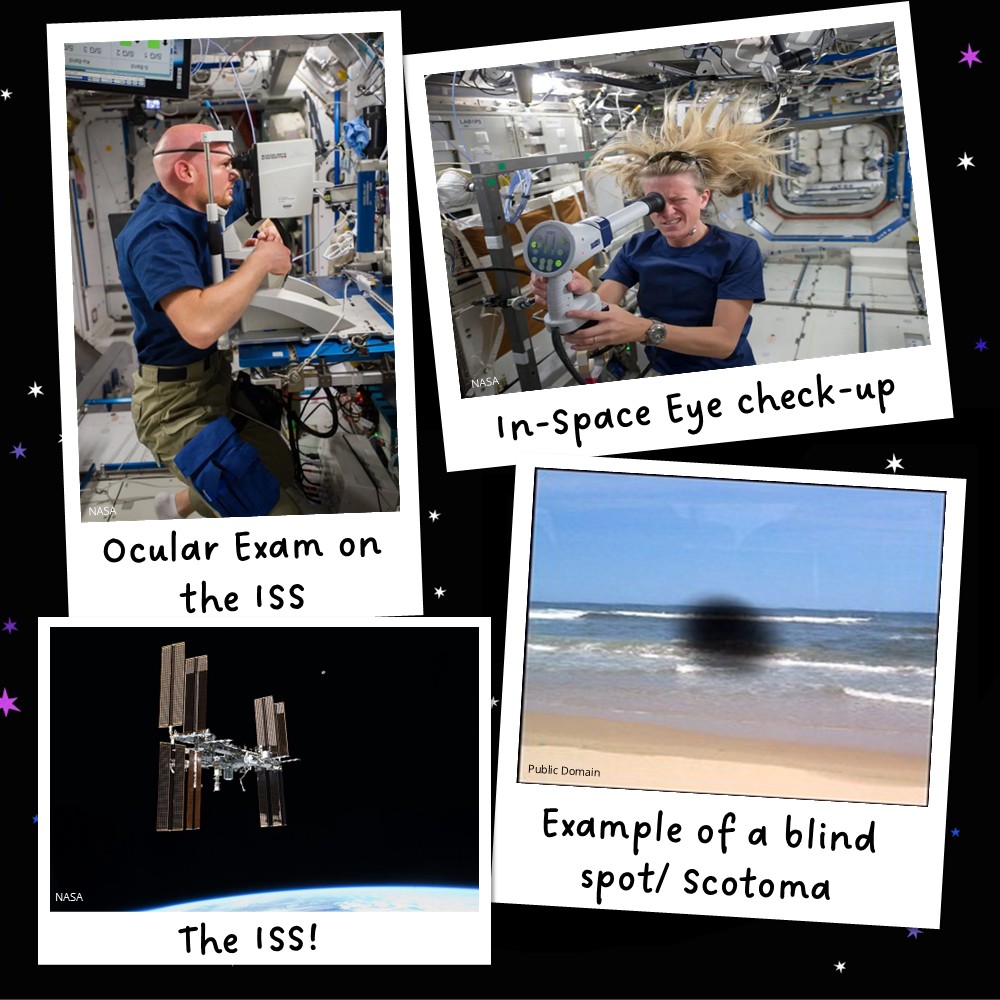
Spaceflight-Associated Neuro-Ocular Syndrome, or SANS, is a medical disorder that is caused by exposure to zero-gravity conditions, like being aboard the International Space Station (ISS). Around 70% of astronauts get one symptom of SANS, with 15-20% getting long term vision problems after they’ve come home. But why?
Here on Earth, our bodies are adapted to the strength of gravity we experrience, which makes sure the fluids in our bodies go to the right places in the correct amounts. This is primarily blood and spinal fluid. But up in space, things are different. Fluids begin to rise to our heads in microgravity, increasing the amount of pressure placed on the eyes.
This buildup of fluid and pressure makes our eyes do some weird things. One effect is that our optic nerves start to swell. This means our eyes and brain aren’t working together as well as they should be – our vision becomes blurry and we might experience some blind spots. If this is left for too long, the nerves may die permanently leading to permanent vision loss or blind spots.
We may also experience an effect known as “globe flattening”, where our eyes begin to flatten and become a little bit shorter. Because of this, our perspective shifts, and we struggle to make sense of how close something is and to understand what we’re looking at. Colour dulling can even happen which is really kind of sad. And our brains don’t escape unscathed either! Because of the lack of gravity and pressure going to the head, our brains are physically pushed into the top of our skulls!
All of this combines to make our vision in space pretty difficult to maintain at crystal clear quality. But have no fear! NASA is actively working on ways to combat the effects of SANS, such as sleeping bags that create a sort of vacuum in our legs or even thigh-bracelets that completely prevent the extreme shift of blood into our heads.
So for you future astronauts, make sure you get all of this information memorised because it might be quite tough to read when you come back down to Earth…
Why not put your own eyes and brain to the test with our easy optical illusion activities?
Get creative, challenge your perception, and see if you can work out what is really going on!

For all three crafts, you will need:
- White paper
- Clipboard
- Pencil
- Scissors
- Tape
- Glue
- Straw
- Ruler
- Black felt tip pen
- Colouring crayons or felt tip pens
3D Handprint Illusion:
-
![DSC9147]()
National Space Centre Step 1
Place your hand on your blank piece of paper
-
![DSC9149]()
National Space Centre Step 2
Lightly trace around your hand with your pencil
-
![DSC9151]()
National Space Centre Step 3
With your ruler, draw evenly spaced, horizontal straight lines, about 1cm apart, across the page – don’t draw inside the handprint yet!
-
![DSC9158]()
National Space Centre Step 4
Inside the handprint, draw curved lines that connect the straight lines together
-
![DSC9164]()
National Space Centre Step 5
Using your colouring crayons or felt tip pens, colour in the lines
-
![DSC9165]()
National Space Centre Step 6
You should now be able to see a 3D handprint illusion!
Why not try this same illusion technique with other drawings, like a rocket!


Astronaut Thaumatrope:
-
![DSC9168]()
National Space Centre Step 1
Cut out two equal sized squares from your paper
-
![DSC9171]()
National Space Centre Step 2
On one of your squares, draw an astronaut helmet – try and draw it in the middle of the square!
-
![DSC9172]()
National Space Centre Step 3
On the other square, draw a face – try and draw it in the middle of the square a little bit smaller than the helmet
-
![DSC9179]()
National Space Centre Step 4
Colour in the helmet and the face!
-
![DSC9182]()
National Space Centre Step 5
Glue or tape a pencil or straw between the two squares
-
![DSC9184]()
National Space Centre Step 6
Hold the pencil or straw between your palms and rub your hands together. As the pencil or straw spins, you can see how the two drawings turn into one!


Cube Illusion:
-
![DSC9161]()
National Space Centre Step 1
Cut out three identical sized squares of paper (8cm by 8cm)
-
![DSC9176]()
National Space Centre Step 2
Mark out 16 identical squares on each piece of paper and colour every other square in black using a felt tip
-
![DSC9191]()
National Space Centre Step 3
Stick two of the pieces of paper together using tape, making sure the grid is facing upwards and the colours next to each other on each piece of paper is the same
-
![DSC9195]()
National Space Centre Step 4
Stick the third piece of paper under the piece of paper on the left and fold together with tape - the squares in the very centre of the half-cube should be the same colour
-
![DSC9203]()
National Space Centre Step 5
Stick a straw down poking upwards to a solid surface with tape and stick the back corner of the shape down to the other side of the straw with more tape - the shape should stand up and be moveable
-
![DSC9205]()
National Space Centre Step 6
Hold the half-cube up at a distance and see if you can make the perspective shift from hollow to a full cube!


So, there you have it! Space can play tricks on us in more ways than one! From the changes our bodies experience in microgravity to our brains finding faces where there are none, what we see isn’t always quite what it seems.
Whether it’s your eyes, your brain or the strange conditions of space playing tricks on you, one thing is for certain: the universe is full of surprises...
Happy spooky season to all you ghosts and ghouls, and remember, don’t believe everything you see!
Full Credits / References:
(Banner image) Cosmic Question Mark, Credit: NASA
(1- SANS Collage) Ocular Exam on the ISS, Credit: NASA; In-Space Eye check-up, Credit: NASA; ISS, Credit: NASA; Example of a blindspot/Scotoma, Credit: Public Domain
(2 - Pareidolia Collage) Container faces, Credit: Creative Commons Attribution-Share Alike 4.0 International; Tube face, Credit: Creative Commons Attribution-Share Alike 4.0 International; Smiley face lakes, Credit: Creative Commons Attribution-Share Alike 4.0 International; The Face on Mars, Credit: NASA, The Face on Mars 2001, Credit: NASA; Pavement face, Credit: Creative Commons Attribution-Share Alike 2.0 Generic; Smiling galaxies, Credit: NASA; Witch Head Nebula, Credit: NASA; Happy Sun, Credit: NASA
(3) Materials and Items, Credit: National Space Centre
(4) 3D Handprint Illusion Instructions - all images, Credit: National Space Centre
(5) Astronaut Thaumatrope - all images, Credit: National Space Centre
(6) Cube Illusion - all images, Credit: National Space Centre
(7) Hand of God Nebula, Credit: NASA
