

Stargazing Challenges - April 2026
- 20th Mar 2026
- Author: Dhara Patel
Each month, we'll be sharing a handful of stargazing challenges for you to try your hand at.
This April, see if you can spot the full moon, locate our star pattern of the month - the Spring Triangle asterism, and have a go at looking for the Moon beside the star Spica in the constellation of Virgo.
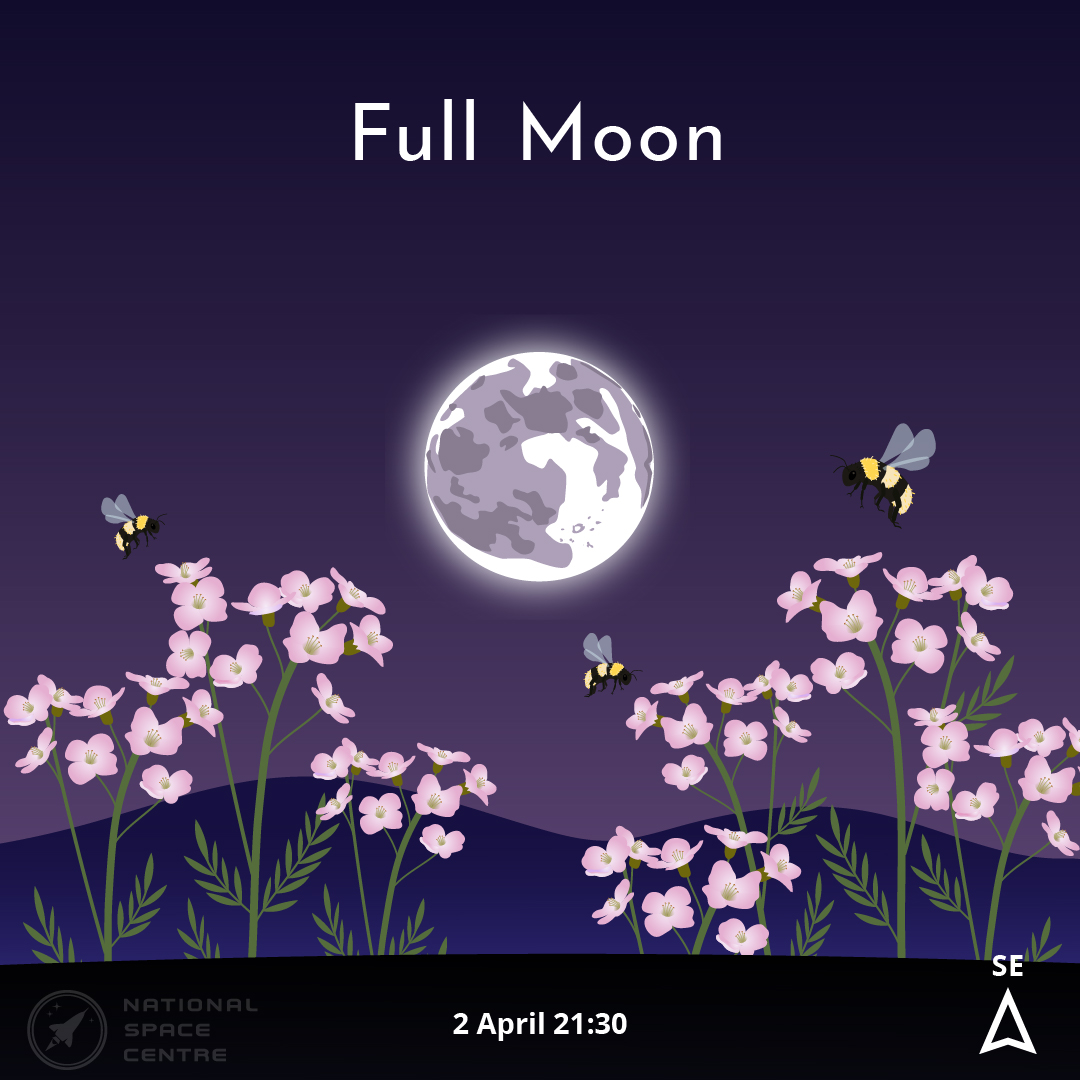
Challenge 1 - Full moon
Can you spot the full moon on 2 April?
See if you can catch the full moon on 2 April rising in the south-eastern sky around 21:30. Because the Moon is positioned on the opposite side of the Earth compared to the Sun at the full moon phase, it usually begins to rise as the Sun sets and sticks around through the night, setting as the Sun rises the following morning. As such, if you don't manage to catch it in the early evening, the full moon should be visible throughout the night - it'll just move further westwards later in the night.
Each month, the full moon is given a traditional name which reflects seasonal changes and agricultural cycles largely taken from Native American, Colonial American, and European cultures. The April full moon is often called the Pink Moon. It is named after an early spring blooming wildflower (Phlox subulata - moss pink) that appears in North America which marks the season's arrival. You can find our full moon calendar and more information on native full moon names in our Full Moons and Full Facts blog.
Full moon FAQ - Why do we always see the same side of the Moon from Earth?
The Moon is 'tidally locked' meaning that it takes the same amount of time to spin on its axis as it does to orbit around the Earth - 27.3 days. In the past the Moon was much closer to Earth and spun faster but the Earth's gravity has slowed the Moon's rotation so that one side now permanently faces the Earth and we always see the same side. Interestingly, all of the large moons in the Solar System are tidally locked with their planets!
Challenge 2 - The Spring Triangle
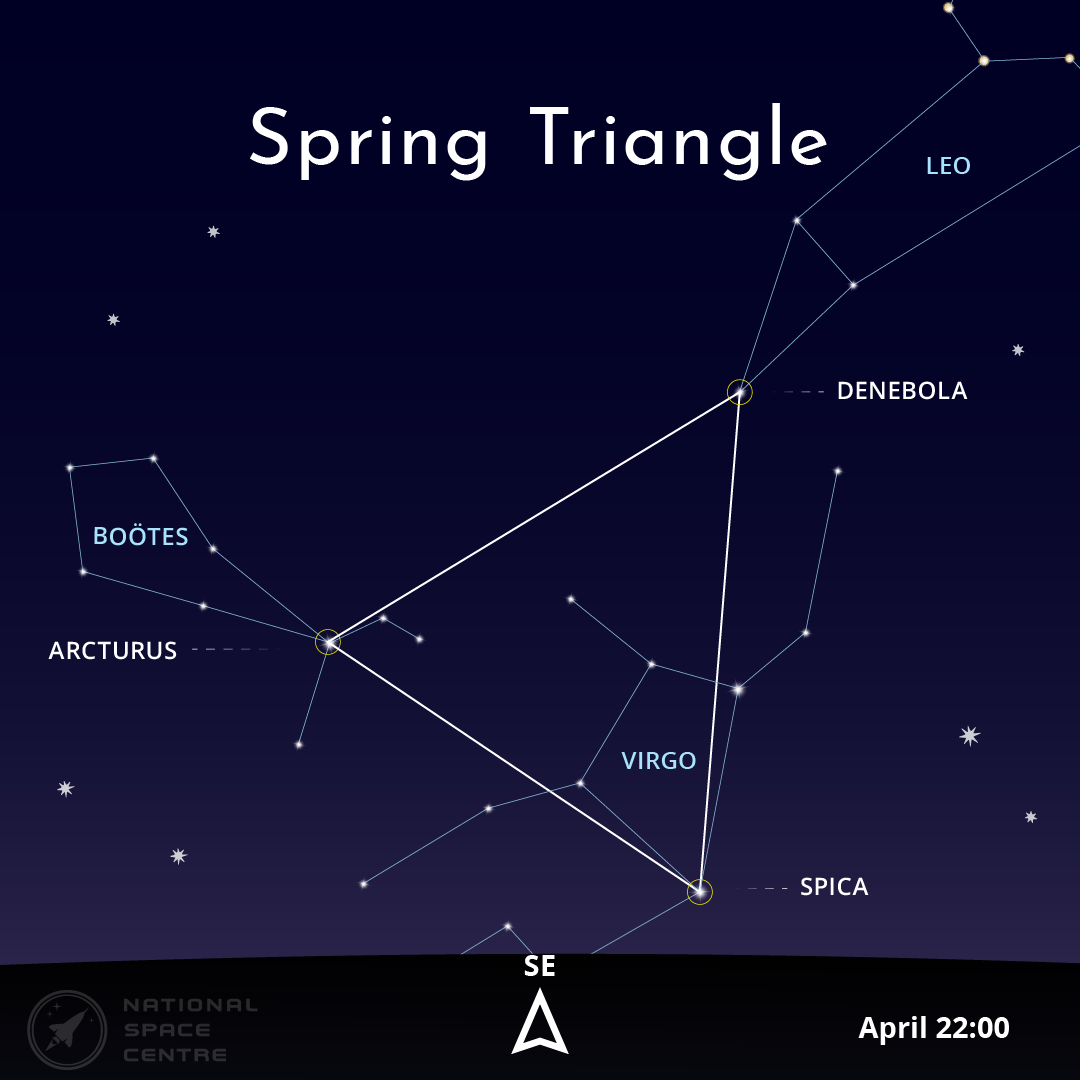
Throughout April - can you find the Spring Triangle asterism?
With spring underway, an easily recognisable pattern of stars becomes visible in the southeast around 22:00 - the Spring Triangle asterism. To locate it, look for three bright stars in a triangle shape: Arcturus in the Constellation of Bootes the herdsman, Denebola in the constellation of Leo the lion and Spica in the constellation of Virgo the maiden. Made up of stars from three different constellations, this familiar star pattern spans a vast area of the Northern Hemisphere's night sky.
Arcturus will be the brightest of the three stars - marking the leftmost corner of the triangle. It's an orange giant star and the fourth brightest in the night sky. At 25 times the size of our Sun, if it was placed at the centre of our Solar System, its surface would extend out beyond the orbit of Mercury.
Spica will also be quite bright and will sit at the bottom corner of the triangle, closest to the horizon. This blue-white star is actually two massive stars located about 250 light years away. The two stars are so close that they orbit each other in just 4 days and their gravity distorts them into egg-shapes rather than being spherical.
Denebola will be the faintest of the three but still visible to the naked eye. If you tried our March stargazing challenges and made yourself familiar with the constellation of Leo, Denebola is the easternmost star in this constellation. This young white coloured star is surrounded by a dusty disk of debris, suggesting that planets may be forming around it!
Challenge 3 - Moon and Spica
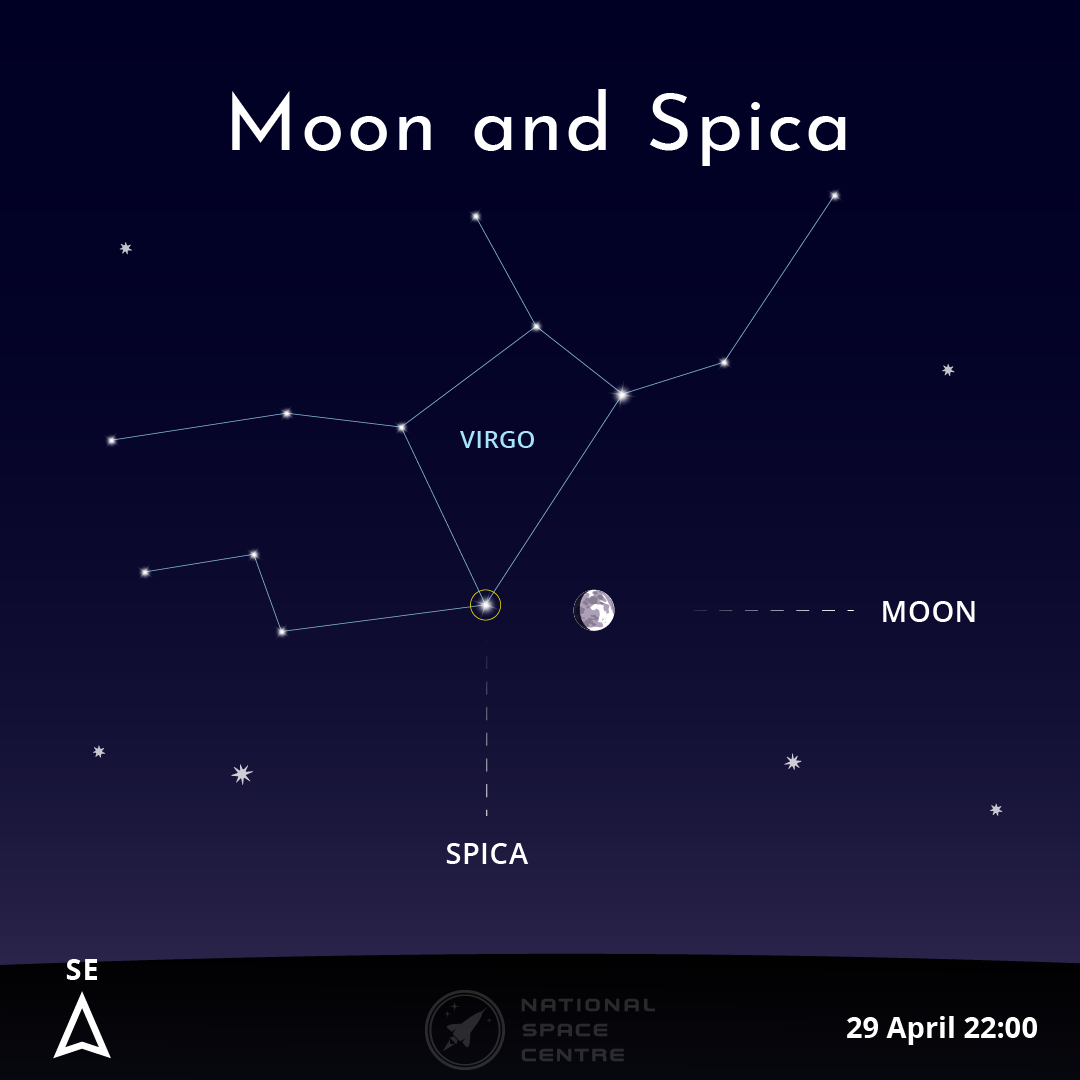
Can you catch the Moon beside the star Spica on 29 April?
If you use the first few weeks of April to get familiar with the Spring Triangle asterism, then by the end of the month, you'll be able to spot the waxing gibbous moon beside the star Spica on 29 April. Face towards the south around 22:00 where you'll be able to find Spica sitting to the left of the Moon. You'll be able to see the duo together from just after sunset. They'll appear in the southeast, until the early hours of the following morning when they'll set below the south western horizon.
If you can locate the constellation of Ursa Major (the Great Bear), there's an astronomer's saying to help you find Spica: "Arc to Arcturus and speed on to Spica" - follow the curve of the stars in the bear's tail to direct you to Arcturus and continue down from there to spot Spica!
Stars like Spica are 'frequently visited' by the Moon and planets. This is because as the Earth orbits our star throughout the year, the Sun traces out an imaginary circle across the sky known as the ecliptic. The zodiac constellations like Virgo, and therefore the star Spica, are centred along this path and from our position on Earth, the planets and Moon are always found along this part of the sky.
Did you know? Flags of the world often depict stars and Spica appears as the only Northern hemisphere star on the Brazilian flag - you can find out more in our Stars and Constellations on Flags blog.
How did you get on? Were you able to spot our stargazing highlights this month?
If you enjoyed putting your stargazing skills to the test, then keep a look out for the astronomy challenges we'll be sharing each month. And don't forget to share your photos with us using #NSCstargazers
And find out what else you can see this month with our 'What's in the Night Sky' video.
Full references / credits:
(Banner) Skyscape. Credit: © National Space Centre
(1) Full Moon on 2 April. Credit: © National Space Centre
(2) Spring Triangle. Credit: © National Space Centre
(3) Moon and Spica on 29 April. Credit: © National Space Centre
