

Stargazing Challenges - August 2026
- 17th Jul 2026
- Author: Dhara Patel
Each month, we'll be sharing a handful of stargazing challenges for you to try your hand at.
This August, see if you can find our star pattern of the month - The Kite asterism, catch the best partial solar eclipse visible from the UK in the foreseeable future, observe the peak of the Perseid meteor shower, have a go at looking for a partial lunar eclipse, and spot the full moon at the end of the month.
Challenge 1 - The Kite
Throughout August - can you find the Kite asterism?
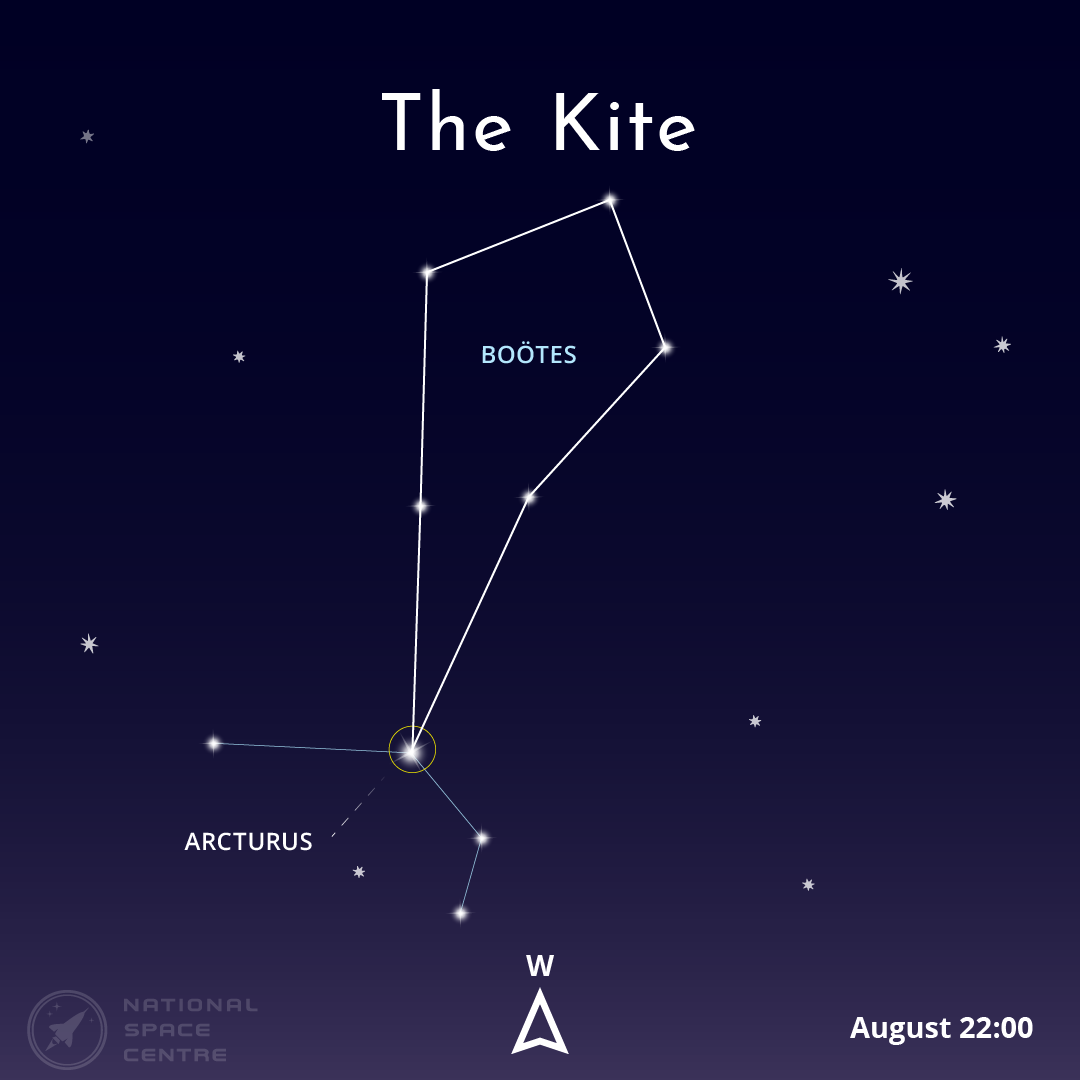
Identifiable by the bright star Arcturus that marks the bottom of this familiar star pattern, the Kite is a great asterism to look out for in the summer evening sky. Earlier this year (Stargazing Challenges - April 2026), we shared a star hopping trick where you can use the Plough asterism (visible all year round) to find Arcturus. The well-known astronomer's saying uses the handle of the Plough to "Arc to Arcturus".
Not an official star pattern itself, the Kite makes up a prominent part of the constellation of Bootes, the herdsman - forming a kite-like or ice-cream cone shape in the sky. Be sure to try and catch it after the Sun sets, the skies darken and it becomes visible, but before it begins to set below the horizon around midnight.
Face westwards around 22:00 throughout August and look for six stars arranged in a slightly skewed kite-shape. Start by locating Arcturus - the brightest star in this star pattern marking the bottom of the asterism. The second brightest star, Nekkar is positioned at the top of the Kite. From there you should be able to make out the remaining stars - visible to the naked eye even from moderately light polluted areas.
Arcturus is actually the fourth brightest star in the night sky - an orange-red giant about 25 times the size of our Sun, which shines over 100 times brighter. As an older star in the end phase of its life, it gives us a sneak peek of what our star will look like in about 5 billion years. And as a star that's zooming through our Milky Way galaxy, its close proximity to our Solar System means that its position in the sky shifts by a noticeable amount over the course of a single human lifetime!
Challenge 2 - Solar Eclipse
Can you catch the partial solar eclipse on 12 August?
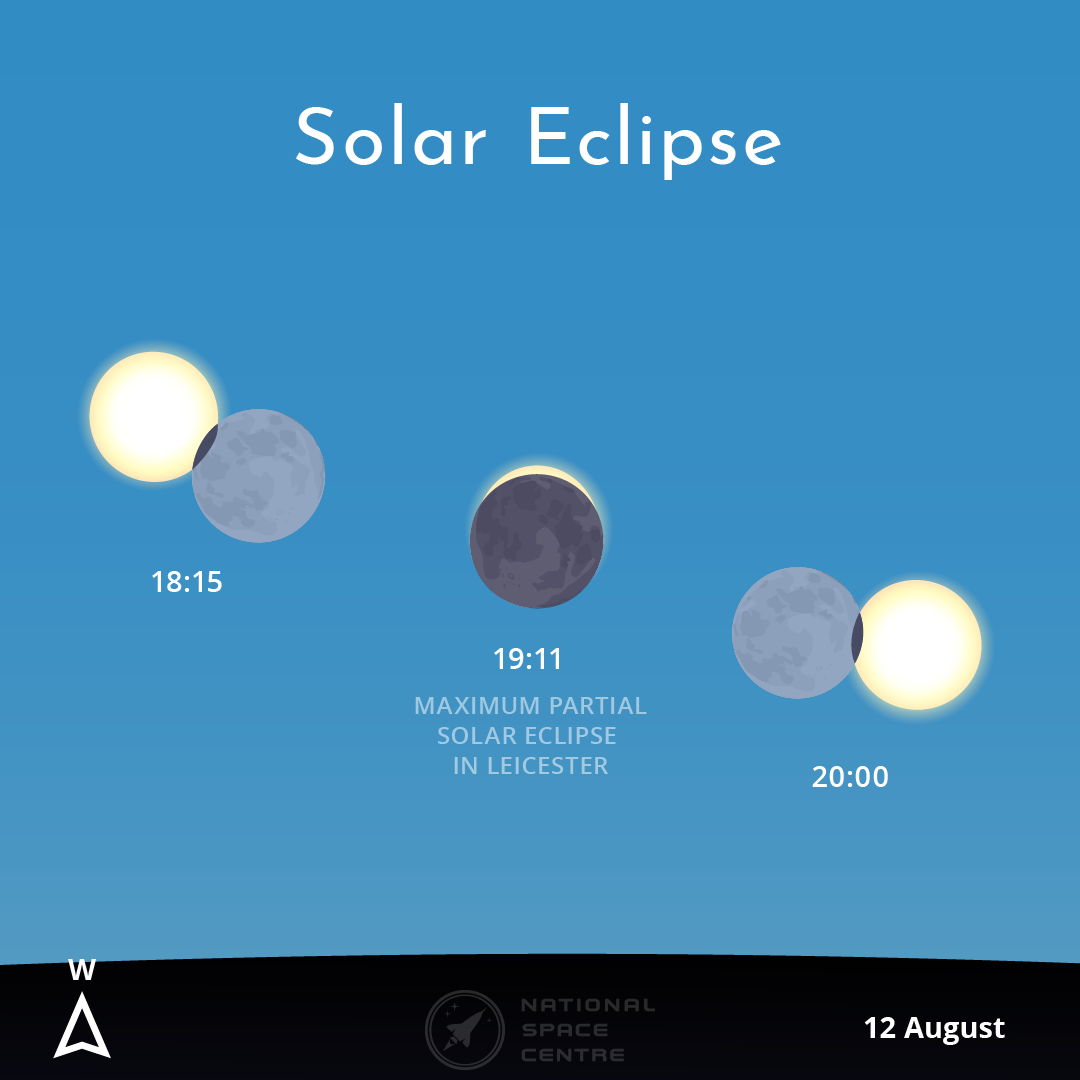
With the Moon blocking out approximately 90% of the Sun's disc at maximum from the UK, this August we've got the best partial solar eclipse viewing opportunity from the British Isles for the next several decades! From Leicester, the event begins around 18:15 - look to the west as the Sun begins to set to see the Moon starting to 'take a bite' out of the Sun. Be sure to observe it correctly by using our helpful guide: 5 Ways to View a Solar Eclipse Safely.
By 19:11, it will reach its maximum coverage, but will be sitting lower down in the sky so don't forget to find a location clear from tall buildings and trees that may obstruct your view. The Moon will then continue passing over the Sun until it leaves the opposite limb around 20:00 - though at this time, the Sun will be grazing the horizon so it'll be tricky to spot. Weather permitting, we'll be holding an observing evening at the National Space Centre: Space Lates - Partial Solar Eclipse, so come along and join us for this special event.
A solar eclipse occurs due to the alignment of the Sun, Earth and Moon. When the Moon happens to pass directly between the Earth and the Sun, it can block out its light in totality or partially depending on where from Earth you witness it. Find out more about solar eclipses in our blog: What is a Solar Eclipse?
Because the Moon's orbit isn't perfect (it's tilted), we don't have solar eclipses each time/month that our lunar neighbour completes an orbit. In fact, from the same position on Earth, you would only expect to see a total solar eclipse every 360-400 years. But if you're willing to travel, there's usually one to observe somewhere in the world every 18 months or so.
Challenge 3 - Perseids
On 12 August, are you able to observe the peak of the Perseid meteor shower?
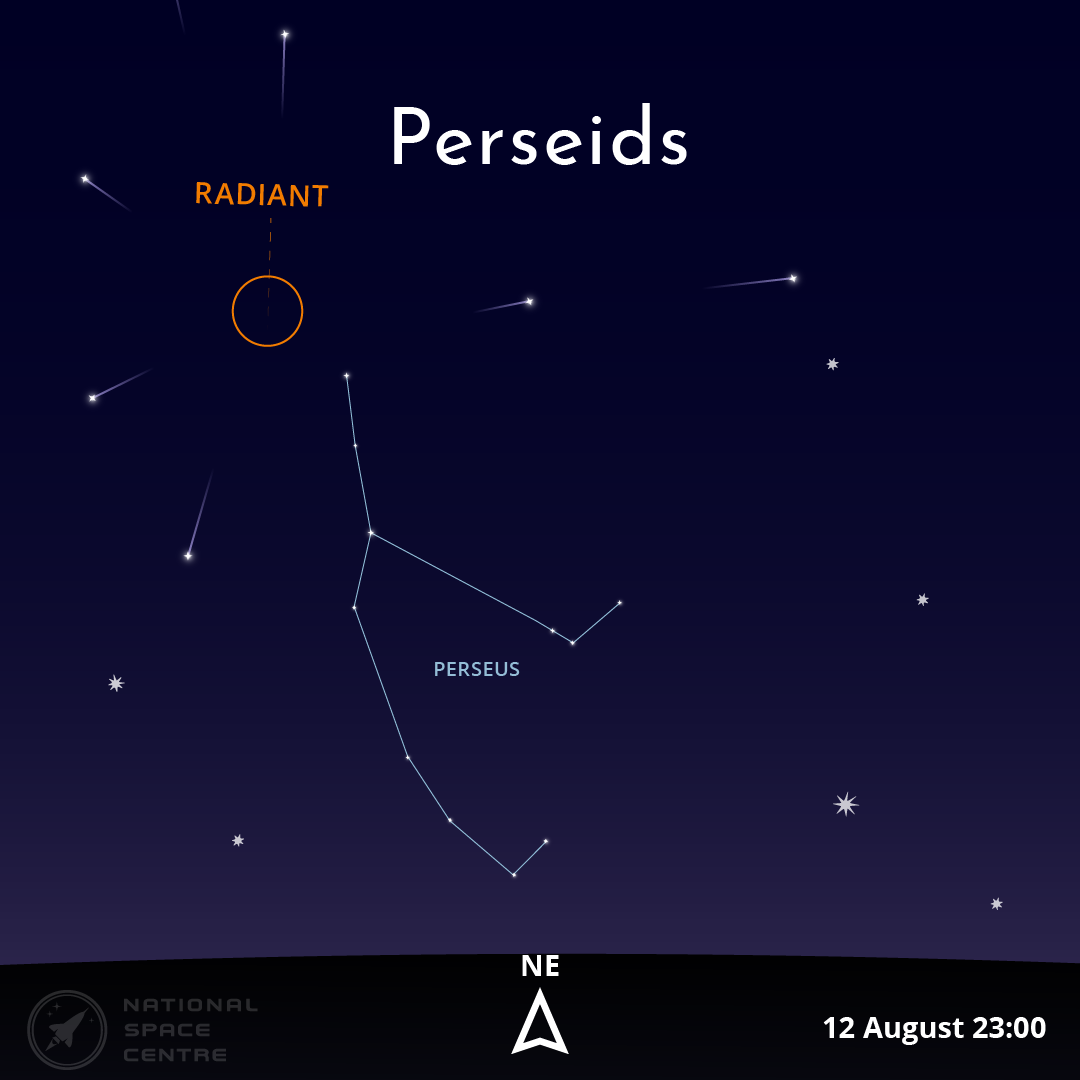
Following on from the fun of a solar eclipse, head out just ahead of midnight on 12 August to begin spotting some meteors from the peak of the Perseid meteor shower. As one of the most prolific meteor displays of the year (with up to 100 meteors per hour in ideal conditions), it's an ideal opportunity to observe a naked eye celestial event in the height of summer where the nights won't get too cold!
Most meteor showers are named after the constellation or star from which the meteors appear to radiate from. The Perseids are named after the constellation of Perseus, the legendary Greek hero. Though meteors will appear in all directions overhead, they'll appear to streak across the sky from this radiant or point.
While you'll want to be facing the radiant which will sit in the northeast, be sure to continuously scan the starry canvas above to try and catch the fast-moving shooting stars. There's no need for binoculars or telescopes - their zooming abilities will limit how much of the sky you can see. Just keep your eyes peeled - blink and you could miss it as meteors are fast! But most importantly - be patient. Meteors don't appear predictably - sometimes you could spot several in the space of a few minutes and then see nothing for a good while. Therefore, spending a good few hours meteor-hunting around and after midnight is recommended - take a blanket, deck chair and some snacks to make your experience more comfortable.
Find out more in our blog: Perseid Meteor Shower including how to plan a meteor-gazing evening and learn why meteor showers occur predictably each year!
Challenge 4 - Lunar Eclipse
Are you able to spot the partial lunar eclipse on 28 August?
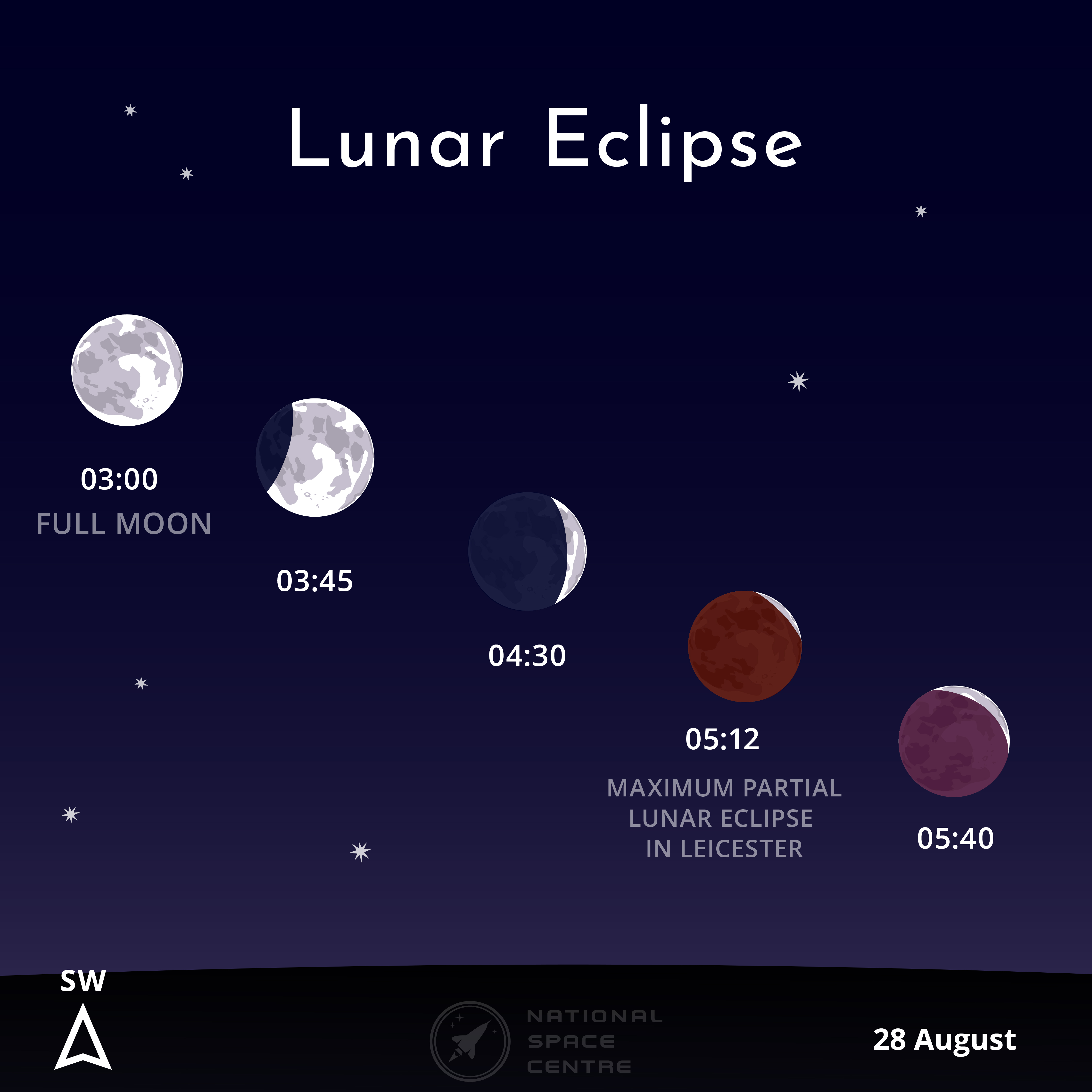
While you might decide to wait until the evening of 28 August to spot the full moon this month (challenge 5), if you want to spot it in a blood red lunar eclipse, then you'll need to catch the Moon in the early hours as the Sun rises. Make sure to have a clear view of the western horizon as it'll be sitting quite low in the sky at this time.
Appearing as its usual fully illuminated face throughout much of the night, you'll be able to notice a shadow on the left edge of the Moon as it begins to be eclipsed by the Earth from just after 03:30. The shadow will creep further over the Moon's surface placing more of it into shadow and from Leicester it will reach maximum partial lunar eclipse at 05:12. With over 90% in shadow, the Moon will take on a reddish hue giving it the characteristic blood moon look! The Moon will then move back out of the Earth's shadow and slowly set below the western horizon before the entire event concludes.
A lunar eclipse occurs due to the alignment of the Sun, Earth and Moon. When the Moon passes behind the Earth and into its shadow (so the Sun and Moon are on opposite sides of the Earth), its face becomes less illuminated. But when directly behind our planet, our atmosphere scatters and bends sunlight around the Earth, such that the red light of the Sun gets projected onto our lunar neighbour giving us a blood moon/total lunar eclipse. Find out more about lunar eclipses in our blog: What is a Lunar Eclipse?
Unlike solar eclipses which require you to be in a specific location on Earth at a specific time, lunar eclipses can be seen from various locations on Earth where the full moon is up in the sky. There may be two to five lunar eclipses occurring in a given year but a total lunar eclipse only happens about twice every three years.
Challenge 5 - Full Moon
Can you catch the full moon on 28 August?
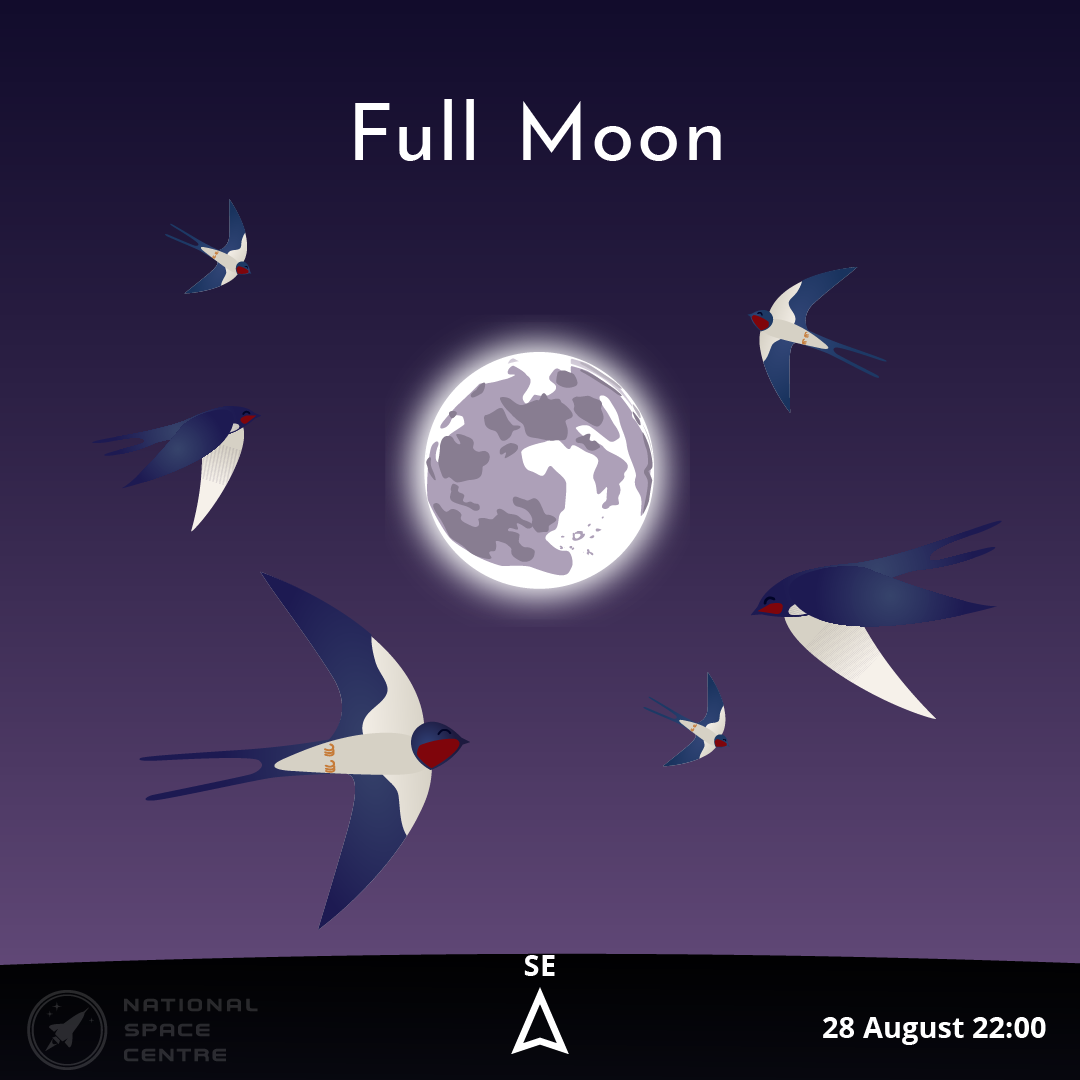
Face towards the southeast around 22:00 on 28 August to catch the full moon this month as it makes its appearance above the horizon. Although the Moon moves relatively slowly around the Earth, our planet spins on its axis every 24 hours, so the Moon will appear to move from east to west throughout the night.That means you'll have all night to try and spot it before it begins to set in the west as the Sun rises on the following morning.
Each month, the full moon is given a traditional name which reflects seasonal changes and agricultural cycles largely taken from Native American, Colonial American, and European cultures. The August full moon is often called the Sturgeon Moon - after North American fishing tribes who realised the sturgeon fish were abundant in this month. But the indigenous Cree culture uses Flying Up Moon, noting the time of year when young birds learn to fly and leave their nests. You can find our full moon calendar and more information on native full moon names in our Full Moons and Full Facts blog.
Full moon FAQ - if the Moon is attracted to the Earth by its gravity, why doesn’t it crash into it?
Earth’s gravity is constantly pulling the Moon towards us (inwards), but the Moon also has motion (moving sideways past the Earth). This means that as the Moon falls towards Earth it keeps missing it due to its forward speed, creating a stable orbit. This same principle keeps satellites orbiting Earth and planets orbiting the Sun. So, in a simplified version, gravity pulls the Moon towards Earth while the Moon's motion carries it forward - these two effects create an orbit.
How did you get on? Were you able to spot our stargazing highlights this month?
If you enjoyed putting your stargazing skills to the test, then keep a look out for the astronomy challenges we'll be sharing each month. And don't forget to share your photos with us using #NSCstargazers
And find out what else you can see this month with our 'What's in the Night Sky' video.
Full references / credits:
(Banner) Skyscape. Credit: © National Space Centre
(1) The Kite. Credit: © National Space Centre
(2) Solar Eclipse on 12 August. Credit: © National Space Centre
(3) Perseid meteor shower on 12 August. Credit: © National Space Centre
(4) Lunar Eclipse on 28 August. Credit: © National Space Centre
(5) Full Moon on 28 August. Credit: © National Space Centre
