

Stargazing Challenges - February 2026
- 19th Jan 2026
- Author: Dhara Patel
Each month, we'll be sharing a handful of stargazing challenges for you to try your hand at.
This February, see if you can spot our star pattern of the month - the Winter Hexagon asterism, try looking for the full moon, and have a go at locating the Solar System's largest planet, Jupiter, beside the Moon.
Challenge 1 - Winter Hexagon
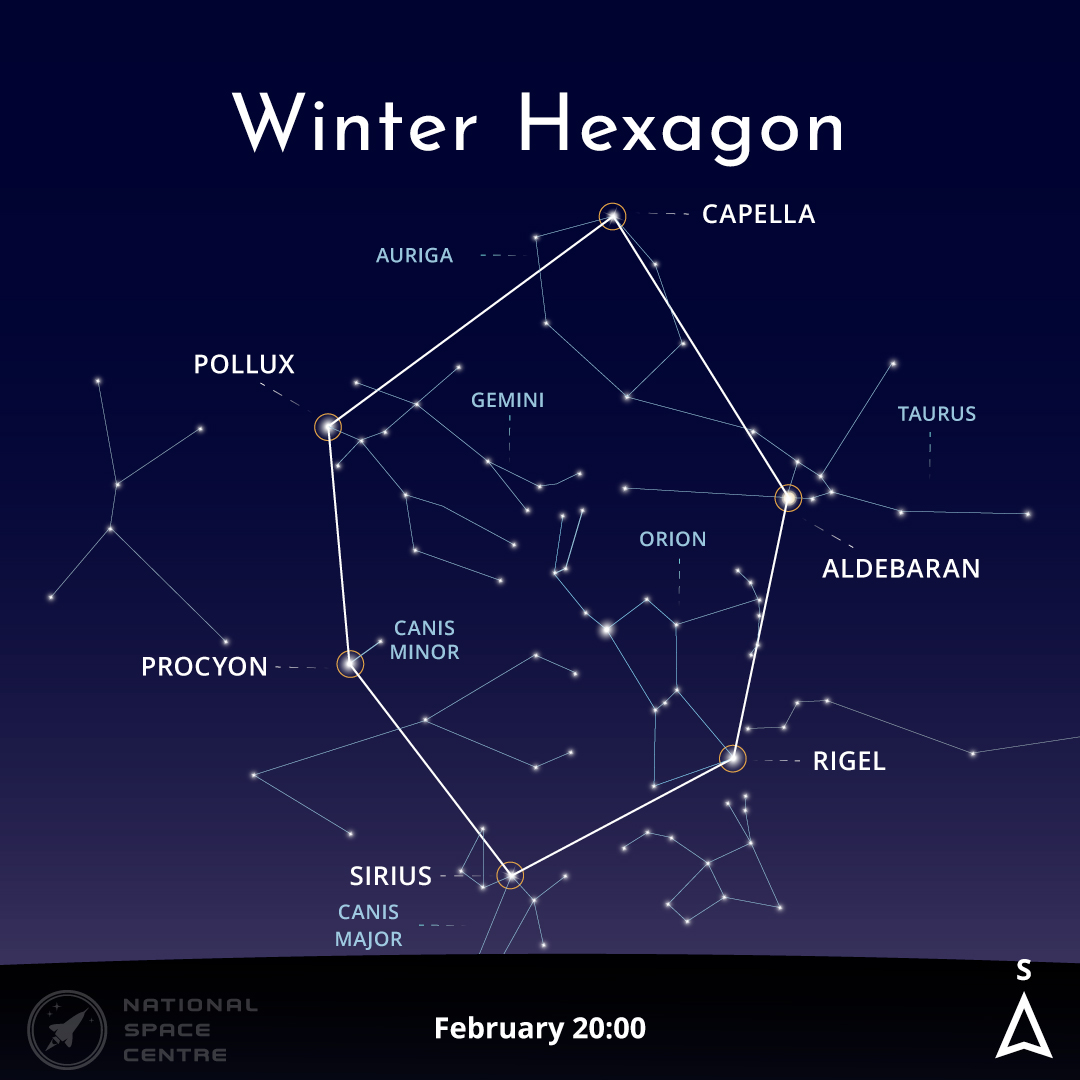
Throughout February - can you find the Winter Hexagon asterism?
Last month, we set you the challenge of trying to spot the Winter Triangle asterism - three bright stars that make up a triangle pattern that's easy to spot in the sky. If you got the hang of that, this month you should have no problem trying to find the largest asterism in the northern hemisphere winter sky.
The Winter Hexagon asterism is a star pattern spanning six different constellations - taking one bright star from each to form a hexagon shape in the sky. Throughout the month, around 20:00, look towards the south. You might recall the star Sirius in the constellation of Canis Major from the Winter Triangle asterism. This is the brightest star in the night sky and will lie closest to the horizon.
From there look further to the right to spot a blue-white coloured star called Rigel in the constellation of Orion. Continuing to the next corner of the hexagon you'll find the red giant star Aldebaran in the constellation of Taurus. Then at the top is Capella - the brightest star in the constellation of Auriga. Looking further left and coming back down towards the horizon, you'll come across Pollux - one of the two prominent stars in the constellation of Gemini (careful not to confuse it with the star Castor that lies just above). And a little further down from there is the final star in the hexagon - Procyon, in the constellation of Canis Minor (another one of the stars from the Winter Triangle).
It's such a fun asterism to try and spot - you'll definitely be able to impress friends and family with your stargazing expertise if you can point out this big star pattern!
Challenge 2 - Full moon
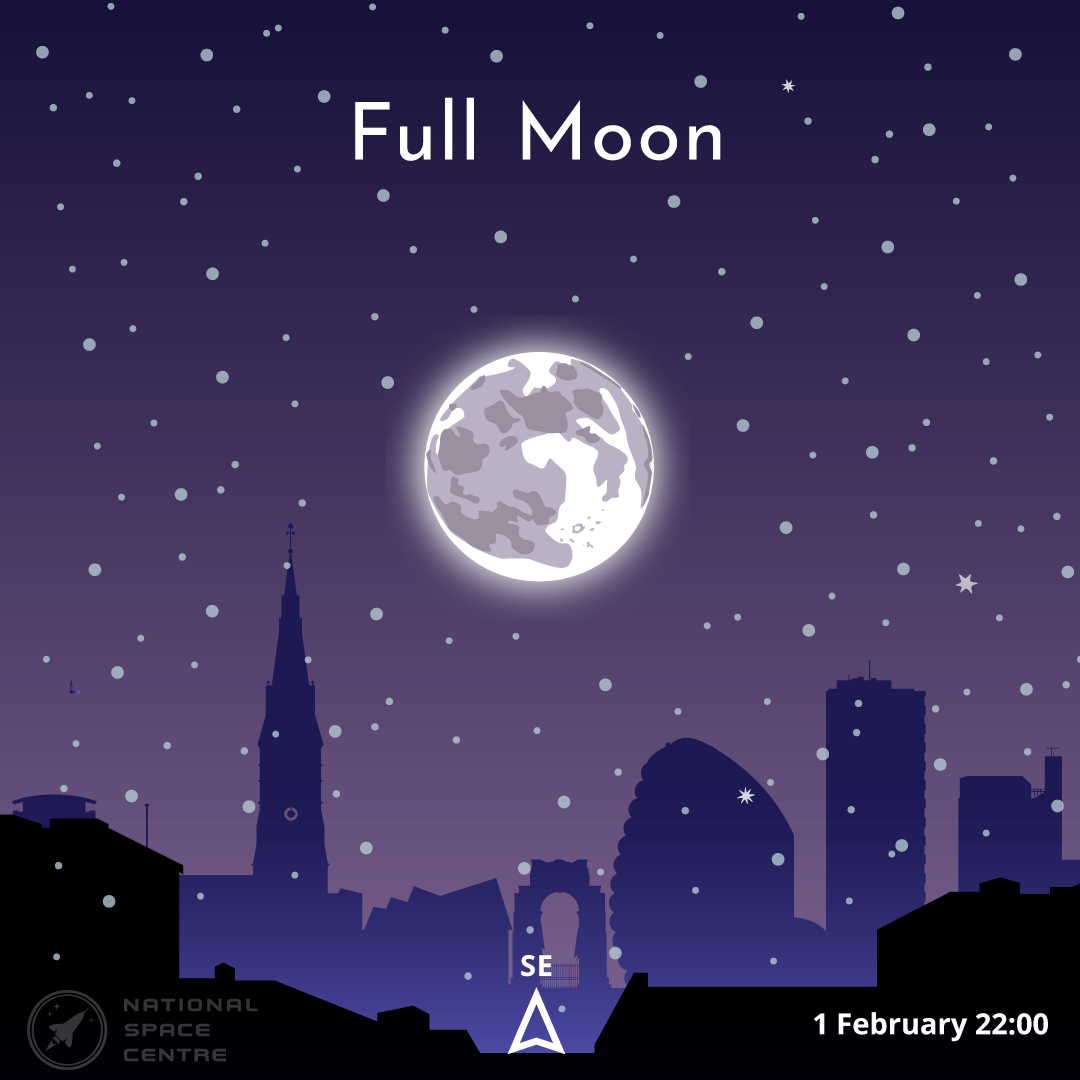
Can you spot the full moon on 1 February?
As the Sun begins to set, the full moon on 1 February will begin creeping above the eastern horizon - here's your chance to catch this month's fully illuminated Moon. It will be visible throughout the night but will slowly move to the west as the night unfolds. To catch the full moon at a practical time, face towards the southeast around 22:00 to spot it high enough above the horizon to easily clear buildings and trees that might otherwise block your view.
Each month, the full moon is given a traditional name which reflects seasonal changes and agricultural cycles largely taken from Native American, Colonial American, and European cultures. The February full moon is often called the Snow Moon, named after the cold and frosty month experienced in North America. You can find our full moon calendar and more information on native full moon names in our Full Moons and Full Facts blog.
Full moon FAQ - Are Moon phases the same everywhere on Earth?
On any given day, the phase of the Moon we see on Earth depends on the position of the Moon relative to the Earth and Sun. So, it's not your location but rather where the Moon is in it's orbit that affects the phase. However, we see the Moon at different angles depending on whether we're north or south of the equator. So if you had a friend in the opposite hemisphere and you both looked at the Moon on the same date, the Moon would be the same phase but would appear upside down to your friend!
Challenge 3 - Moon and Jupiter
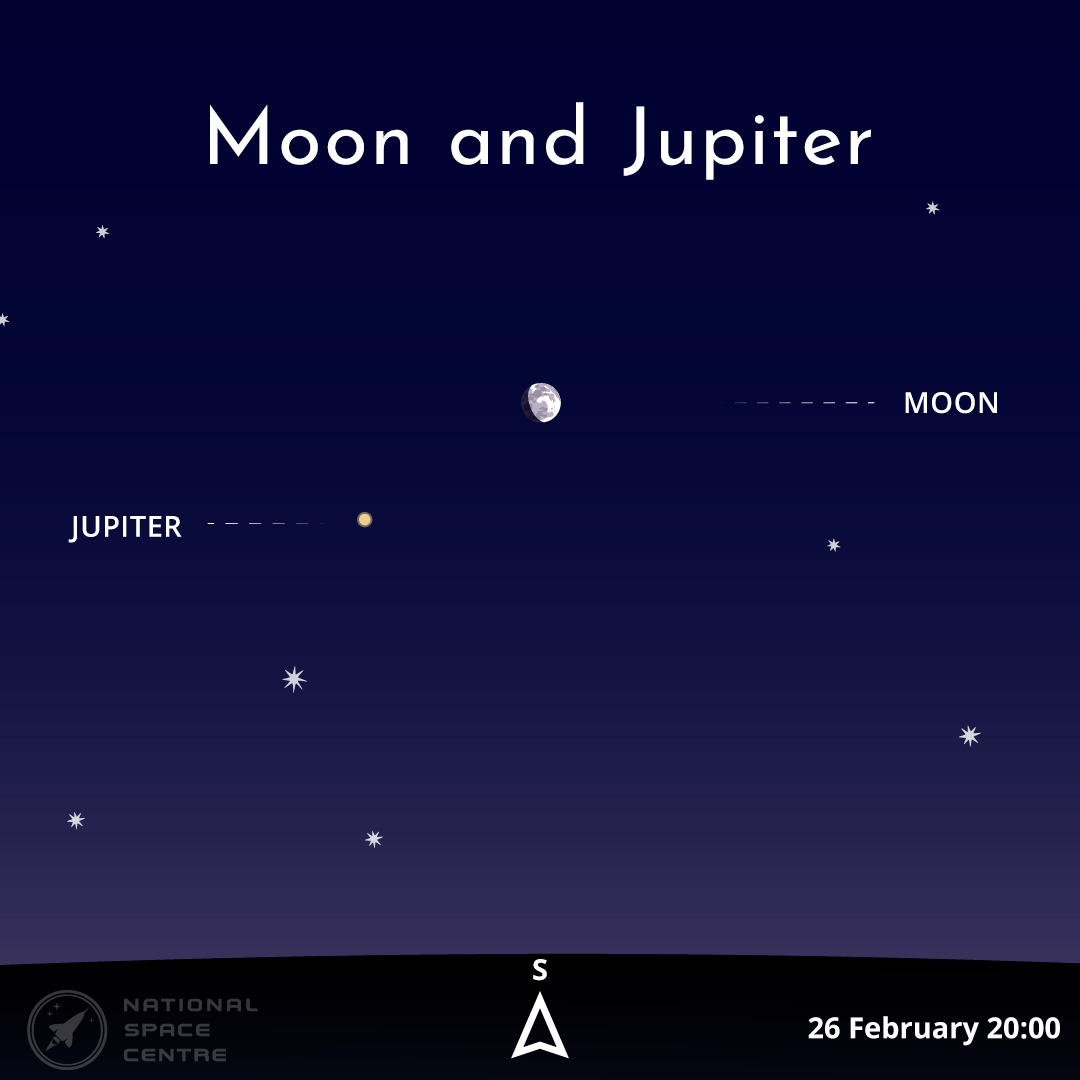
Can you catch the Moon beside Jupiter on 26 February?
Look to the south around 20:00 on 26 February to see Jupiter lying close to the waxing gibbous moon. Jupiter is one of the brightest planets visible to the naked eye so provided there are clear skies, you should be able to spot it quite easily even in light polluted skies. The pair continue to move westwards and closer to the horizon as the night unfolds so the early evening is the best time to observe the duo.
If you had a go at challenge 1 - finding the Winter Hexagon asterism, you'll see that on this night, Jupiter and the Moon will be sitting within this star pattern close to the star Pollux.
With the Moon in its waxing gibbous phase, it's a great time to grab your binoculars or preferably a telescope to look for the Clavius crater. Look along the terminator - the boundary between the lit and unlit parts of the Moon. Towards the bottom (or the top if you're looking at an inverted image through a telescope), you'll see a cascade of craters popping out as the shadows cast from their crater walls give them a real three-dimensional look. Clavius is a crater that has multiple smaller craters within it!
And Jupiter is also worth a look through your optical aids - even with a pair of moderate binoculars you could spot the four largest moons of Jupiter as star-like points beside the planet - Io, Europa, Ganymede and Callisto.
How did you get on? Were you able to spot our stargazing highlights this month?
If you enjoyed putting your stargazing skills to the test, then keep a look out for the astronomy challenges we'll be sharing each month. And don't forget to share your photos with us using #NSCstargazers
And find out what else you can see this month with our 'What's in the Night Sky' video.
Full references / credits:
(Banner) Skyscape. Credit: © National Space Centre
(1) Winter Hexagon. Credit: © National Space Centre
(2) Full Moon on 1 February. Credit: © National Space Centre
(3) Moon and Jupiter on 26 February. Credit: © National Space Centre
