

Stargazing Challenges - January 2026
- 18th Dec 2025
- Author: Dhara Patel
Each month, we'll be sharing a handful of stargazing challenges for you to try your hand at.
This January, see if you can find our star pattern of the month - the Winter Triangle asterism, try spotting the full moon, head out to catch some meteors during the peak of the Quadrantid meteor shower and look for the Moon and Saturn together in the sky.
Challenge 1 - Winter Triangle
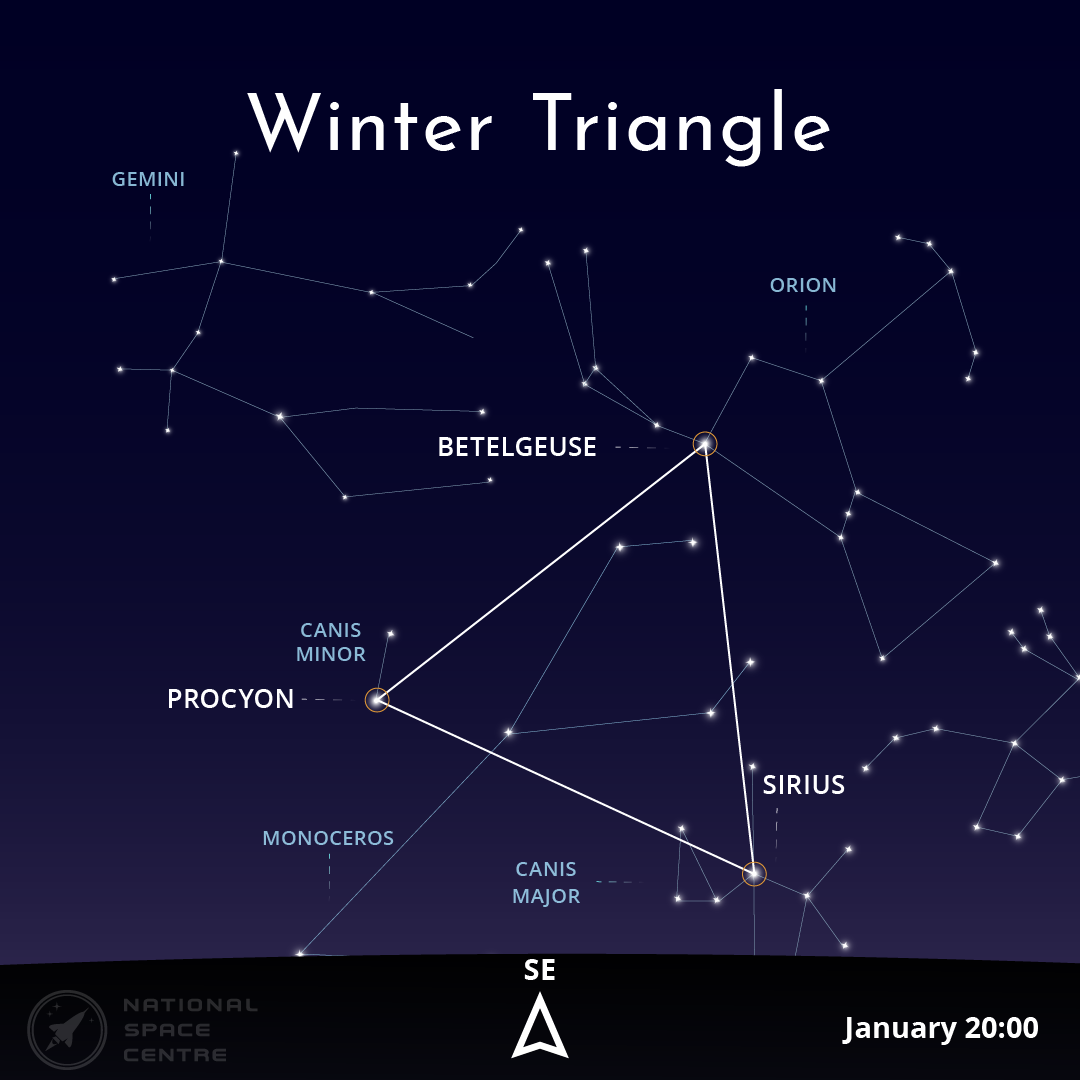
Throughout January - are you able to pick out the Winter Triangle asterism?
Getting familiar with navigating the night sky starts with being able to identify the brightest and most recognisable features. So, see if you can try spotting three bright stars making up a triangle shape in the sky known as the Winter Triangle. Although it's not an official star pattern (constellation) itself - the Winter Triangle is a very familiar pattern known as an asterism.
Throughout the month at around 20:00, look towards the southeast to spot the brightest star in the night sky - Sirius, close to the horizon in the constellation of Canis Major. Further up, you'll spot an orange-red coloured star called Betelgeuse marking one of the shoulders of Orion the hunter. And completing the third corner of the triangle is the star Procyon in Canis Major. In Greek mythology, Canis Major and Canis Minor were the two hunting dogs of Orion.
All three should appear visible to the naked eye, even in moderately light-polluted skies. That's because this trio of stars are amongst the ten brightest stars in the night sky - with Procyon at number seven and Betelgeuse rounding up the top ten!
Due to Sirius' brightness and with it usually being positioned low in the sky it's starlight is bent or refracted by the Earth's atmosphere. This makes it appear to twinkle rapidly with flashes of colour including red, blue, and green!
Use January to get familiar with this star pattern as we'll be using the Winter Triangle as a starting point to find our February star pattern of the month.
Challenge 2 - Full moon
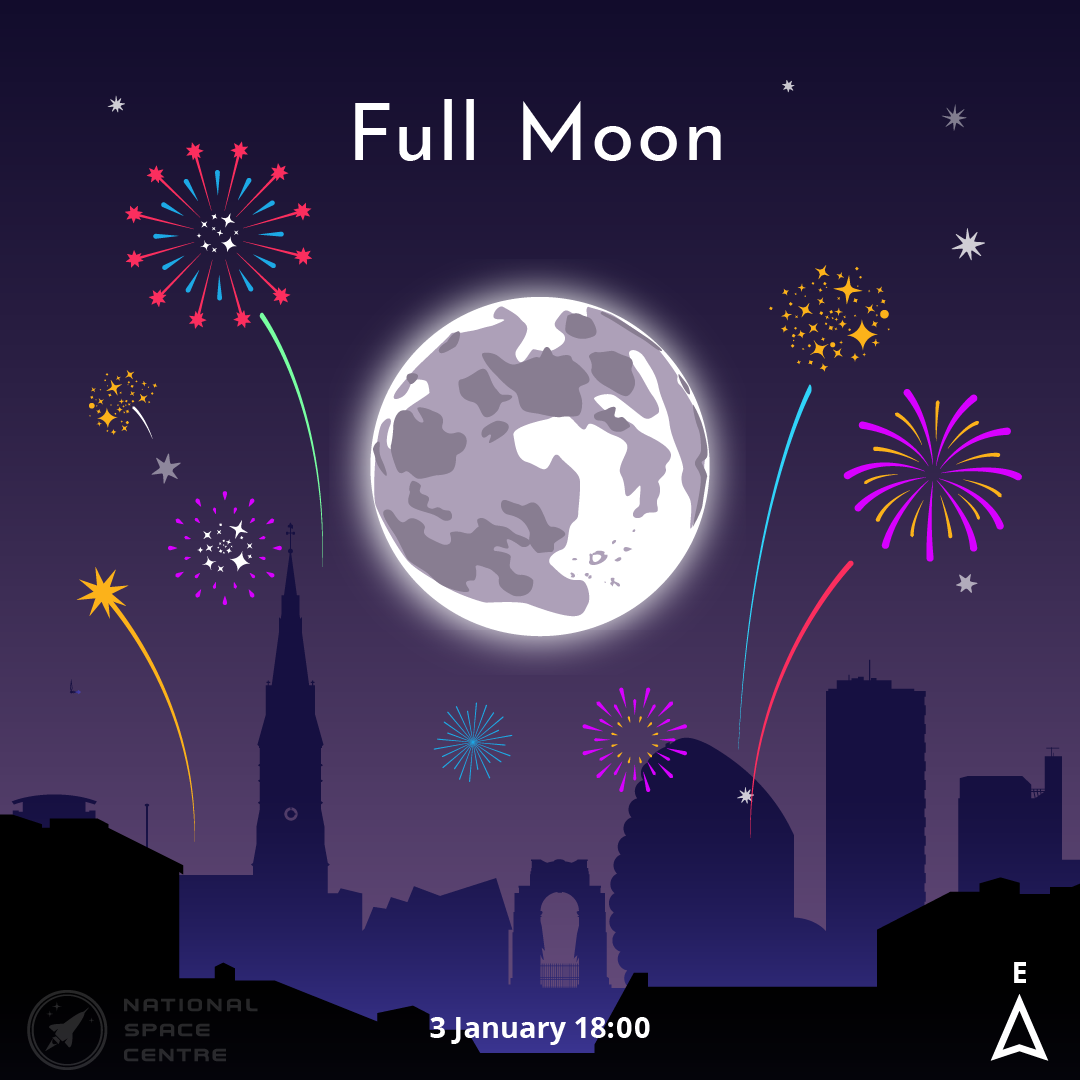
Can you spot the full moon on 3 January?
Rising in the east just as the Sun sets on 3 January, see if you can observe the first full moon of 2026. Whilst it will be visible throughout the night (though will move further westwards as the evening progresses), look toward the east around 18:00 to catch it dominating the skyline at a reasonable hour.
You'll also find Jupiter sitting below the Moon - providing a great opportunity to locate the Solar System's largest planet more easily. Both will be visible to the naked eye, but a pair of binoculars or telescope could provide a more detailed view of these celestial objects.
Each month, the full moon is given a traditional name which reflects seasonal changes and agricultural cycles largely taken from Native American, Colonial American, and European cultures. The January full moon is often called the Wolf Moon, named after the hungry wolves that could be heard howling in the dead of winter. You can find our full moon calendar and more information on native full moon names in our Full Moons and Full Facts blog.
Full moon FAQ - How long does a full moon phase actually last?
The Moon is only at full moon for a specific moment - when the Sun, Earth and Moon are perfectly lined up in space - what astronomers call 'syzygy'. For this month, it occurs at 10:02 on 3 January, but the Moon will always appear to be fully illuminated for a couple of days around the exact moment of its full moon phase.
Challenge 3 - Quadrantids
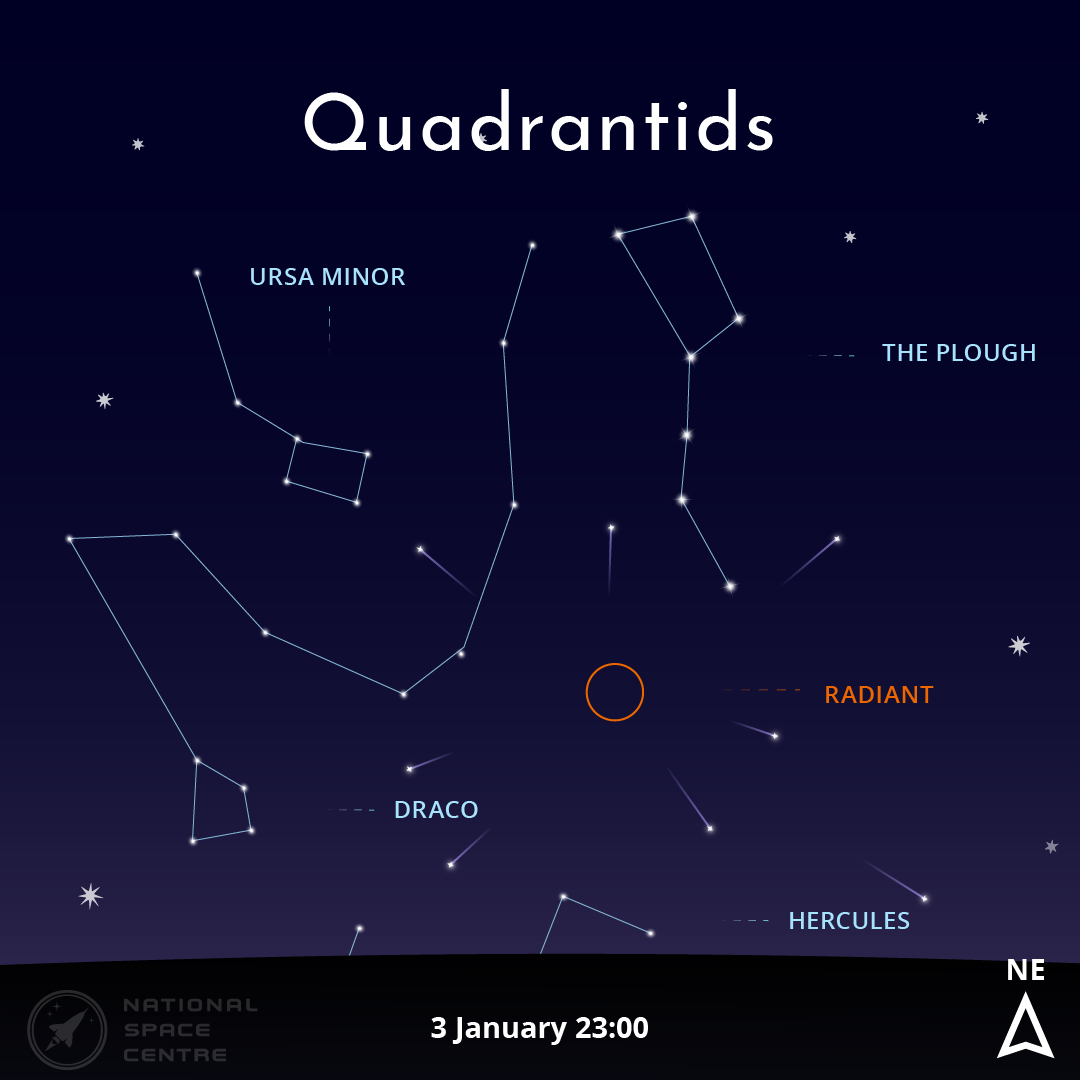
On 3-4 January, are you able to catch the peak of the Quadrantid meteor shower?
Get dressed in your winter thermals and make your way outside on 3 January just before midnight to start spotting some meteors from the peak of the Quadrantids meteor shower. As one of the most prominent meteor displays of the year, with up to 80 meteors per hour in ideal conditions, you won't want to miss the opportunity to see this.
Most meteor showers are named after the constellation from which the meteors appear to radiate from. In the case of the Quadrantids - that's Quadrans Muralis, which is now a defunct constellation. The meteors will appear to streak across the sky from a point that lies in an area bordered by three other constellations: Ursa Major (specifically, near the handle of The Plough asterism), Draco and Hercules.
You want to face towards the radiant in the northeast but be sure to look all over the sky to try and catch the fast-moving shooting stars. There's no need for binoculars or telescopes as they'll limit your overall view of the sky, just keep your eyes peeled - blink and you could miss it! Be patient though, as they won't appear predictably - sometimes you may see a few within a matter of minutes and then nothing for some time. Spending a few hours meteor-hunting around and after midnight is recommended.
Find out more about how to best plan a meteor-gazing evening in our blog: Quadrantids Meteor Shower, and learn why meteor showers like this occur annually, like clockwork!
Challenge 4 - Moon and Saturn
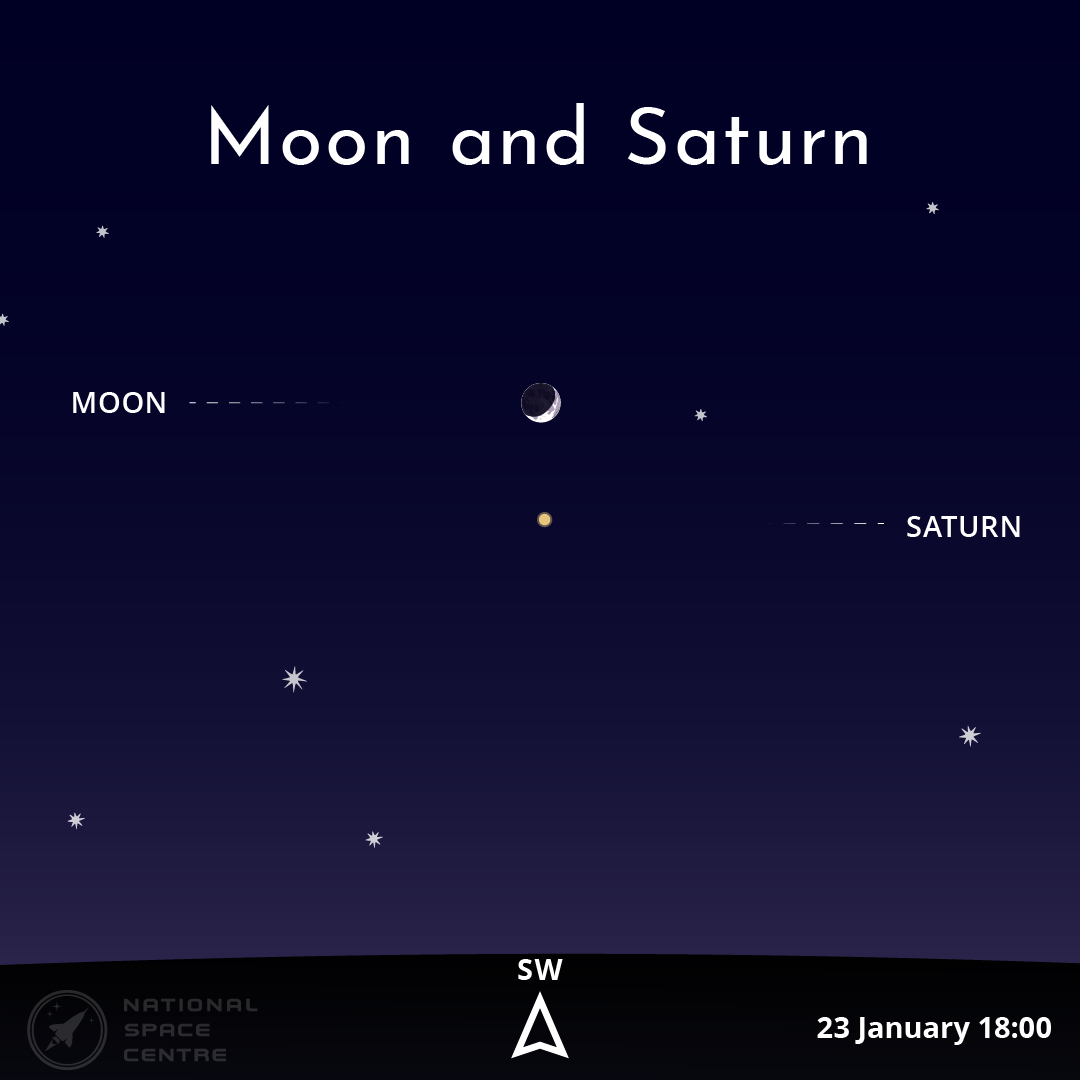
Can you find the Moon beside Saturn on 23 January?
On the evening of 23 January, around 18:00, look towards the southwest to spot the waxing crescent moon sitting above Saturn. You'll be able to see both with just your eyes and they'll move westwards as the night unfolds - setting in the west by 21:00, so be sure to head out before then.
The mature crescent phase of the Moon is a great time to direct your binoculars or telescope towards it. The boundary between the dark and illuminated sides, known as the terminator' makes the craters along this region appear more three-dimensional, as the shadows cast from the crater walls add more depth.
Saturn is also a great target in even a moderate telescope. Famed for it's rings, at the moment they're not clearly visible. Due to Saturn's axial tilt combined with its orbital motion, every 13-15 years it goes through ring plane crossing - where the rings appear edge-on from Earth. Over the next several years the rings will gradually become more face-on. It's still worth a look now though - there's nothing like spotting the planet with its rings even if they look thin!
And if you fancy a challenge, Neptune will be lying almost equidistant between the Moon and Saturn though will not be visible to the naked eye - you'll need a telescope. Darker skies would aid your viewing and using a star app will likely help you find our most distant planet some 4.5 billion kilometres away from Earth!
How did you get on? Were you able to spot our stargazing highlights this month?
If you enjoyed putting your stargazing skills to the test, then keep a look out for the astronomy challenges we'll be sharing each month. And don't forget to share your photos with us using #NSCstargazers
And find out what else you can see this month with our 'What's in the Night Sky' video.
Full references / credits:
(Banner) Skyscape. Credit: © National Space Centre
(1) Winter Triangle. Credit: © National Space Centre
(2) Full Moon on 3 January. Credit: © National Space Centre
(3) Quadrantids on 3 January. Credit: © National Space Centre
(4) Moon and Saturn on 23 January. Credit: © National Space Centre
