

Stargazing Challenges - July 2026
- 16th Jun 2026
- Author: Vir Limbachia (edited by Dhara Patel)
This July, see if you can find our star pattern of the month - the Summer Triangle asterism, look for the Moon beside the bright star Antares, and catch the full moon towards the end of the month.
Each month we share a handful of stargazing challenges for you to try your hand at. Let us know how you get on.
Challenge 1 - Summer Triangle
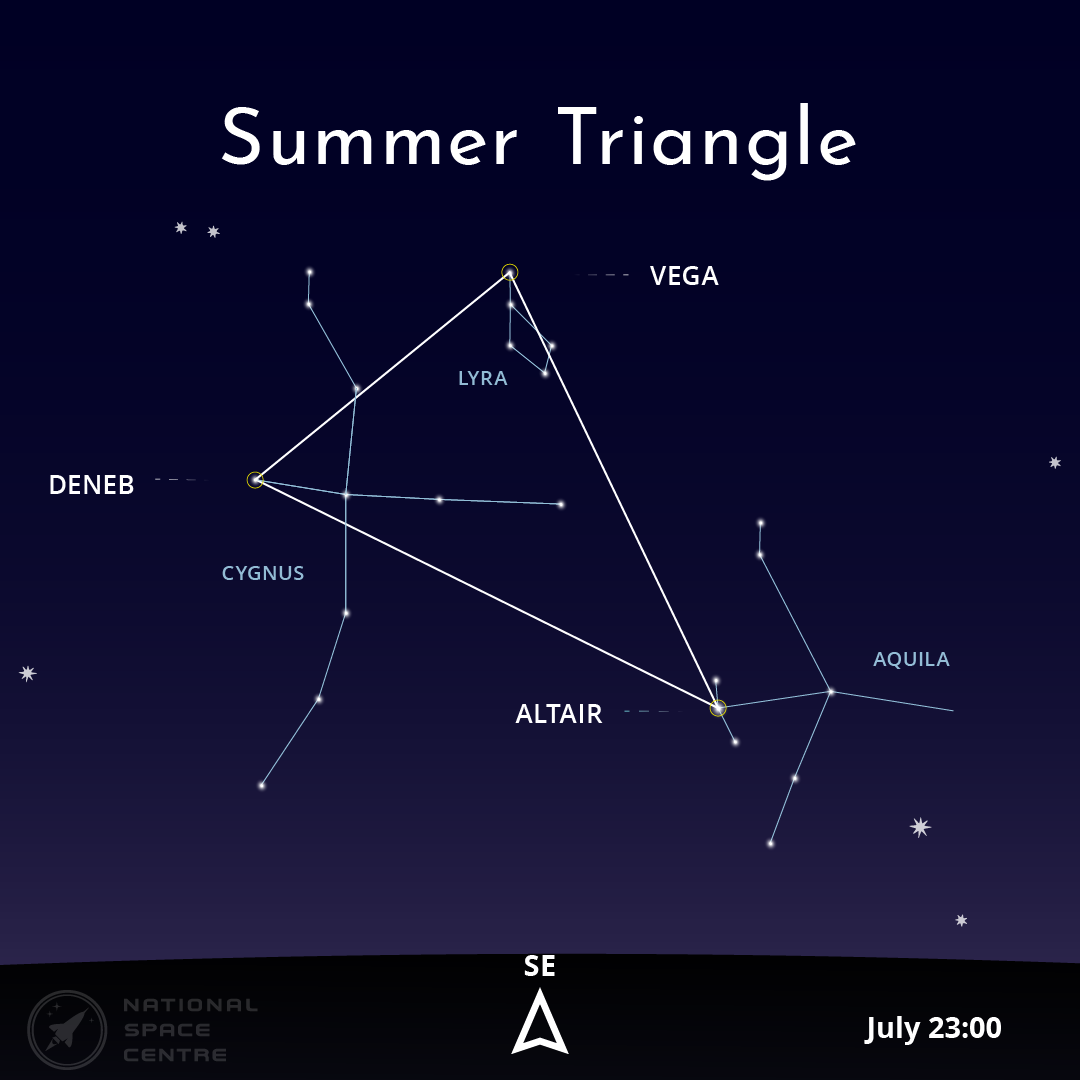
Throughout July - can you find the Summer Triangle asterism?
Being a very visible star pattern seen in the sky, the summer triangle is made from three bright stars: Deneb, Vega and Altair. They span from the three constellations: Cygnus the swan, Lyra the lyre (a musical instrument) and Aquila the eagle. These stars create a large triangular shape stretching from the tail of the swan, across the top of the lyre, and down to the neck of the eagle.
If you look out to the south east with a clear sky (around 23:00 for the best view) you will be able to see the stars making an isosceles triangle shape, with Vega sitting as the highest star in the sky out of the three.
Deneb is actually the brightest star in the constellation of Cygnus and sits as the nineteenth brightest star in the sky. It sits at the left-most vertex or corner of the triangle and is a blue-white supergiant star that is thousands of times more luminous (brighter) than the Sun. It’s about 2,600 light years away and is nearing the end of its life as a massive star. It's expected to eventually explode as a supernova, but don’t worry, this is not expected to happen for a very long time.
Vega is another massive star which bigger and brighter than the Sun and also the brightest of this trio of stars. A fun fact about this star is that astronomers have also discovered a large disc of dust surrounding it which could imply that planets may have formed or could be still forming around it!
The final star Altair rotates rapidly, taking about 9 hours to complete one revolution. This speed makes the star stretch out on its equator and flatten at its poles - so it's bulging out at its centre!
Challenge 2 - Moon and Antares
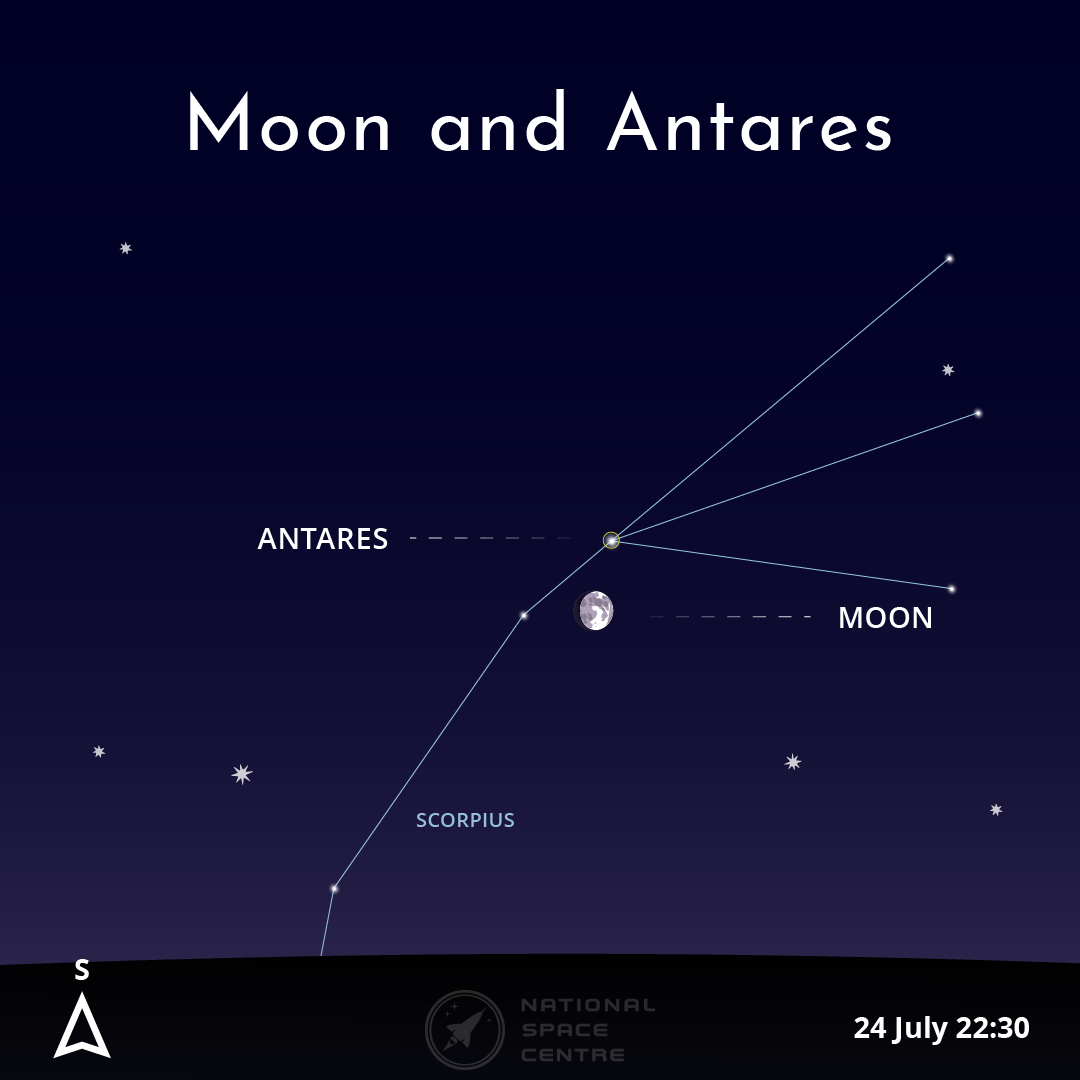
Can you catch the Moon below the star Antares on 24 July?
Look to the south around 22:30 on 24 July and you will see the waxing gibbous moon situated under a bright red star called Antares, part of the constellation of Scorpius, which will all be visible to the naked eye. Our lunar neighbour will rise above the southeastern horizon shortly after 18:00 but, in the daytime sky, Antares won't yet be visible. You'll want to wait until the skies darken to catch the pair before they set at set around 30 minutes past midnight.
The gibbous phase of the Moon is a great time to look for some features on its surface. The line between the light and shadowed parts of the surface is called 'the terminator' and looking towards this can help highlight mountain ranges and craters with intense shadows. When you look up, some of the easiest features to spot on the Moon’s surface include the dark volcanic plains known as the Maria, as well as large craters such as Tycho and Copernicus. While the moon can be visible with the naked eye, a pair of 10x50 binoculars will reveal many craters and other surface features. Telescopes are a great way of seeing the Moon in further detail if you have one to hand.
Antares is a massive supergiant star and is often called the “Heart of the Scorpion” and because of its striking red colour, it's a favourite target for stargazers especially in the summer months when it's visible at a decent hour. It is also one of the brightest stars in the sky and is expected to explode as a supernova millions of years in the future as it nears the end of its life.
Challenge 3 - Full moon
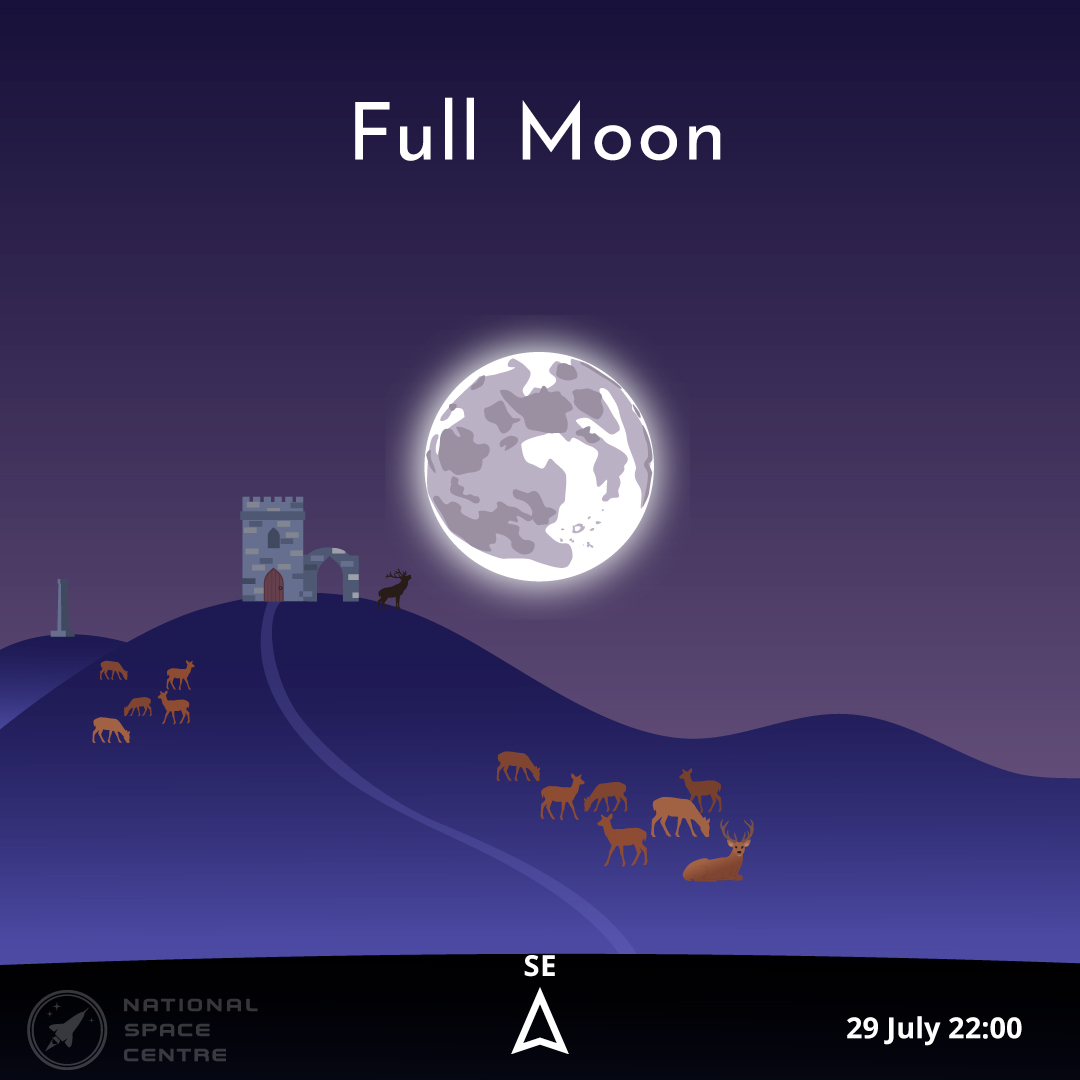
Can you spot the full moon on 29 July?
Look to the southeast from around 22:00 to spot July's full moon against a darker sky. During the full moon, our natural satellite is positioned on the opposite side of the Earth to the Sun so its face is fully illuminated by sunlight. The Moon will rise earlier that evening over the southeastern horizon and will move westwards throughout the night, setting in the southwest the following morning as the Sun rises - so you'll be able to observe it all night long.
Each month, the full moon is given a traditional name which reflects agricultural and seasonal changes. These are taken from native, colonial American and European cultures.This month’s full moon is called the Buck moon as it is when bucks' (male deer) antlers are in their rapid growth stage. During the cold winter months, they usually shed their antlers and start regrowing them in the late spring and early summer. You can find our full moon calendar and more information on native full moon names in our Full Moons and Full Facts blog.
Full moon FAQ - How does the Moon effect Earth’s tides?
The Moon plays a crucial role in the formation of the Earth’s tides. The way it works is that the Moon's gravity pulls on Earth’s oceans, causing the water to slightly bulge on the side of earth facing the Moon. And because the Moon's gravity pulls the solid Earth slightly more than the ocean water furthest from it, a a second bulge forms on the opposite side of the Earth too - creating what we know as high tides. However, the Sun also influences the tides with its gravitational pull, and when the Earth, Moon and Sun are aligned during a full or new moon, the tides are stronger and are known as spring tides.
How did you get on? Were you able to spot our stargazing highlights this month?
If you enjoyed putting your stargazing skills to the test, then keep a look out for the astronomy challenges we'll be sharing each month. And don't forget to share your photos with us using #NSCstargazers
And find out what else you can see this month with our 'What's in the Night Sky' video.
Full references / credits:
(Banner) Skyscape. Credit: © National Space Centre
(1) Summer Triangle. Credit: © National Space Centre
(2) Moon and Antares on 24 July. Credit: © National Space Centre
(3) Full Moon on 29 July. Credit: © National Space Centre
