

Stargazing Challenges - June 2026
- 18th May 2026
- Author: Dhara Patel
This June, see if you can find our star pattern of the month - the Northern Cross asterism, catch the Moon beside Venus, Jupiter and Mercury, and spot the full moon at the end of the month.
Each month we share a handful of stargazing challenges for you to try your hand at. Let us know how you get on.
Challenge 1 - Northern Cross
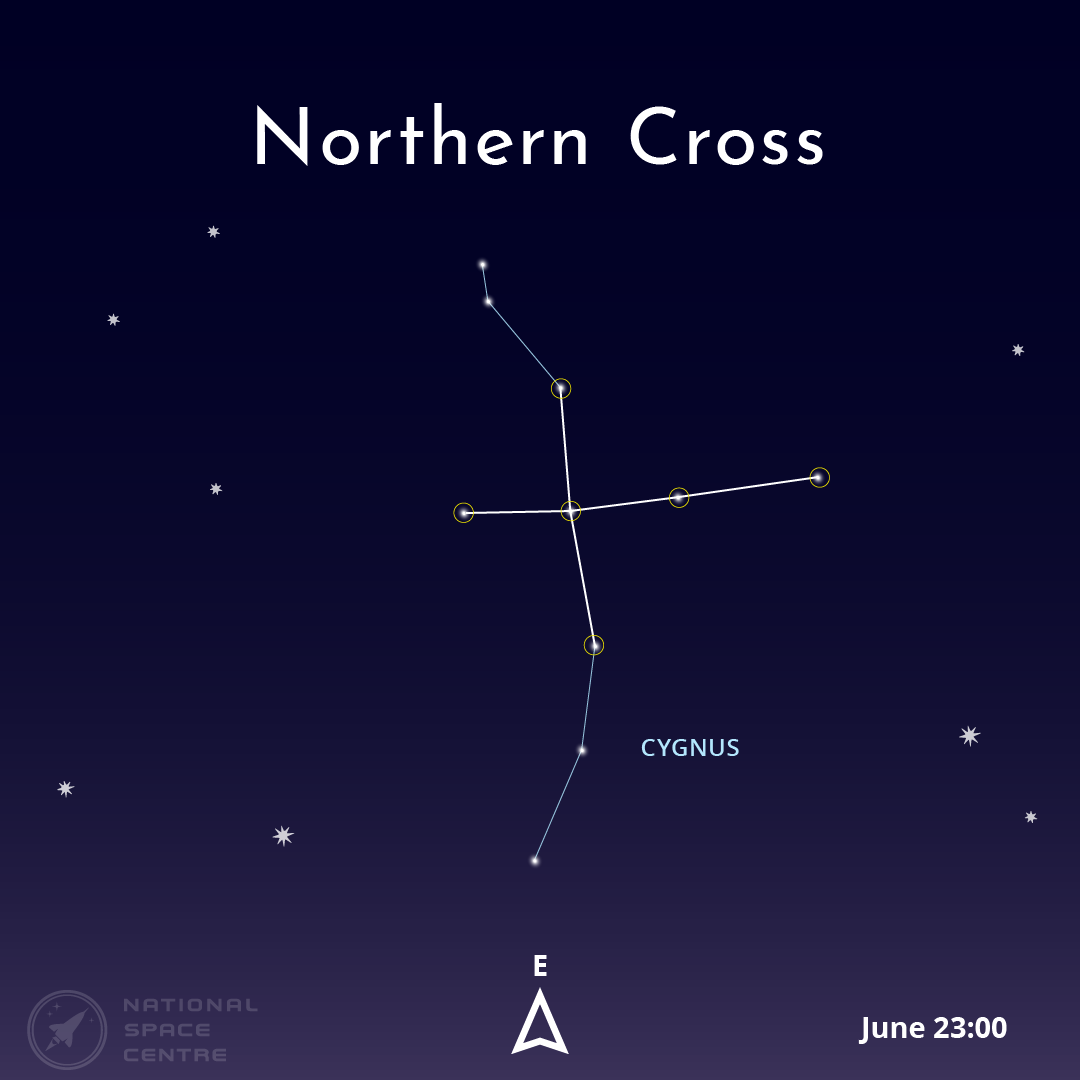
Throughout June - can you find the Northern Cross asterism?
Making up a smaller but perhaps more prominent part of the constellation of Cygnus the Swan, the Northern Cross is a prominent asterism visible throughout the summer and autumn months. With the length representing the beak through to the tail end of the swan and the shorter 'crossbar' marking the outstretched wings, this iconic star pattern visible in the northern hemisphere is a reliable seasonal guide for stargazers.
Throughout June, face towards the east around 23:00 and look for the six bright stars that make up this cross-shaped asterism. Visible to the naked eye, even in moderately light-polluted areas, Deneb will be the brightest star positioned on the far left. Hopping horizontally to the right, you'll then spot Sadir (the central star), with the wing stars Fawaris (above) and Aljanah (below). And continuing to the right from Sadir is Delta Cygni and finally Albireo which marks the beak of the swan.
Deneb also forms part of the Summer Triangle asterism (coming up next month), so it's worth using June to become an expert at locating it.
Albireo is another star worth getting familiar with. Although Albireo looks like a single star to the naked eye, a standard pair of (10x50) binoculars will be able to help you see that it's actually a double star - with beautiful contrasting golden and sapphire-blue colours. Even though they appear close together in the sky, these two stars are actually separated by vast cosmic distances.
Challenge 2 - Moon, Venus, Jupiter and Mercury
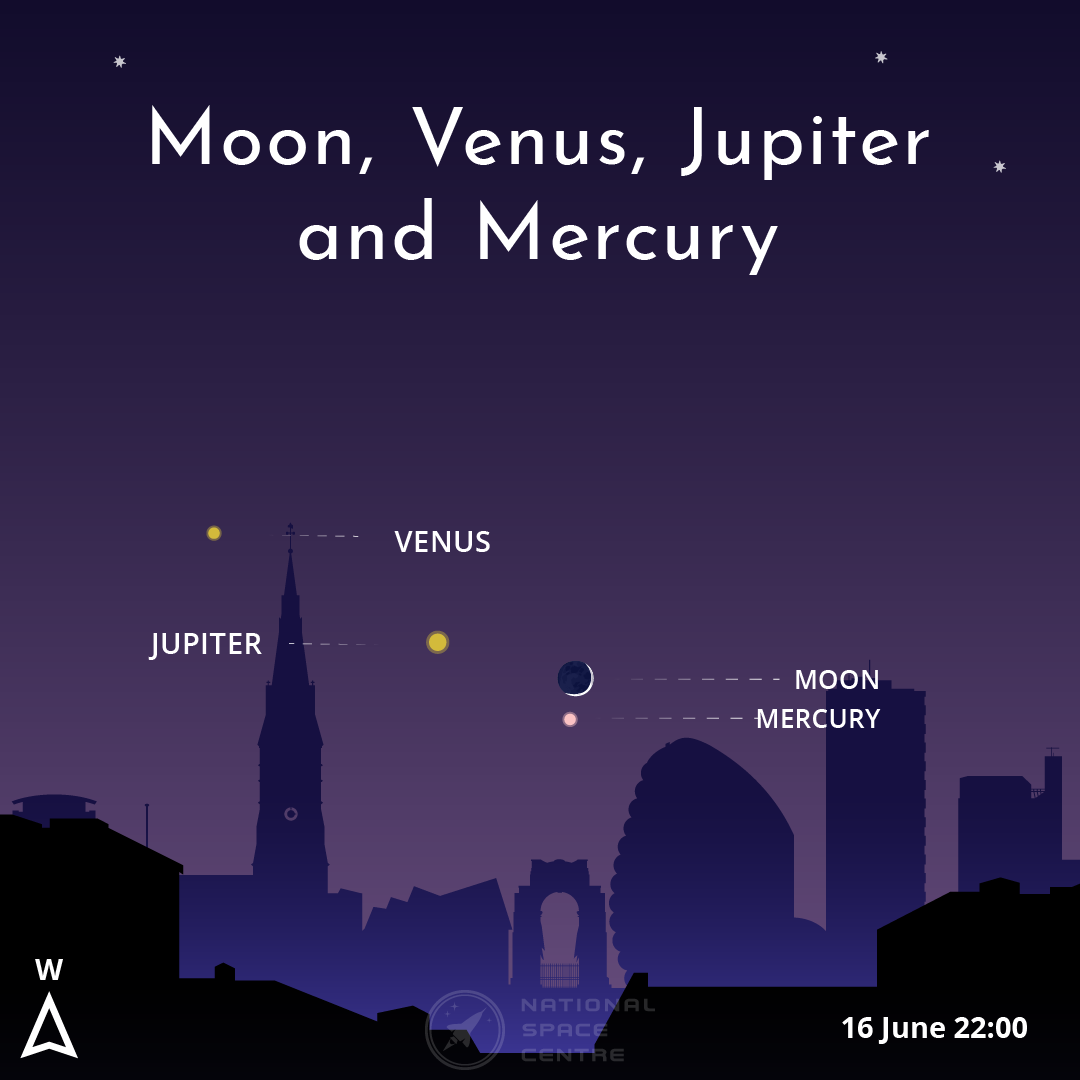
Can you catch the Moon beside Venus, Jupiter and Mercury on 16 June?
Try spotting the thin waxing crescent moon as the Sun sets on the evening of 16 June beside three planets - Venus, Jupiter and Mercury. Look towards the west around 22:00 to locate Mercury appearing as a faint star-like point beneath the Moon, Jupiter a little further to the left of the Moon, and Venus even further left and slightly higher up - all visible to the naked eye. As they'll be very low on the horizon, you'll need good, clear views without tall trees and buildings that may block your view. And be sure to head out in good time, as they'll begin setting around 23:00 so you won't be able to catch them for long.
Venus is stunning to observe and often appears as one of the first bright points of light as the Sun sets, but it's a hellish world. With more than 1,600 major volcanoes, this planet is incredibly active volcanically, and due to its thick atmosphere of heat-trapping carbon dioxide, it boasts temperatures of 462 degrees Celsius - hot enough to melt lead!
Jupiter also appears brightly - as the largest planet, it's able to reflect enough sunlight to make it appear prominently in the night sky. It was the first planet to be observed with a telescope (by Galileo Galilei in 1610) and if you have a good pair of binoculars or a telescope to hand, you may be able to spot its four largest moons appearing beside it as faint dots - just as Galileo did.
Mercury is generally difficult to spot as it usually appears very close to the Sun in the sky, owing to the fact that it's the planet that orbits our star the closest. Despite daytime temperatures exceeding 400 degrees Celsius, Mercury has ice locked inside the deep craters at its north and south poles.
Challenge 3 - Full moon
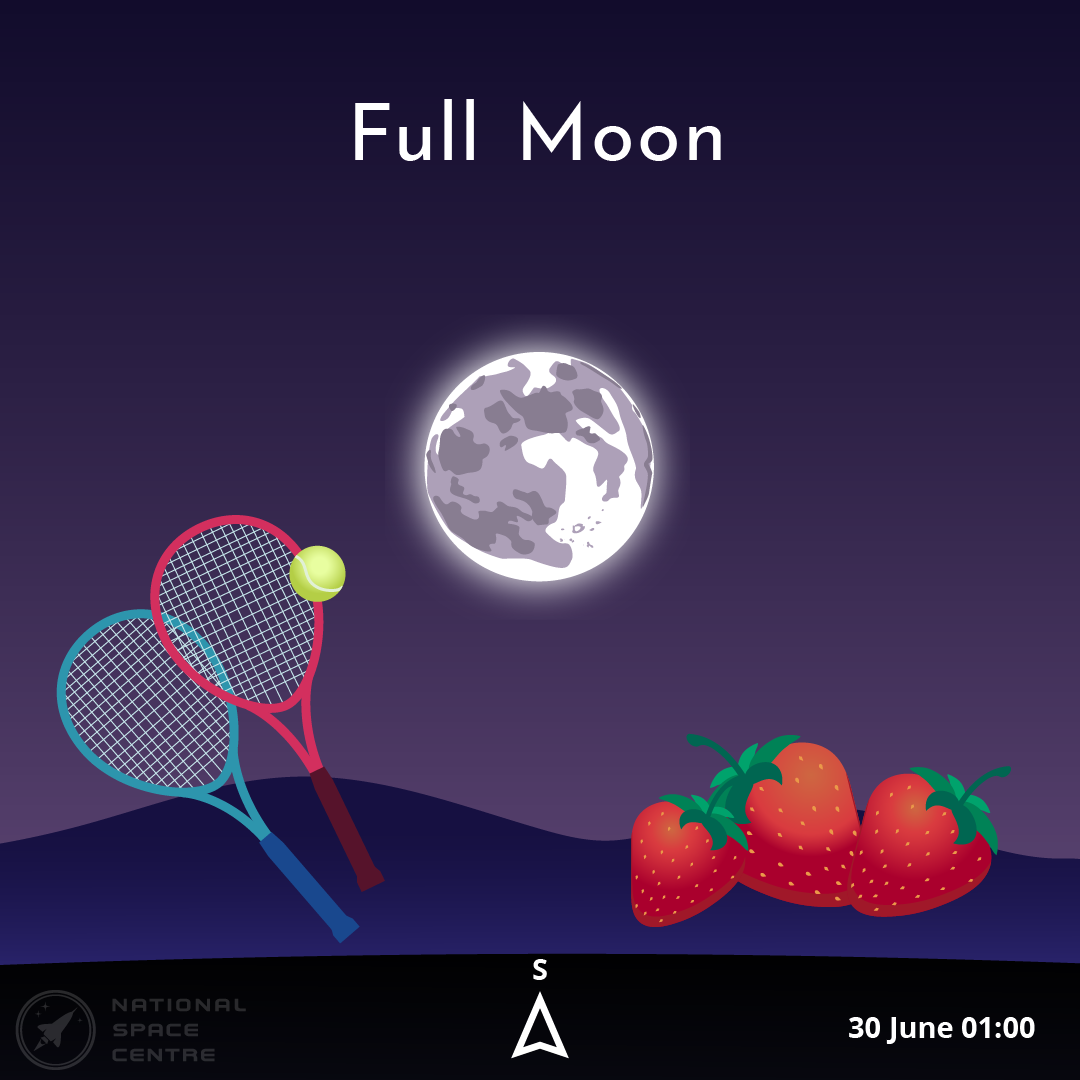
Can you spot the full moon on 30 June?
Look to the south during the hours after midnight on 30 June to try and spot the full moon (which will also be a micromoon). At full moon, our lunar neighbour is positioned on the opposite side of the Earth compared to the Sun and its face is fully lit up. While the full moon occurs at around 01:00 on 30 June, it will actually rise as the Sun sets the previous evening and will be visible throughout the night until sunrise. So if you're not a night owl, you can catch it during the evening of 29 June further towards the southeast.
Each month, the full moon is given a traditional name which reflects seasonal changes and agricultural cycles largely taken from Native American, Colonial American, and European cultures. The June full moon is often called the Strawberry Moon. It is named to mark when it was favourable to start harvesting strawberries. You can find our full moon calendar and more information on native full moon names in our Full Moons and Full Facts blog.
Full moon FAQ - What is a supermoon and micromoon?
The Moon's orbit around the Earth isn't a perfect circle - its elliptical orbit means that it is sometimes a bit closer and at other times a little further away from Earth. And this orbit 'precesses' or rotates slowly which means the Moon isn't always at its closest at the same point in its orbit each month. But when the Moon is at its closest and this coincides with a full moon - we get a supermoon (which appears slightly bigger and brighter to us) and when the Moon happens to be at its furthest distance and in its full phase, we get a micromoon.
How did you get on? Were you able to spot our stargazing highlights this month?
If you enjoyed putting your stargazing skills to the test, then keep a look out for the astronomy challenges we'll be sharing each month. And don't forget to share your photos with us using #NSCstargazers
And find out what else you can see this month with our 'What's in the Night Sky' video.
Full references / credits:
(Banner) Skyscape. Credit: © National Space Centre
(1) Northern Cross. Credit: © National Space Centre
(2) Moon, Venus, Jupiter and Mercury on 16 June. Credit: © National Space Centre
(3) Full Moon on 30 June. Credit: © National Space Centre
