

Stargazing Challenges - March 2026
- 16th Feb 2026
- Author: Dhara Patel
Each month, we'll be sharing a handful of stargazing challenges for you to try your hand at.
This March, see if you can locate our star pattern of the month - the Sickle asterism, have a go at finding the Moon beside the star Regulus in the constellation of Leo, and try looking for the full moon.
Challenge 1 - The Sickle
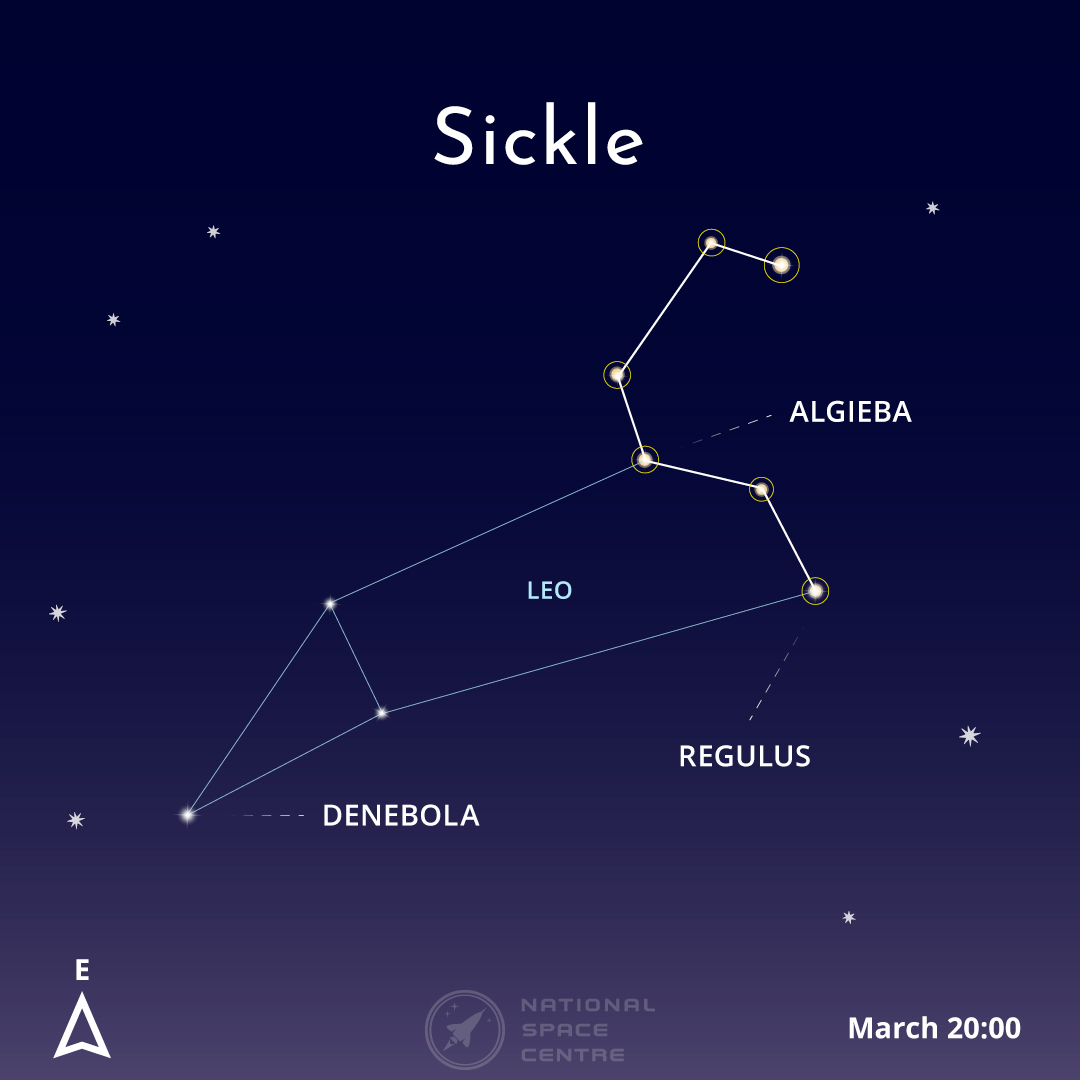
Throughout March - can you find the Sickle asterism?
As we head into spring, a prominent constellation that will take to the stage in the theatre of the sky is Leo. To find it, look to the east around 20:00 to spot the reverse question mark shape of stars that make up the Sickle asterism within the larger constellation of the Lion. Observable throughout the month, this familiar star pattern makes up the head and shoulders of the beast.
Made up of six stars, Regulus marks the base of the Sickle and is often described as the lion's heart! And Algieba is a colourful double star representing the mane of the lion, though it's name stems from the Arabic word Al-jeb-bah which means the forehead. You might notice that many stars in the night sky begin with 'Al' meaning The. For example, Aldebaran in Taurus is 'The follower' chasing the Pleiades star cluster across the sky, and Altair in Aquila is 'The flyer' denoting the Eagle it depicts.
Algieba is a binary star - two stars that orbit each other around a common centre of gravity. As Algieba is 130 light years away, the two stars appear as a single point of light to our eyes, but if you have a large pair of binoculars held steady on a tripod, or a small telescope, it's possible to separate and see this double star as two separate and distinct points of light!
The Sickle also hosts the radiant or apparent origin point of meteors from the annual Leonid meteor shower that peaks in mid-November. While the rate is generally low, it can produce some high intensity displays every 33 years, so it's helpful to get familiar locating this asterism for later in the year.
Challenge 2 - Moon and Regulus
Can you catch the Moon beside the star Regulus on 2 March?
Perhaps you've made yourself familiar with the Sickle right at the beginning of the month but if not, use the night of 2 March to catch the Moon beside the star Regulus to work out where to find the Sickle during the rest of March. While the Moon orbits our planet every month so moves fairly quickly across the sky from night to night, the background of stars appear to move slower changing with the seasons across the length of a year.
Look to the east around 20:00 to spot the very plump waxing gibbous moon sitting below the brightest star in the constellation of Leo - Regulus. They will move westwards throughout the night and set in the west as the Sun rises the following morning, so the duo will be visible later in the night but they'll be well placed in the east at a reasonable evening hour to spot before bed!
Throughout the year, as the Earth orbits our star, the Sun traces out an imaginary circle across the sky known as the ecliptic and the zodiac constellations, like Leo, are centred along this path. From our position on Earth, the planets and Moon are always found along this part of the sky. So stars like Regulus, which lie close to the ecliptic, are 'frequently visited' by the Moon and planets.
To the naked eye, Regulus can be seen as a brilliant blue-white coloured star. What we don't see is that is spins very quickly, completing a full rotation in 16 hours. This rapid rotation causes the star to flatten out into an oblate shape instead of remaining as a sphere. Amazingly, this spin rate is about 96.5% of the speed that would be needed to tear the star apart - so it's just about holding itself together!

Challenge 3 - Full moon
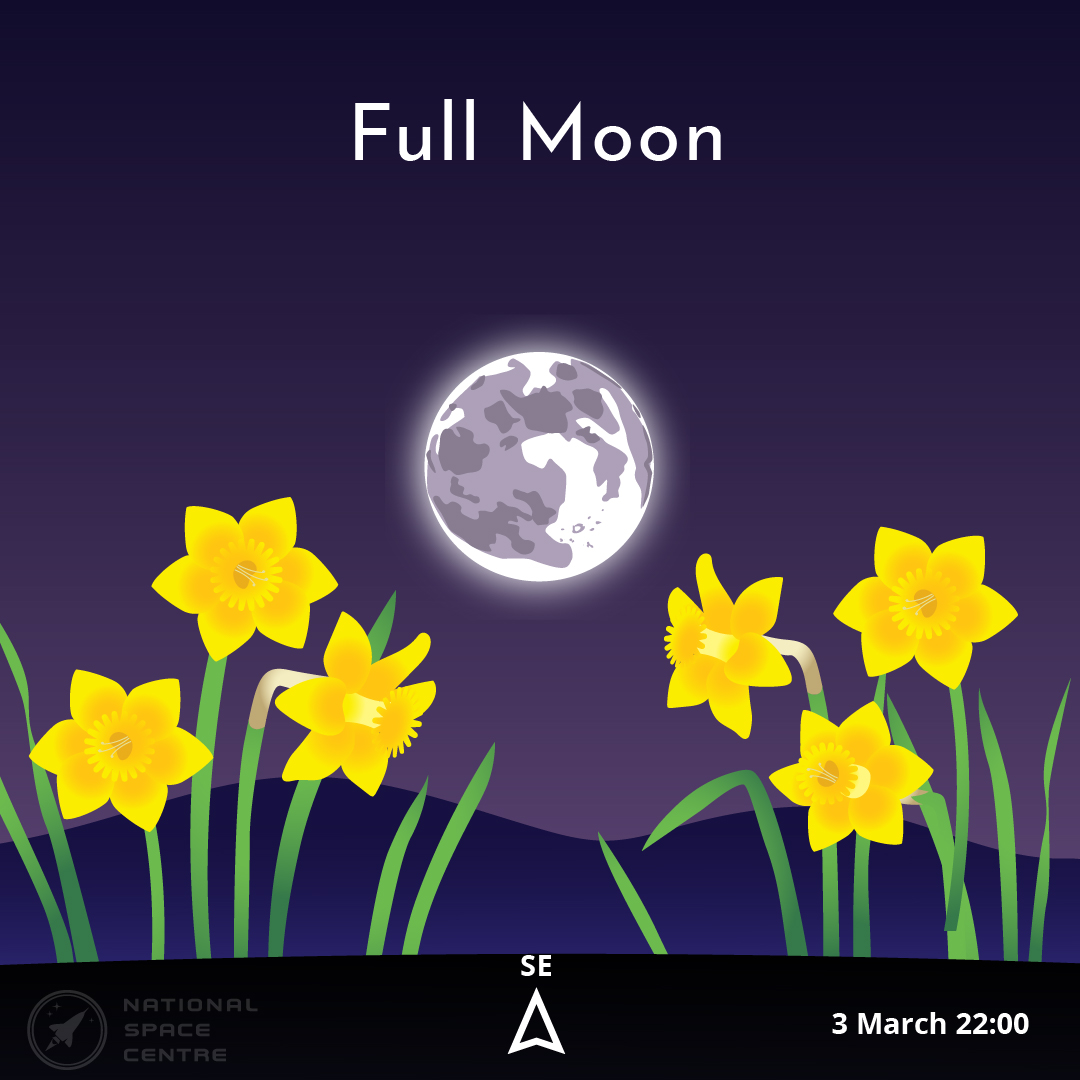
Can you spot the full moon on 3 March?
Fingers crossed for clear skies during the beginning of March as the Moon is busy putting on a few different performances. On 3 March, face towards the southeast to watch the full moon rising into the night sky. At full moon, our lunar neighbour is positioned on the opposite side of the Earth to the Sun, so it usually rises around sunset and sets as the Sun rises the following morning. This means the full moon is visible through the night but will drift westwards later into the evening.
Each month, the full moon is given a traditional name which reflects seasonal changes and agricultural cycles largely taken from Native American, Colonial American, and European cultures. The March full moon is often called the Worm Moon, named as such because as the cold thawed, people were able to see worm trails on the warming grounds. You can find our full moon calendar and more information on native full moon names in our Full Moons and Full Facts blog.
Full moon FAQ - Why does the full moon look huge on the horizon?
It's actually a moon illusion! The Moon doesn't change size and you can test this by holding up your little finger at arms length - the Moon will always be about the size of your fingernail. We still don't have a solid scientific explanation for it, but the best idea we have is that when our brain sees the Moon in the foreground of objects on the horizon like buildings, mountains or trees, it tricks us into thinking the Moon is actually closer and bigger than it is, compared to when we see it with nothing around higher up in the sky!
How did you get on? Were you able to spot our stargazing highlights this month?
If you enjoyed putting your stargazing skills to the test, then keep a look out for the astronomy challenges we'll be sharing each month. And don't forget to share your photos with us using #NSCstargazers
And find out what else you can see this month with our 'What's in the Night Sky' video.
Full references / credits:
(Banner) Skyscape. Credit: © National Space Centre
(1) Sickle. Credit: © National Space Centre
(2) Moon and Regulus on 2 March. Credit: © National Space Centre
(3) Full Moon on 3 March. Credit: © National Space Centre
