

Stargazing Challenges - May 2026
- 19th Apr 2026
- Author: Dhara Patel
Each month, we'll be sharing a handful of stargazing challenges for you to try your hand at.
This May, see if you can spot the full moon at the start and end of the month, catch the peak of the Eta Aquariid meteor shower, find our star pattern of the month - The Plough asterism, and have a go at looking for the Moon beside Venus.
Challenge 1 - Full moon
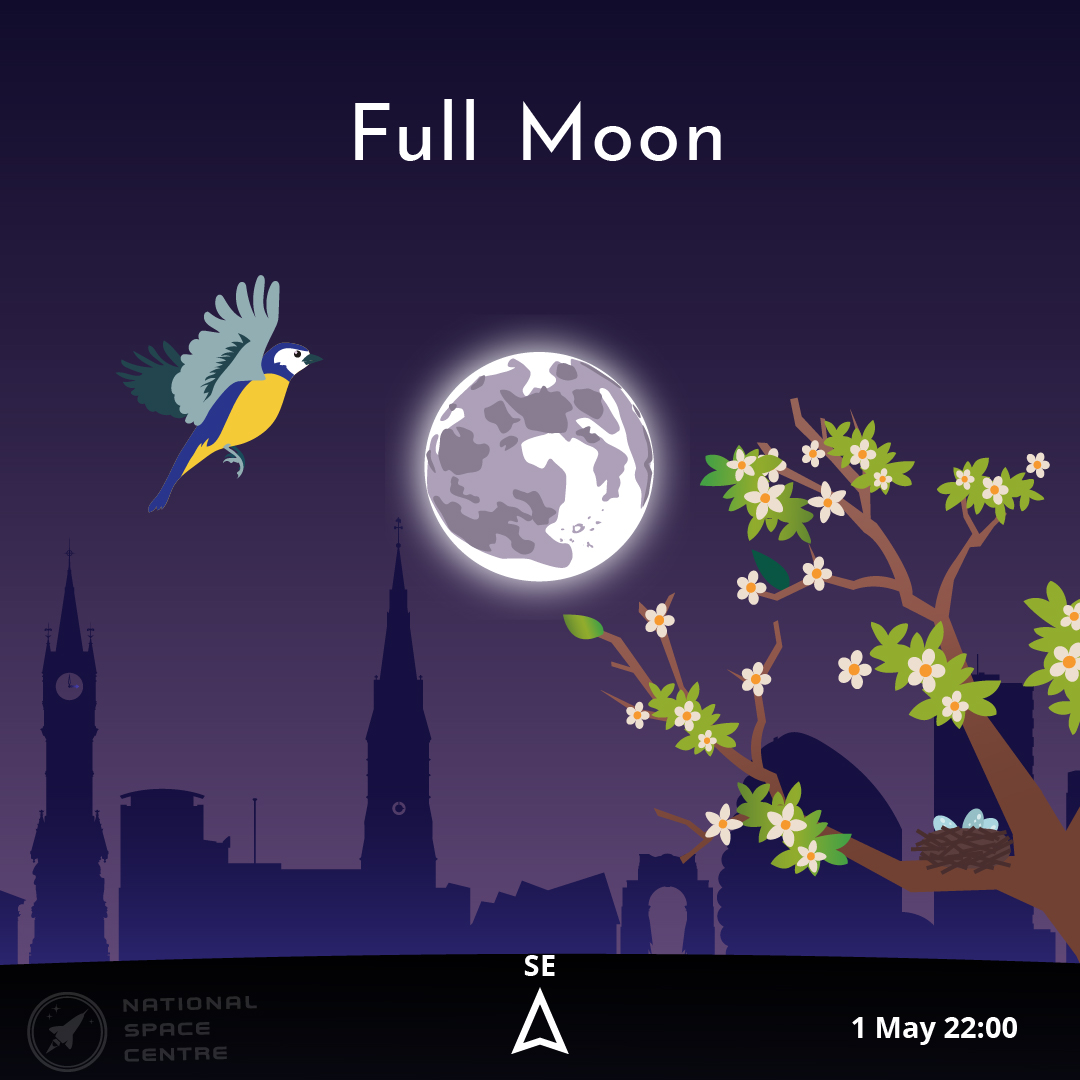
Can you spot the full moon on 1 May?
Look to the southeast around 22:00 on 1 May to try and spot the first full moon of the month. At full moon, our lunar neighbour is positioned on the opposite side of the Earth compared to the Sun which means that it rises as the Sun sets and is visible throughout the night until the Sun rises the following morning. This means it's possible to view the full moon throughout the night but at later hours you'll find it has moved further towards the western sky.
Each month, the full moon is given a traditional name which reflects seasonal changes and agricultural cycles largely taken from Native American, Colonial American, and European cultures. The May full moon is often called the Flower Moon. It is named to mark the point in the year that flowers bloomed again. You can find our full moon calendar and more information on native full moon names in our Full Moons and Full Facts blog.
Full moon FAQ - How is it possible for us to see 59% of the Moon's surface?
Because the Moon is tidally locked, the same side of the Moon is always facing towards our planet, so at any one point we see 50% of it's surface from our Earth-bound position. But due to the Moon's elliptical orbit, axial tilt and the Earth's rotation, the Moon appears to 'wobble' and over an extended period and reveals glimpses of little rims of the far side from time to time. This means in total we're able to map out 59% of the Moon's surface without leaving the Earth!
Challenge 2 - Eta Aquariids
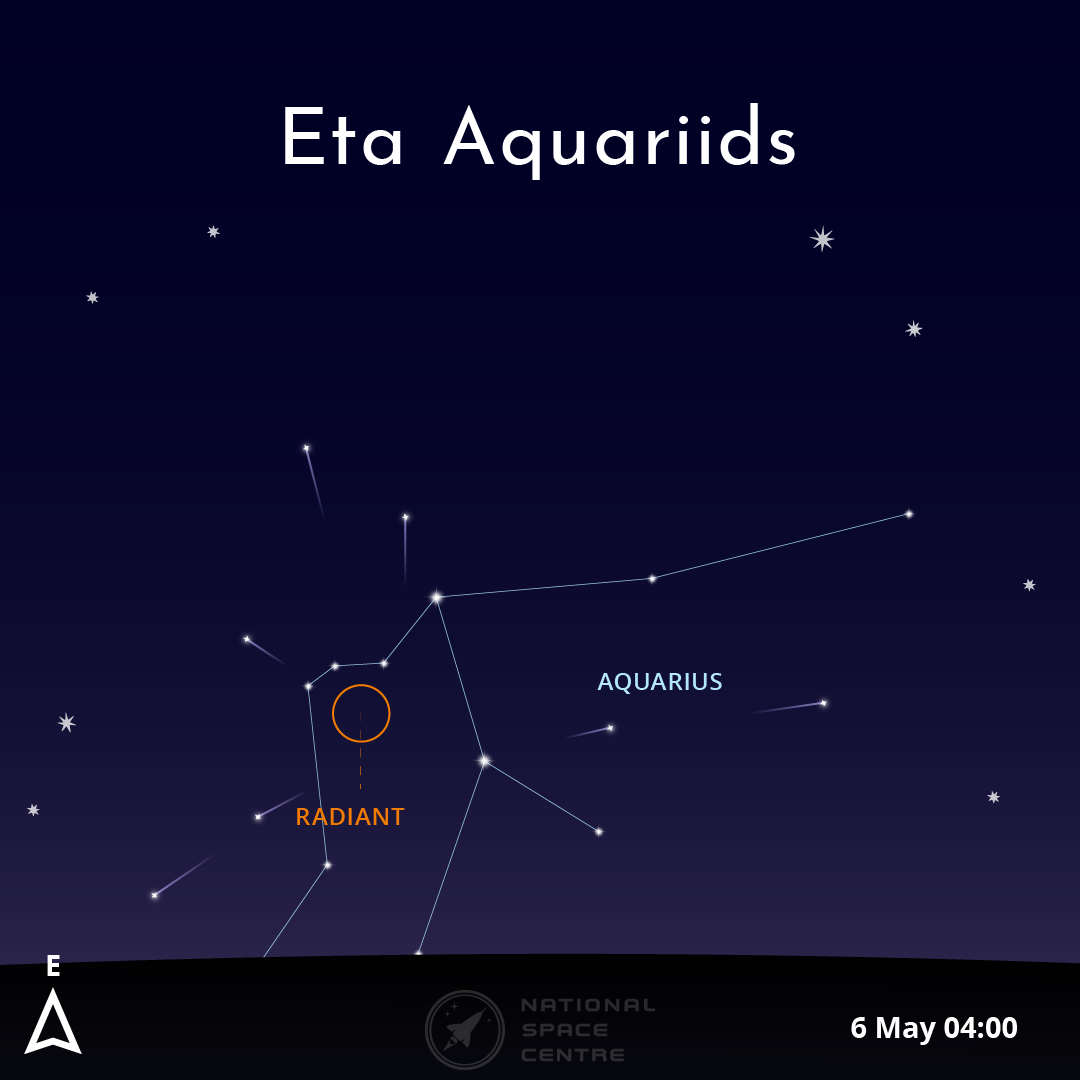
On 6 May, are you able to catch the peak of the Eta Aquariid meteor shower?
Head out after midnight on 6 May to begin spotting some meteors from the peak of the Eat Aquariid meteor shower. While it's not a particularly active meteor display (10-20 meteors per hour in ideal conditions), it's still a great opportunity to observe a naked eye celestial event - just be sure to wrap up warm even though we're now well into spring.
Most meteor showers are named after the constellation or star from which the meteors appear to radiate from. In the case of the Eta Aquariids - that's the star Eta Aquarii in the constellation of Aquarius - depicted as the water-bearer. The meteors will appear to streak across the sky from this point.
Even though you'll want to be facing the radiant which will lie in the east, be sure to look all over the sky to try and catch the fast-moving shooting stars. There's no need for binoculars or telescopes as they'll limit your overall view of the sky, just keep your eyes peeled - blink and you could miss it! Most importantly - be patient! Meteors don't appear predictably - sometimes you may see a few within a matter of minutes and then nothing for some time. Spending a few hours meteor-hunting around and after midnight is recommended.
Find out more in our blog: Eta Aquariid Meteor Shower including how to best plan a meteor-gazing evening and learn why meteor showers like this occur annually, like clockwork!
Challenge 3 - The Plough
Throughout May - can you find The Plough asterism?
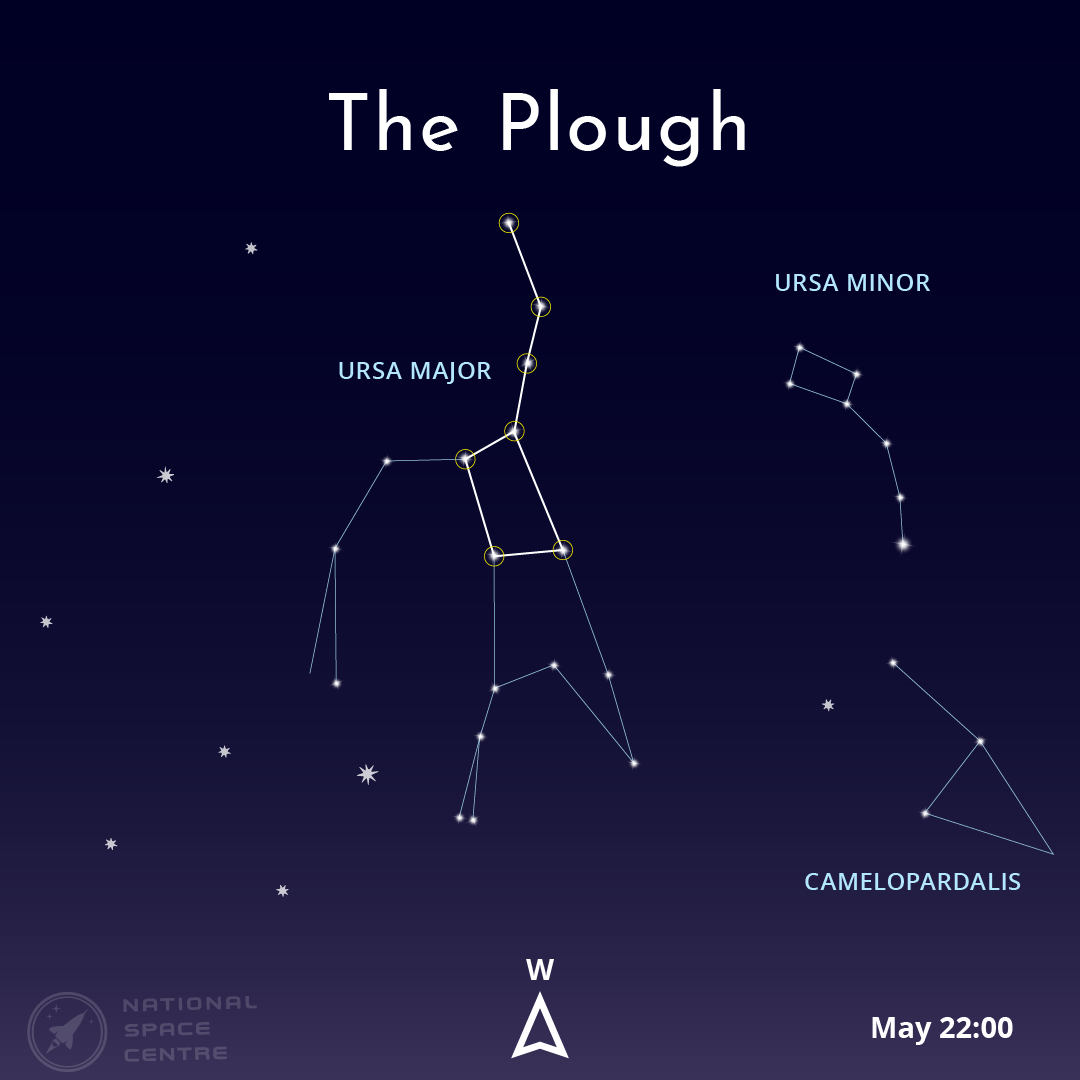
Arguably the most familiar pattern of stars visible in the Northern Hemisphere is the Plough asterism. It forms the hindquarters of the constellation of Ursa Major, the great bear. So while it's not a constellation itself, the Plough (also sometimes called the Big Dipper) is an easily recognisable pattern of stars and is visible all year round from the UK. During May, it appears almost directly overhead in the late evening making it effortless to spot.
Face westwards around 22:00 throughout May and look for seven (actually eight) stars arranged in an upside down kite shape or a saucepan on its side. The two stars along the bottom (Merak - left and Dubhe - right) are called the pointer stars, as a line extending from them points to the star at the tip of the constellation Ursa Minor - a star called Polaris (better known as the North star). A straight line down to the ground from Polaris gives you the direction of North - a useful stargazers tip!
This follows on from another star hopping trick mentioned in last months blog: Stargazing Challenges - April 2026 - there's an astronomer's saying that uses the handle of the Plough to find two other bright stars. Follow the arc of the handle to "Arc to Arcturus" - a star in the constellation of Bootes and from there "Speed on to Spica" - the brightest star in the constellation of Virgo.
The second star from the end of the handle of the saucepan is called Mizar which looks like a single star to the untrained eye but look carefully and you'll be able to see that it's actually two stars - the counterpart is called Alcor. Whilst the stars aren't physically located close together at the same distance, they appear to be from our line of sight and have historically been used to test for sharp vision!
Challenge 4 - Moon and Venus
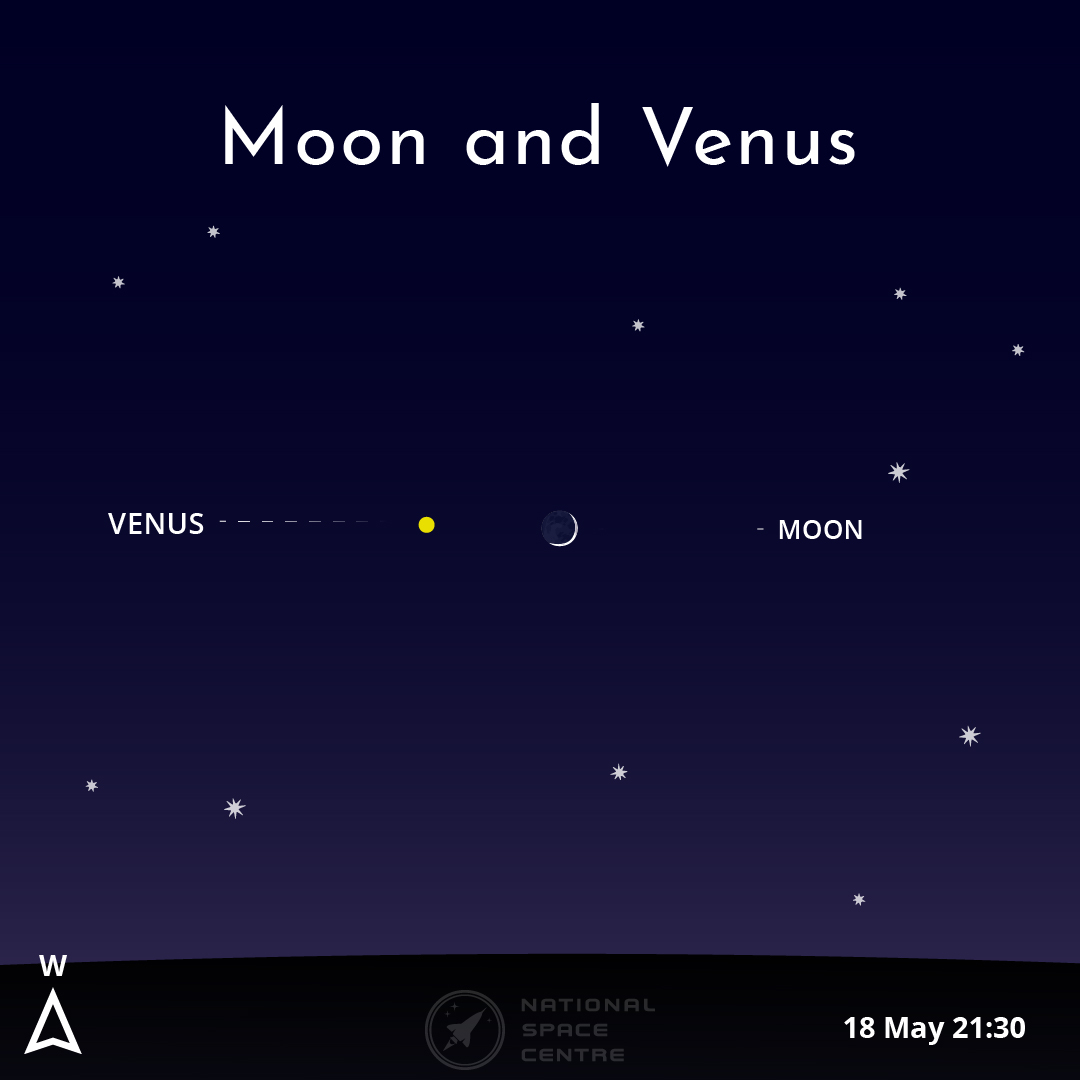
Can you catch the Moon beside Venus on 18 May?
Try spotting the brightest planet visible to the naked eye, Venus, beside the very thin waxing crescent moon on 18 May around 21:30 in the western sky. Venus will appear like a bright star like point sitting to the left of the Moon. You'll be able to see the duo together from just after sunset, but they'll be easier to spot as the sky darkens. That said, they'll also continue setting as the evening unfolds so they'll be fairly low down in the sky. Be sure to have a clear view of the west without obstructions to help you catch them!
Venus' thick atmosphere reflects sunlight very well making it appear easily visible with the naked eye from Earth. And due to it being one of the innermost planets to the Sun, it never appears too far from it. As such Venus is often referred to as the 'Morning star' or 'Evening star' depending on whether it's visible around dawn or dusk - it's usually one of first bright points to appear in the evening sky or the last the fade in the glare of the rising Sun.
Around the same time (21:30 ) from Leicester, the ISS - International Space Station will be travelling overhead. It will rise over the western horizon (further to the left of Venus and the Moon) and slowly arc over to the eastern sky where it will set several minutes later. Look out for a bright star-like point moving relatively quickly across the sky - the reflective solar arrays of the ISS make it visible to us! At 400km above our heads, the ISS is 1000 times closer than the Moon (roughly 400,000km away) and half a million times closer than Venus, which lies some 200 million km from Earth!
Challenge 5 - Full Moon
Can you catch the Blue Moon on 31 May?
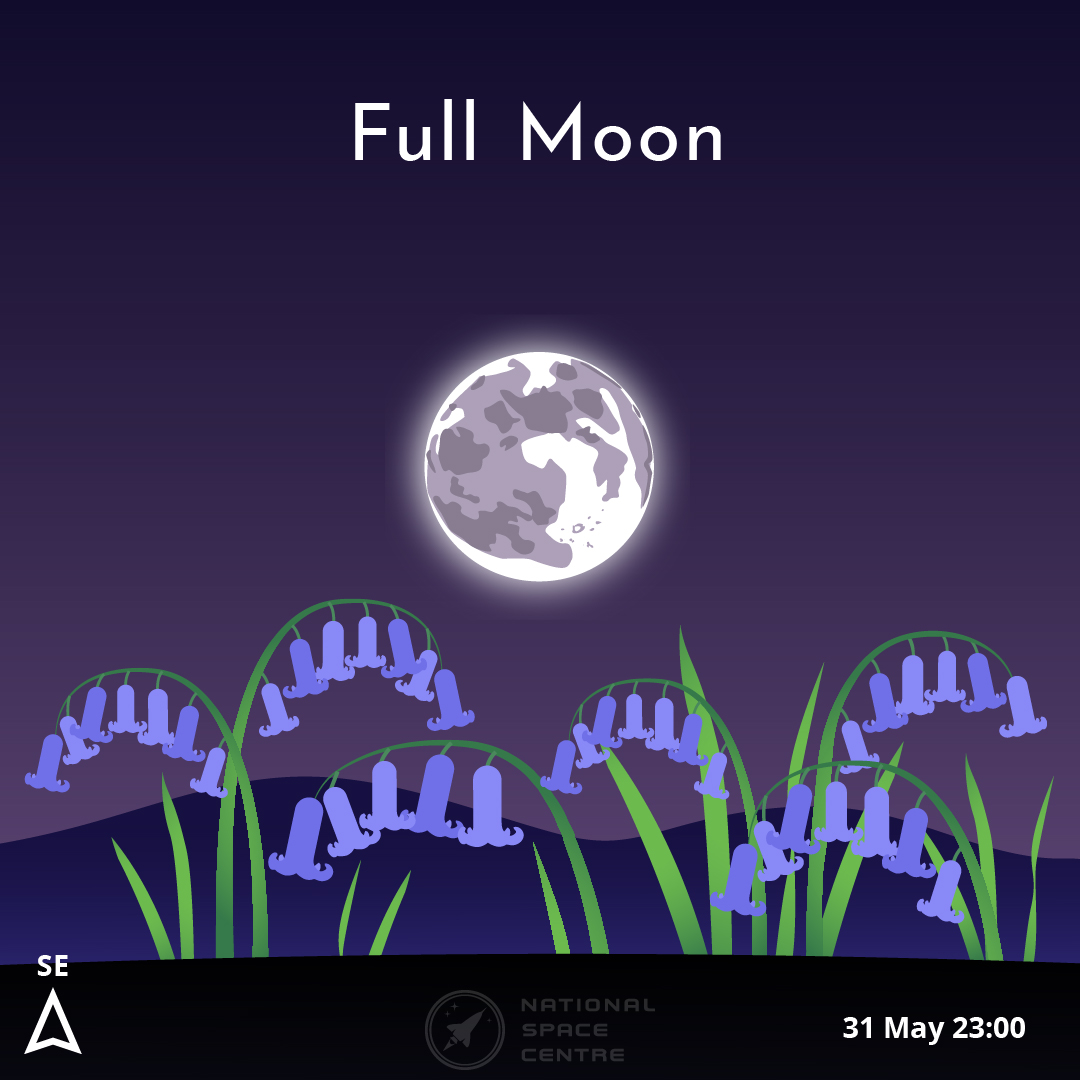
If you missed the full moon at the start of the month, you're in luck as May rounds off with a second full moon to look out for! Face towards the southeast around 23:00 on 31 May to catch the full moon as it begins to rise above the horizon. As the night unfolds and the Earth continues to spin on its axis, the Moon will appear to move further westwards where it will set as the Sun rises the following morning - so you'll have all night to try and spot it.
A blue moon is a relatively rare phenomenon and its name originates from a 16th-century phrase for something unusual "once in a blue moon", rather than it actually changing colour. Occurring once every two to three years, a blue moon is the second of two full moons in a single calendar month and this doesn't happy very often as the Moon takes 29.5 days to complete a lunar cycle. Usually there's only one full moon per month, but if a full moon falls at the start of a month, it is possible for the next one to fall at the end of the same month.
Full moon FAQ - Is the Moon ever really blue?
The Moon appears visible in shades of grey. Some areas on the Moon with higher concentrations of titanium-bearing minerals can appear bluer in enhanced images, but it's not perceptible to the naked eye. It's possible for the Moon to take on a blue-tint when dust or smoke particles (released from volcanoes or wildfires) act as a filter and scatter red light away, leaving blue light pass through. For example the sulphur dioxide and ash released into the air made the Moon appear bluer at night for around one year!
How did you get on? Were you able to spot our stargazing highlights this month?
If you enjoyed putting your stargazing skills to the test, then keep a look out for the astronomy challenges we'll be sharing each month. And don't forget to share your photos with us using #NSCstargazers
And find out what else you can see this month with our 'What's in the Night Sky' video.
Full references / credits:
(Banner) Skyscape. Credit: © National Space Centre
(1) Full Moon on 1 May. Credit: © National Space Centre
(2) Eta Aquariid meteor shower on 6 May. Credit: © National Space Centre
(3) The Plough. Credit: © National Space Centre
(4) Moon and Venus on 18 May. Credit: © National Space Centre
(5) Full Moon (blue moon) on 31 May. Credit: © National Space Centre
