

Stargazing Challenges - October 2026
- 17th Sep 2026
- Author: Ed Kellond-Turner
This October, see if you can find our star pattern of the month - the Keystone asterism, look for Mars near the Moon, and catch the full moon towards the end of the month.
Each month we share a handful of stargazing challenges for you to try your hand at. Let us know how you get on.
Challenge 1 - The Keystone Asterism
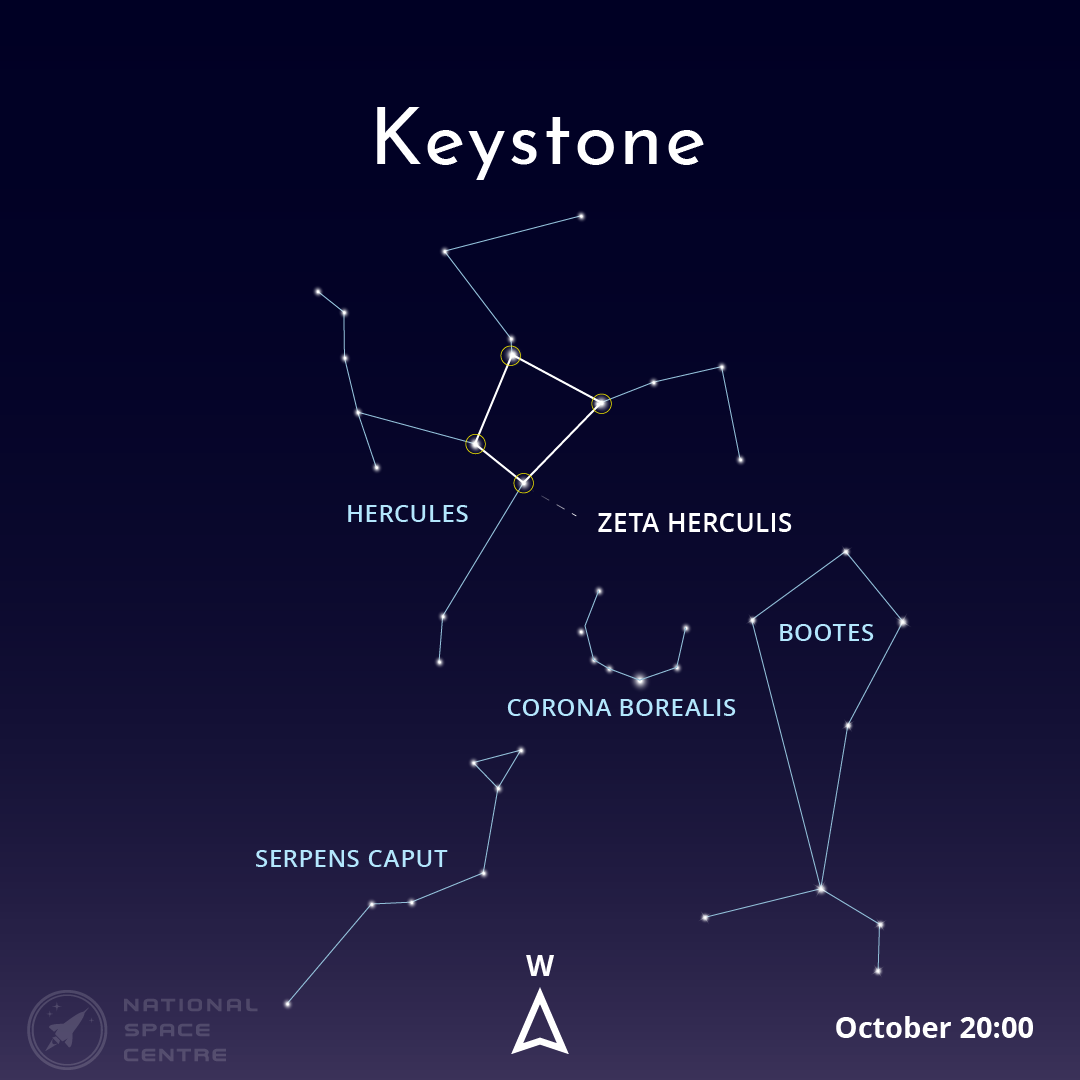
Whilst facing in a westerly direction, try looking for a familiar star pattern in the constellation of Hercules known as the Keystone asterism. It will be visible throughout October, but towards the end of the month it’ll appear closer to the horizon when viewing at the same time.
Hercules is the Roman name for the Greek demigod Heracles, famed for his mighty strength and courage. The constellation is best seen in the night sky between the spring and autumn in the UK and is the fifth largest of the 88 constellations identified by the International Astronomical Union (IAU). Hercules can quickly be recognised by spotting four stars in a lopsided square shape that make up the torso of the hero, known as the Keystone asterism. It gets its name from an architectural term: a keystone is the central stone at the top of an archway that holds the whole structure together.
Along the perimeter of the Keystone asterism is a deep sky object known as the Hercules Globular Cluster, which is a densely packed group of several hundred thousand stars located roughly 25,000 light years away. To the naked eye on a dark night, it will appear as a fuzzy blob and is one of the brightest globular clusters visible form the Northern Hemisphere. With a pair of binoculars or a small telescope, you’ll be able to resolve a hazy round patch and with a larger aperture telescope, you could even resolve or separate individual stars.
The M13 Globular Star cluster contains the famous ‘blue straggler’ stars which were the target of the 1974 radio transmission known as the Arecibo message. This interstellar message included some basic information about humanity and Earth, and was intended to demonstrate how we could initiate contact with potential intelligent extra-terrestrial life. The message has a long journey time though, about 25,000 years!
Challenge 2 - Mars near the Moon
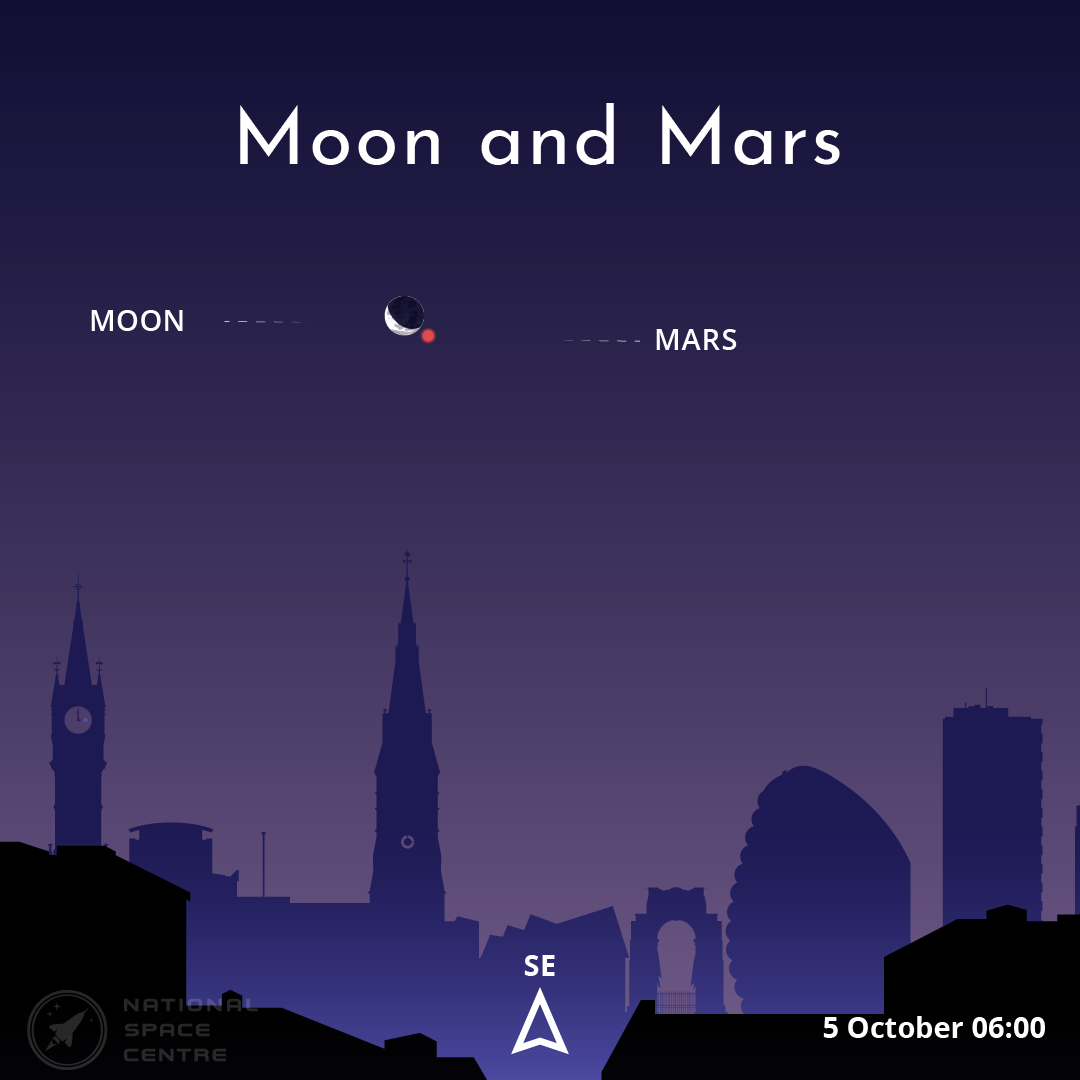
Try spotting Mars beside the Moon on 5 October as they rise together above the north-eastern horizon at around 01:00. Mars will appear to get closer to the Moon over the next few hours until they reach their closest approach just before sunrise at around 06:30.
Mars is easily distinguishable against the background stars, as it appears as a blood red point in the night sky. This reddish hue is why the planet is called Mars, as the ancient Romans likened the colour to blood after a battle. Hence, they attributed the planet to their god of war; Mars. Similarly, other civilisations named Mars for its colour, with the ancient Egyptians calling it "Her Desher", or "the red one".
Due to its size, features of Mars are difficult to make out, but a good-sized telescope may be able to make out darker patches on the surface, the polar caps, or even clouds if you are lucky.
Challenge 3 - Full Moon
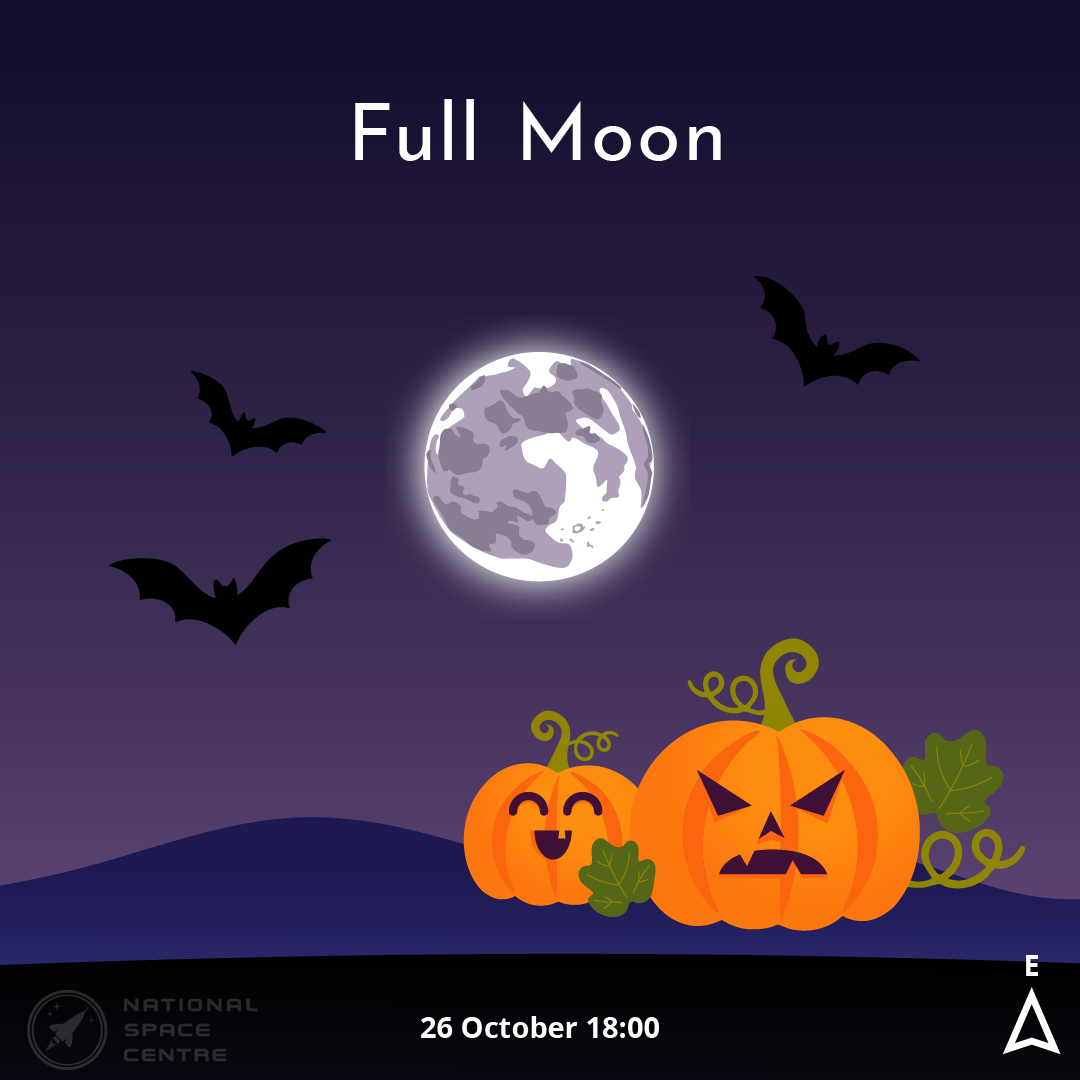
Look to the eastern horizon as the Sun sets at around 18:00 to see October's full moon. During a full moon, our natural satellite is positioned on the opposite side of the Earth to the Sun so its face is fully illuminated by sunlight. As the night continues, the Moon will make its way across the sky towards the western horizon until the Sun rises again, so you'll be able to observe it all night long.
Each month, the full moon is given a traditional name which reflects agricultural and seasonal changes. These are taken from native, colonial American and European cultures. This month’s full moon is called the Hunter's Moon, and is named to mark the best time of the year to hunt, as animals would be plump from abundant food throughout the summer. You can find our full moon calendar and more information on native full moon names in our Full Moons and Full Facts blog.
Full moon FAQ - Water on the Moon
Whilst several surface features on the Moon follow a marine-based naming convention, such as the Sea of Tranquillity where Apollo 11 touched down in 1969, we have long considered the Moon to be nothing more that a dry barren rock. Recent evidence, however, has suggested that this may not be the case.
In 2008, India's Chandrayaan-1 mission detected hydroxyl molecules spread across the lunar surface, and NASA missions such as Lunar Prospector, LCROSS, and the Lunar Reconnaissance Orbiter, have detected water ice in the permanently shadowed regions of the lunar poles. This is an incredibly important discovery, as if we want to send astronauts to the lunar surface for extended periods of time, such as with the Artemis Program, then having water already on the Moon that we can extract saves a lot of launch mass. Not only that, but water, or H2O, can be split via electrolysis to make rocket fuel.
Full references / credits:
(Banner) Skyscape. Credit: © National Space Centre
(1) Keystone. Credit: © National Space Centre
(2) Moon and Mars on 5 October. Credit: © National Space Centre
(3) Full Moon on 26 October. Credit: © National Space Centre
