

Stargazing Challenges - September 2026
- 19th Aug 2026
- Author: Ed Kellond-Turner
This September, see if you can find our star pattern of the month - the Teapot asterism, look for Saturn near the Moon, and catch the full moon towards the end of the month.
Each month we share a handful of stargazing challenges for you to try your hand at. Let us know how you get on.
Challenge 1 - The Teapot Asterism
In September are you able to spot the Teapot asterism?
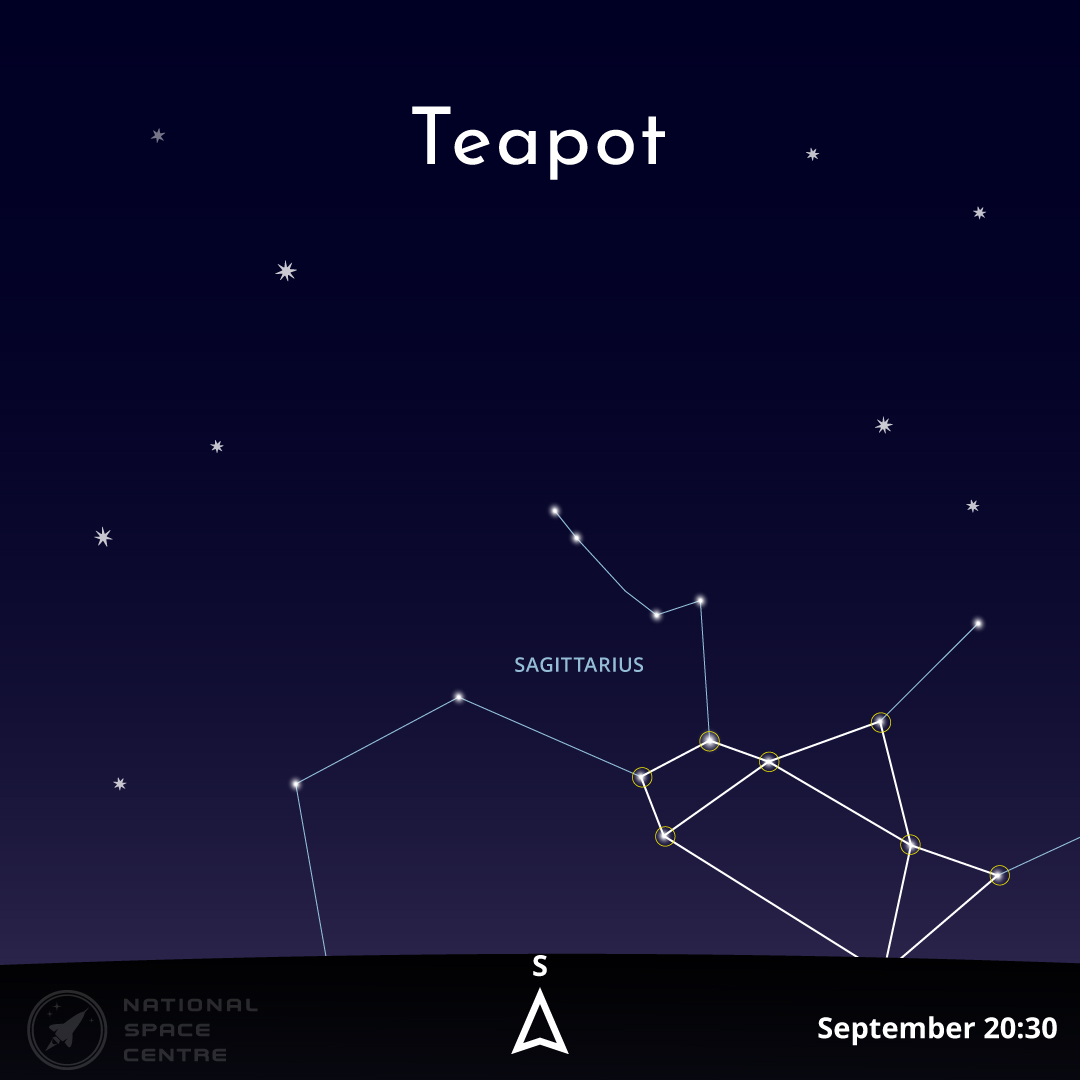
Visible throughout the month, try looking for a familiar star pattern in the constellation of Sagittarius known as the Teapot asterism. Look to the south, around 20:30. Earlier in the month, you’ll have to wait a little later for the skies to darken and towards the end of the month a little earlier before it dips below the horizon.
Usually depicted as a centaur (half-man, half-horse creature) drawing a bow, Sagittarius is only visible for a couple of months from the UK, during the summer. And the Teapot asterism is formed from eight bright stars, visible to the naked eye, from within this constellation - which are rather helpfully arranged to resemble a teapot - complete with a handle, spout and lid.
It may be challenging to spot this star pattern in heavily light polluted cities but it’s not impossible. Because the eight stars are relatively bright (especially those that form the lid), they can be seen from moderately light-polluted areas. The Moon will be in its full moon phase on 26 September, so the bright moonlight may affect your visibility. As the Sun will still be setting, the skies won’t be very dark yet but hopefully that will help the eight bright stars appear more prominent than other fainter points in the sky. Head out a little earlier to ensure you’re all set up – can you spot all eight stars before they set below the horizon?
And if you’re a keen stargazer with a good telescope ready for some action, there are a number of nebulae and star clusters hidden within the Teapot asterism like the Lagoon Nebula and the globular cluster NGC 6440.
Challenge 2 - The Moon and Saturn
Can you spot Saturn just below the Moon on 26 September?
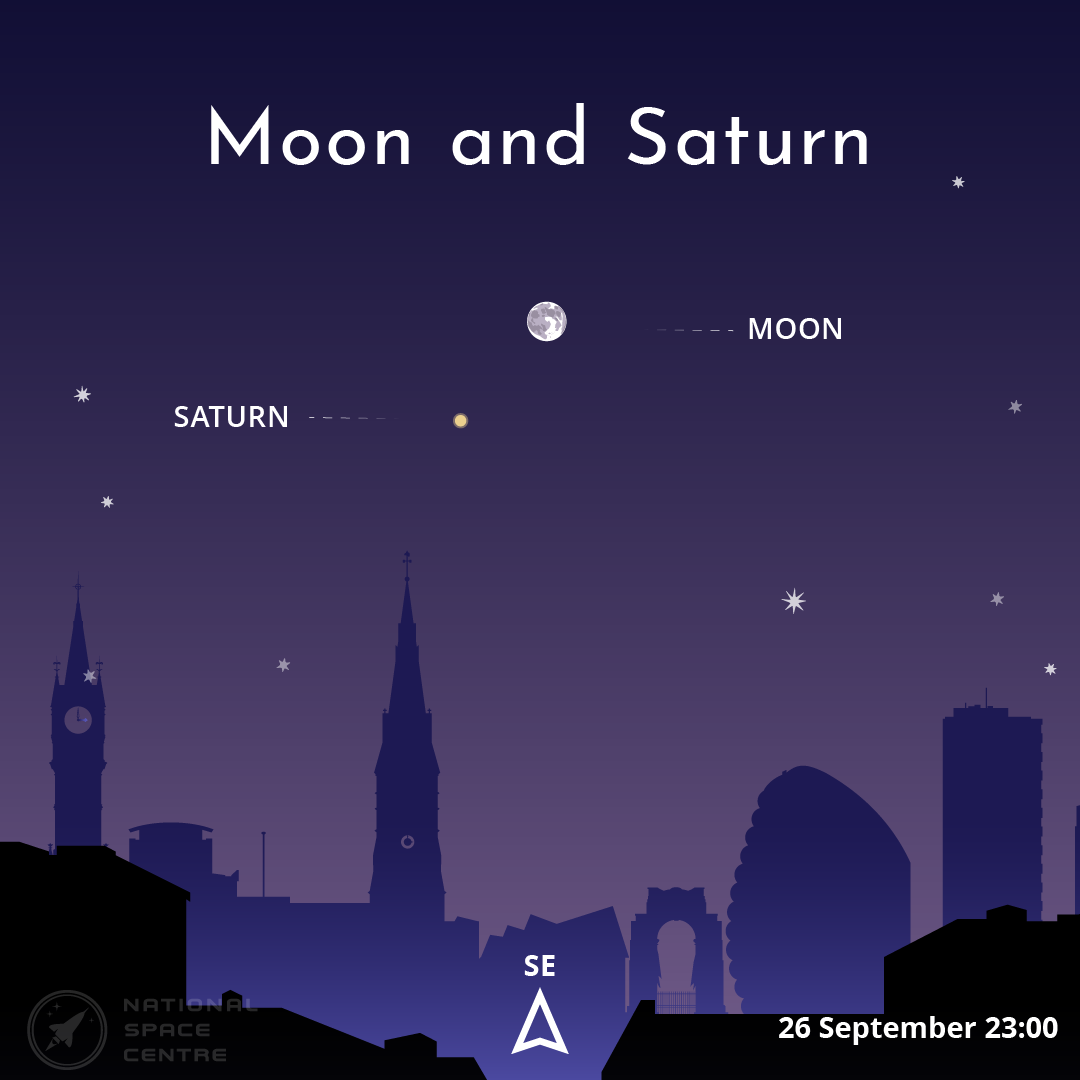
Try spotting Saturn beside the full moon on 26 September around 23:00 above the south-eastern horizon. You'll be able to see the duo together from just after sunset, but they'll be easier to spot as the sky darkens. Saturn will appear to chase the Moon across the sky as the night continues.
Saturn is the dimmest planet visible using the naked eye, so its proximity to the full moon will make it difficult to make out. Through a telescope, you may be able to spot its iconic rings surrounding the planet, and perhaps even Saturn's largest moon, Titan.
Neptune is also close to the Moon at this time, but being so far from the Sun it is invisible to the naked eye. It was only discovered when it was, in 1846, due to the calculations of French astronomer Urbain Le Verrier, who instructed Johann Galle to investigate a specific portion of the night sky. If you wish to see Neptune yourself, you'll need a fairly powerful telescope.
Challenge 3 - Full Moon
Can you spot the full moon on 26 September?
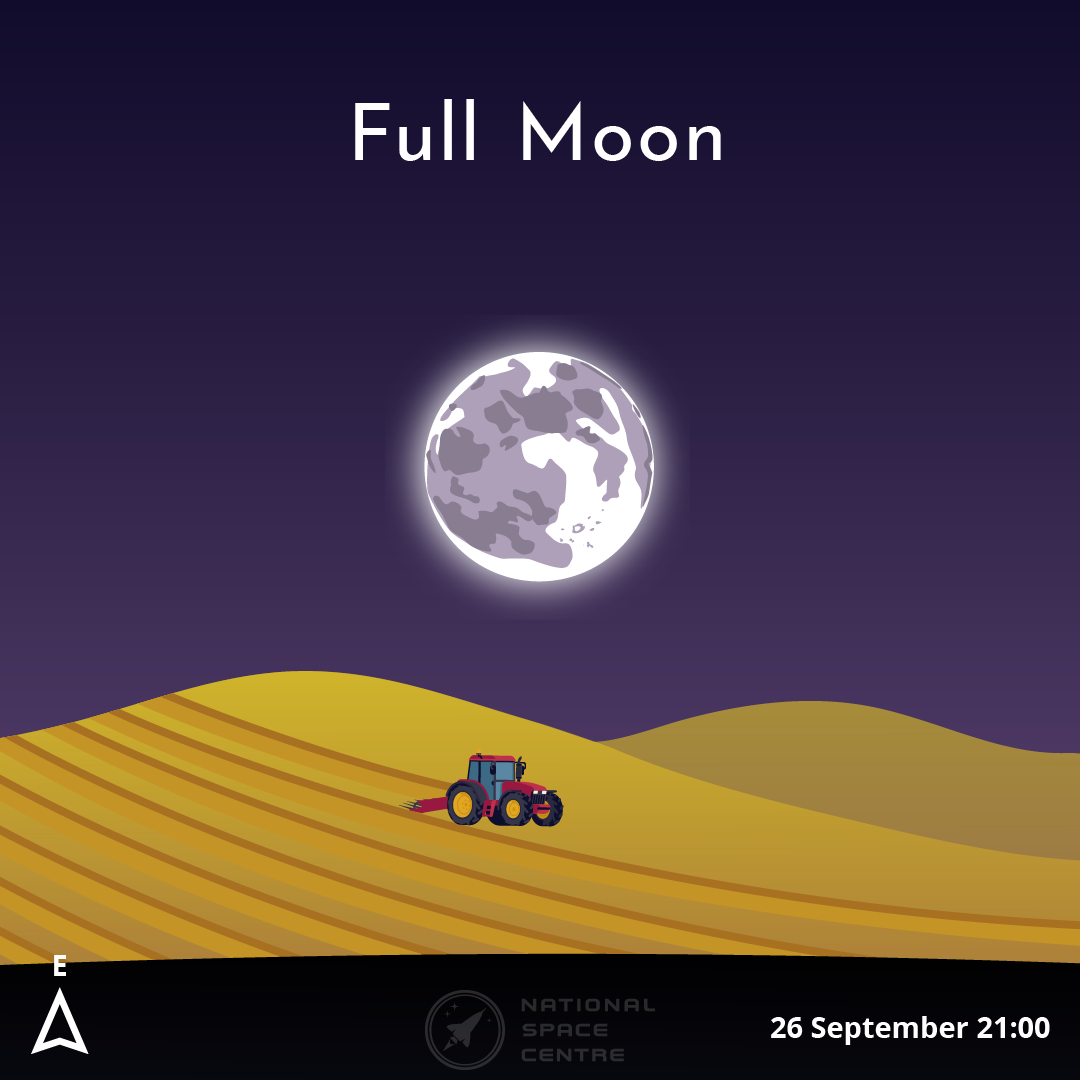
Look to the southeast from around 21:00 to spot September's full moon against a darker sky. During the full moon, our natural satellite is positioned on the opposite side of the Earth to the Sun so its face is fully illuminated by sunlight. The Moon will rise earlier that evening over the eastern horizon and will move westwards throughout the night, setting in the west the following morning as the Sun rises - so you'll be able to observe it all night long.
Each month, the full moon is given a traditional name which reflects agricultural and seasonal changes. These are taken from native, colonial American and European cultures. This month’s full moon is called the Harvest moon, named after the time that farmers would start to gather or harvest their crops. You can find our full moon calendar and more information on native full moon names in our Full Moons and Full Facts blog.
Full moon FAQ - How did the Moon form?
Its hard to accurately state how the Moon came to be in orbit around the Earth, seeing as it formed around 4.5 billion years ago. Other moons form at the same time as their host planet, or are captured through interactions with gravity. The prevailing belief is that a large Mars-sized object called Theia crashed into Earth, throwing debris out into space. Some of those ejected rocks settled into orbit around the Earth, clumping together under gravity, and so our Moon was formed. Evidence for this theory lies in lunar rocks, which contain very similar isotope ratios to Earth, something that wouldn't be the case had chunks of Earth not been ejected by a collision.
Full references / credits:
(Banner) Skyscape. Credit: © National Space Centre
(1) Teapot. Credit: © National Space Centre
(2) Moon and Saturn on 26 September. Credit: © National Space Centre
(3) Full Moon on 26 September. Credit: © National Space Centre
