

What's In The Night Sky? December 2026
- 25th Nov 2026
- Author: Ed Kellond-Turner
This December, see if you can find our star pattern of the month - the Orion's Belt asterism, look for a close conjunction between the Moon, Jupiter, Regulus, and Mars, try to spot the Geminids meteor shower, and catch the Christmas Eve supermoon towards the end of the month.
Each month we share a handful of stargazing challenges for you to try your hand at. Let us know how you get on!
Challenge 1 - Orion's Belt
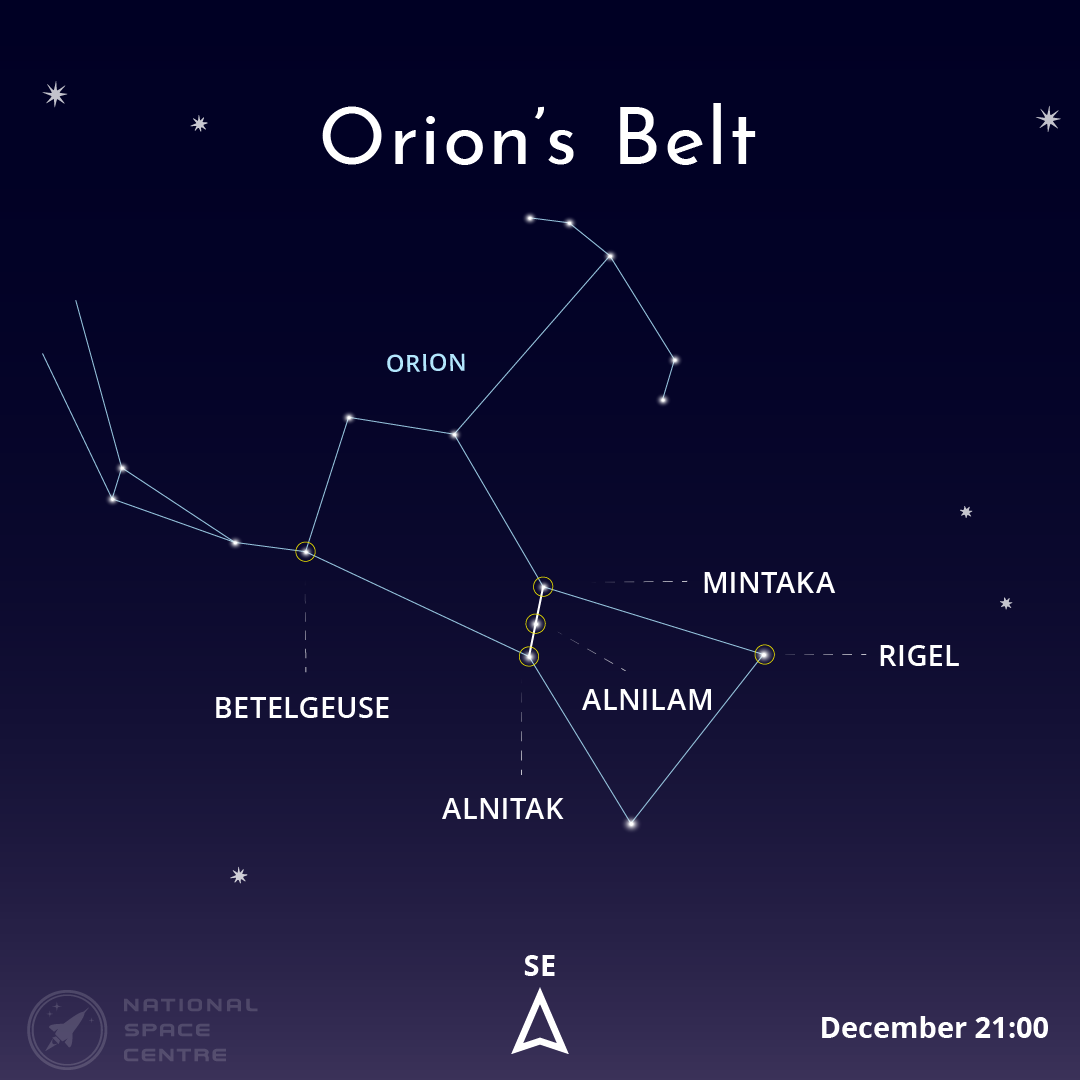
Can you spot the Orion's Belt asterism throughout December?
As the temperature starts dropping more and more, any brave stargazers amongst you can head out at around 21:00 to spot the constellation Orion. Known as the hunter, this constellation contains a famous asterism made up of three stars called Orion's Belt. Despite appearing so linear and close together, these three stars are all at differing distances. Alnilam in the middle is about 2,000 light years away while the other two are around 1,200 light years away. Rather unexpectedly, the two stars on either end of the ‘belt’ that appear furthest from each other (Alnitak and Mintaka) are actually closest together in the three dimensional space of our galaxy.
Also seen in Orion is the star Betelgeuse. Apart from having a slightly spooky name that you shouldn't say three times in a row, this star seems to be reaching the end of its life. As Betelgeuse has a mass around 700 times greater than the Sun, this red giant will explode as a supernova, shining as bright as a waxing gibbous moon! Although this may take another 100,000 years, so we might be waiting for a long time...
For those of you with a telescope, you can use Orion's Belt to spot an incredible deep sky object: The Orion Nebula. Just below the belt you can spot a vertical line of 'stars' that could be Orion's sword. The middle 'star' is actually a huge stellar nursery. The Orion Nebula is the closest large star-forming region to Earth at only around 1,300 light-years away. It's also one of the brightest nebulae when viewed from Earth, making it a popular target for amateur astronomers. Give it a go this December!
Challenge 2 - Geminid Meteor Shower
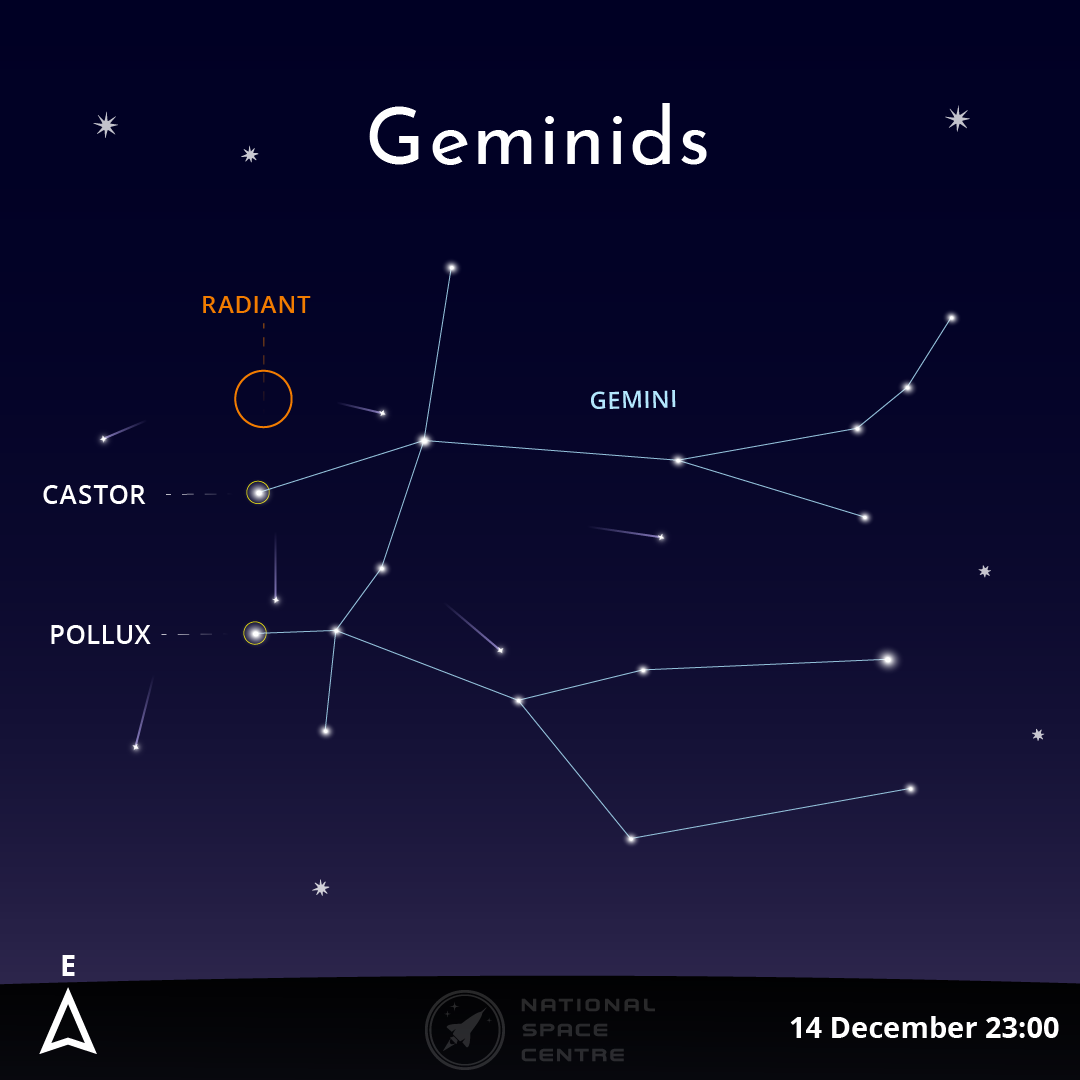
On 14 December, are you able to catch the peak of the Geminid meteor shower?
Head out just before midnight on 14 December to spot some meteors from the Geminid meteor shower. The meteors will appear to streak across the sky from a point in the constellation of Gemini which will lie in the east at midnight.
Face this direction but look all over the sky to try and catch the fast-moving shooting stars. Be patient though, as they won't appear in a steady stream but rather chaotically - sometimes a few in close succession and then nothing for a few minutes. And they'll appear in all different directions, so it's a bit like playing whack-a-mole, if you look away you might miss it!
Throughout the year, it’s possible to catch an odd meteor shooting across the sky – these sporadic meteors aren't predictable. But there a a number of meteor showers that occur like clockwork where a number of shooting stars can create a truly memorable experience. The Geminids are arguably the best meteor shower of the year - in ideal conditions, you could spot up to 150 meteors per hour!
Whilst most people would assume that telescopes and binoculars make stargazing even better, on this occasion, it’s the opposite. Because the meteors will streak brightly but disappear in an instance, you want to be able to scan as much of the sky as quickly as possible and our eyes are the best tool for the task!
Find out more about how to best plan a meteor-gazing evening in our blog, Geminid Meteor Shower, and learn why the meteor shower occurs annually.
Challenge 3 - Supermoon
What could be better than a standard full moon?
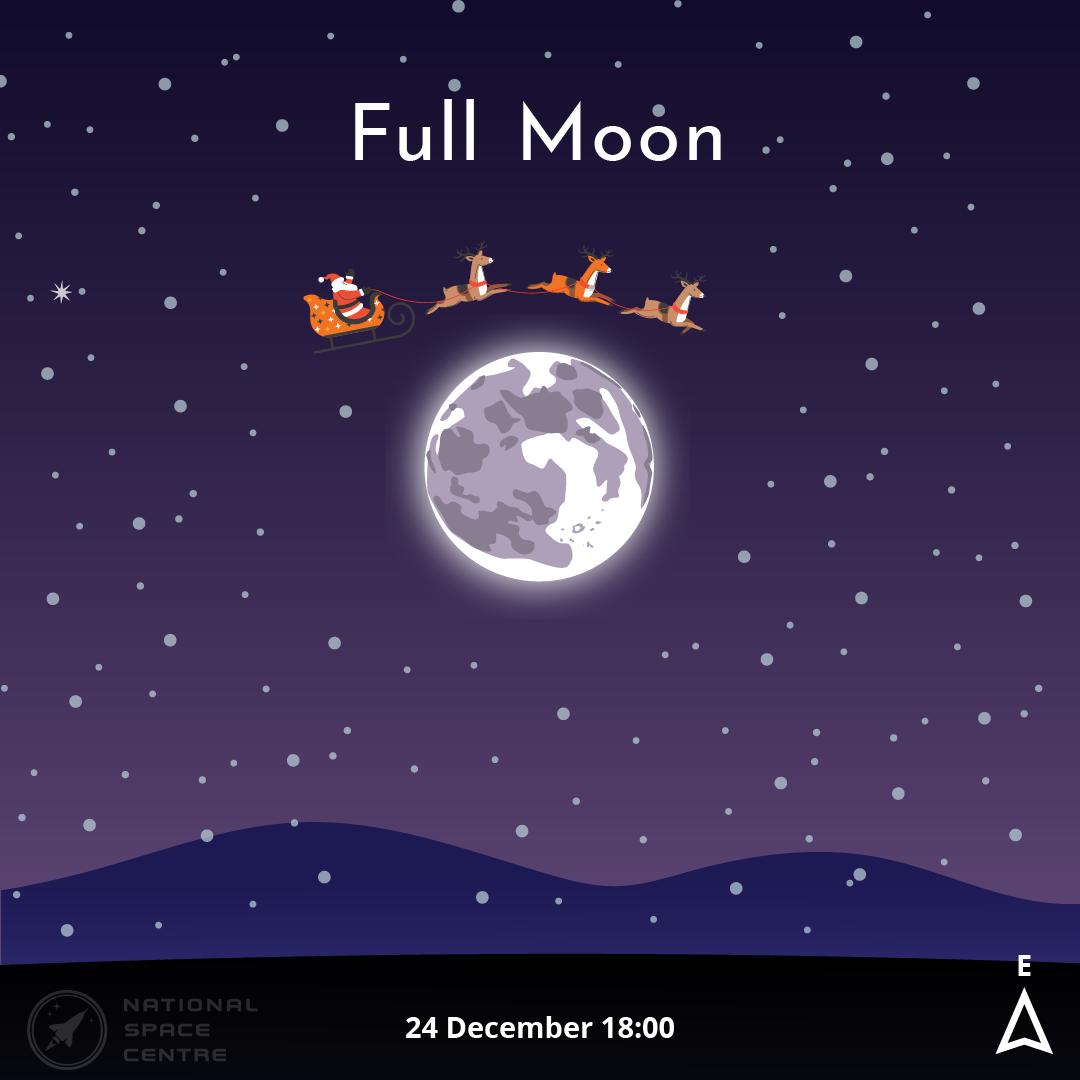
We are lucky that the final full moon of the year will be a supermoon, and as the full moon will be at its maximum on 24 December, you may even see a certain red suited jolly fellow flying overhead too!
Because the Moon is so easily visible, all you need is your eyes (and clear skies) to enjoy the spectacular view. If you have binoculars or a telescope to hand, you'll be able to pick out more details like the dark mare or large craters, though it can be useful to use a moon filter on your optics to make viewing more comfortable with the Moon being particularly bright.
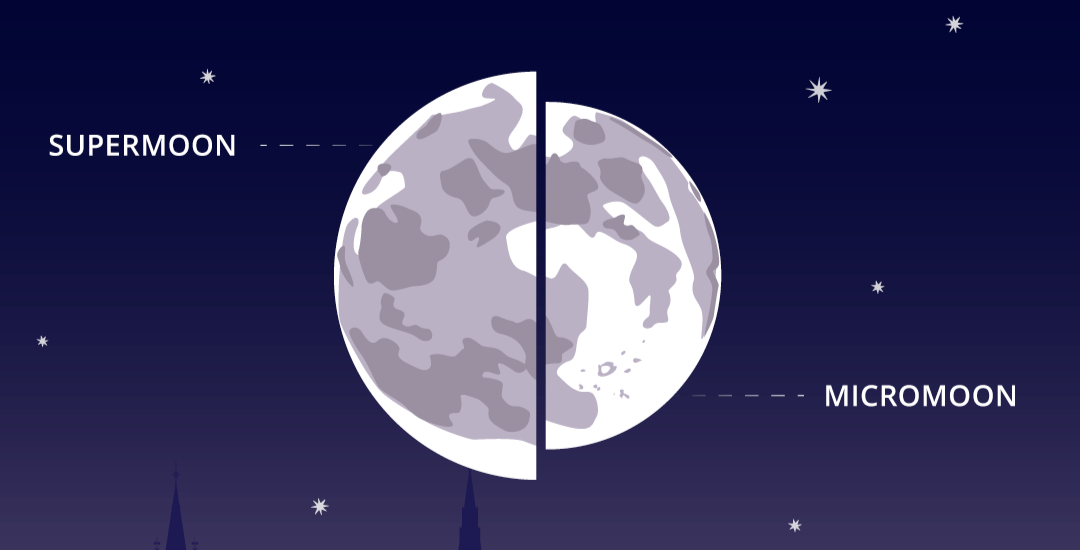
Supermoons happen roughly three to four times a year and occur because the Moon’s orbit around the Earth isn’t a perfect circle. On average the Moon is 384,000 kilometres from Earth, but its elliptical orbit brings it closer and further from our planet.
And when its closest approach coincides with a full moon we get a supermoon. It can appear 30% brighter and 14% larger than when at its furthest point. And while the size difference isn’t easily detectable, its increased brightness will be!
The technical term is a perigee-syzygy of the Sun-Earth-Moon system. Syzygy means the three bodies are in a straight-line configuration and perigee is when the Moon is at its closest distance to Earth.
‘Supermoon’ though, isn’t an official astronomical term – it was actually coined by an astrologer named Richard Nolle, in 1979. Whilst there is no set definition for how close the Moon needs to be to qualify it as a supermoon, he defined it as a full moon that occurs when it is within roughly 90% of its closest approach to Earth in its orbit (less than 360,000 kilometres away from us).
The last time there was a supermoon this big on Christmas Eve was over 200 years ago in 1787! Definitely worth a look.
Challenge 4 - The Moon, Jupiter, Regulus, and Mars
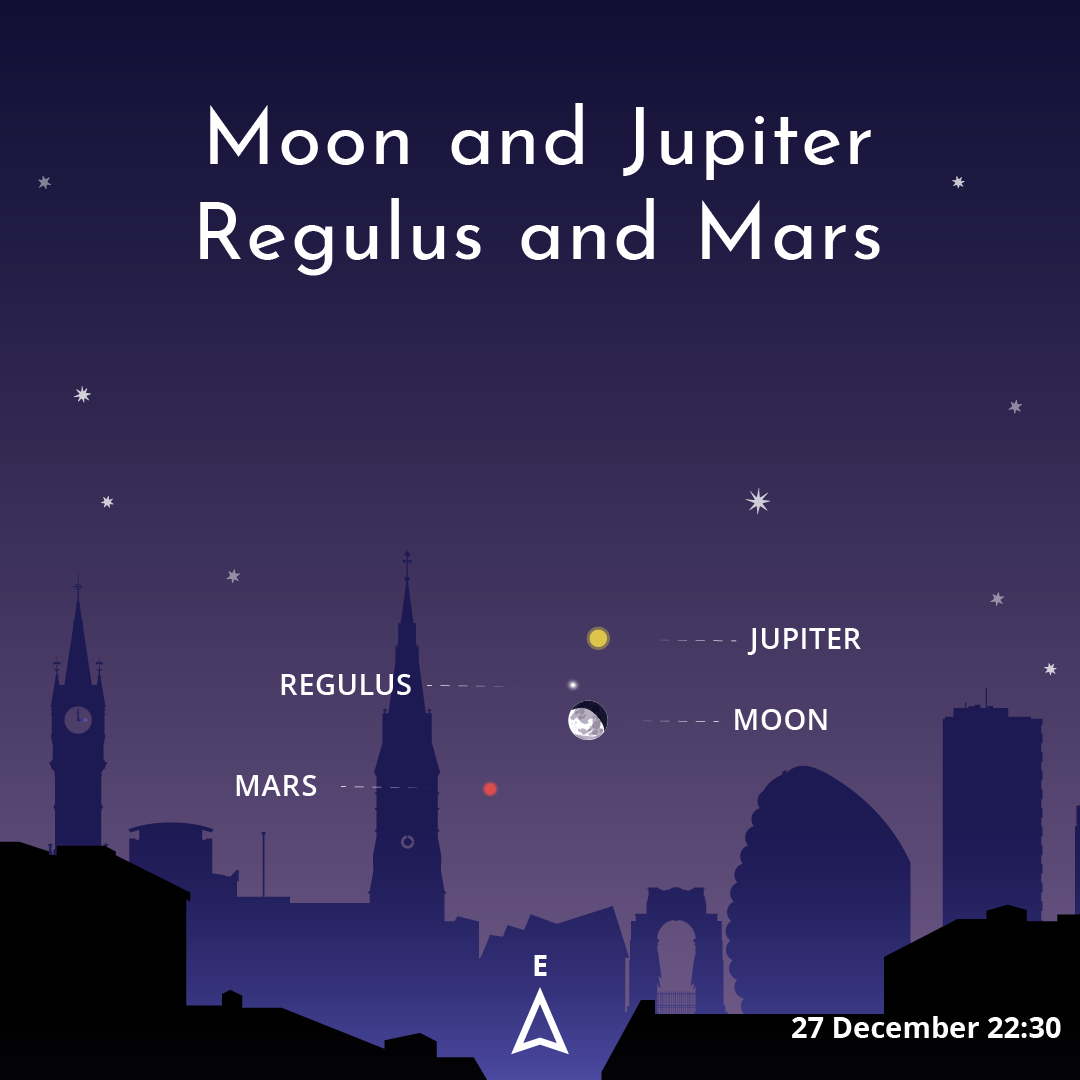
If you are still looking for more stargazing challenges, then you are in luck! We have a celestial meeting of four night sky targets on 27 December: The Moon, Jupiter, Regulus, and Mars.
The quartet will rise from the eastern horizon, becoming easily visible at around 22:30. They will then travel as a group across the sky towards the west, before the Sun rises at around 08:00.
If you want even more planetary action, Saturn is visible to the south after the Sun sets at around 18:00, and Venus appears for a few hours before sunrise on 28 December from around 05:00. For those of you with a more powerful telescope, even Uranus and Neptune can be spotted during this night as well! Certainly worth waiting up for if you ask me!
Spot the Station
Finally, for those of you that want to start their Christmas Day off with a bit of celestial magic, the International Space Station will be visible several times in the early hours of 25 December. Travelling west to east, the ISS will only be visible for a few minutes, so maybe an early rise is in store for some of us! Of course, there is a chance that this bright object whizzing overheard isn't the ISS at all, but actually JSN: Jolly Saint Nick!
Image Credits / References
(Banner) Skyscape. Credit: National Space Centre
(1) Orion's Belt in the constellation Orion. Credit: National Space Centre
(2) The Moon, Jupiter, Regulus, and Mars. Credit: National Space Centre
(3) The Geminids Meteor Shower. Credit: National Space Centre
(4) A Christmas Eve full moon. Credit: National Space Centre
