

What's in the Night Sky? November 2026
- 21st Oct 2026
- Author: Ed Kellond-Turner
This November, see if you can find our star pattern of the month - the Great Square of Pegasus asterism, look for Venus near the Moon, and catch the full moon towards the end of the month.
Each month we share a handful of stargazing challenges for you to try your hand at. Let us know how you get on.
Challenge 1 - The Great Square of Pegasus
Your asterism spotting challenge this month is the Great Square of Pegasus
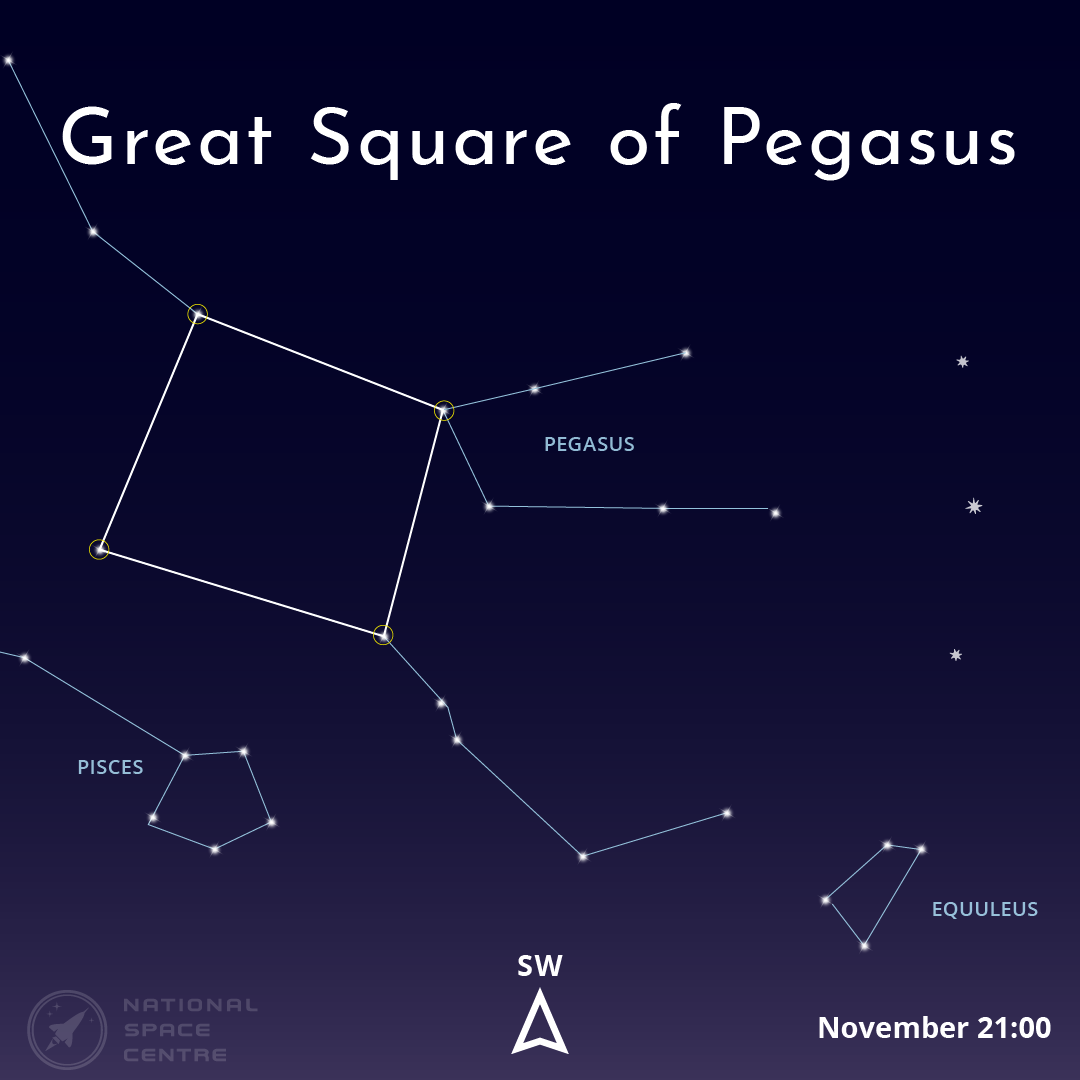
Facing southwest throughout November, see if you can spot the Great Square of Pegasus, an asterism within the constellation of Pegasus.
According to Greek mythology, Pegasus was the winged horse that emerged from the gorgon Medusa after the hero Perseus severed her head. Perseus then rode Pegasus to save Andromeda from the sea monster Cetus after she had been chained to a rock as a sacrifice by her parents Cassiopeia and Cepheus. All characters in this story are represented by constellations close to Pegasus in the night sky.
Beginning in the top left of the asterism and moving clockwise, the stars in the square are Alpheratz, Scheat, Markab, and Algenib. Alpheratz is actually part of the constellation of Andromeda.
You can use the Great Square of Pegasus as a navigation tool to find the Andromeda galaxy, which is the closest major galaxy to the Milky Way. The asterism also hosts an important scientific discovery - it’s the location of the first exoplanet found around a star like our Sun, named 51 Pegasi b, which was discovered in 1995. And the square can also act as a light-pollution indicator with the number of stars visible inside it indicating how dark your skies are. No faint stars are visible in heavily light polluted skies, up to five can be spotted inside the square in average skies and in exceptionally dark skies, you could count as many as 35 inside it.
Challenge 2 - The Moon and Venus
Try out some planet spotting as the Moon and Venus approach each other in the sky
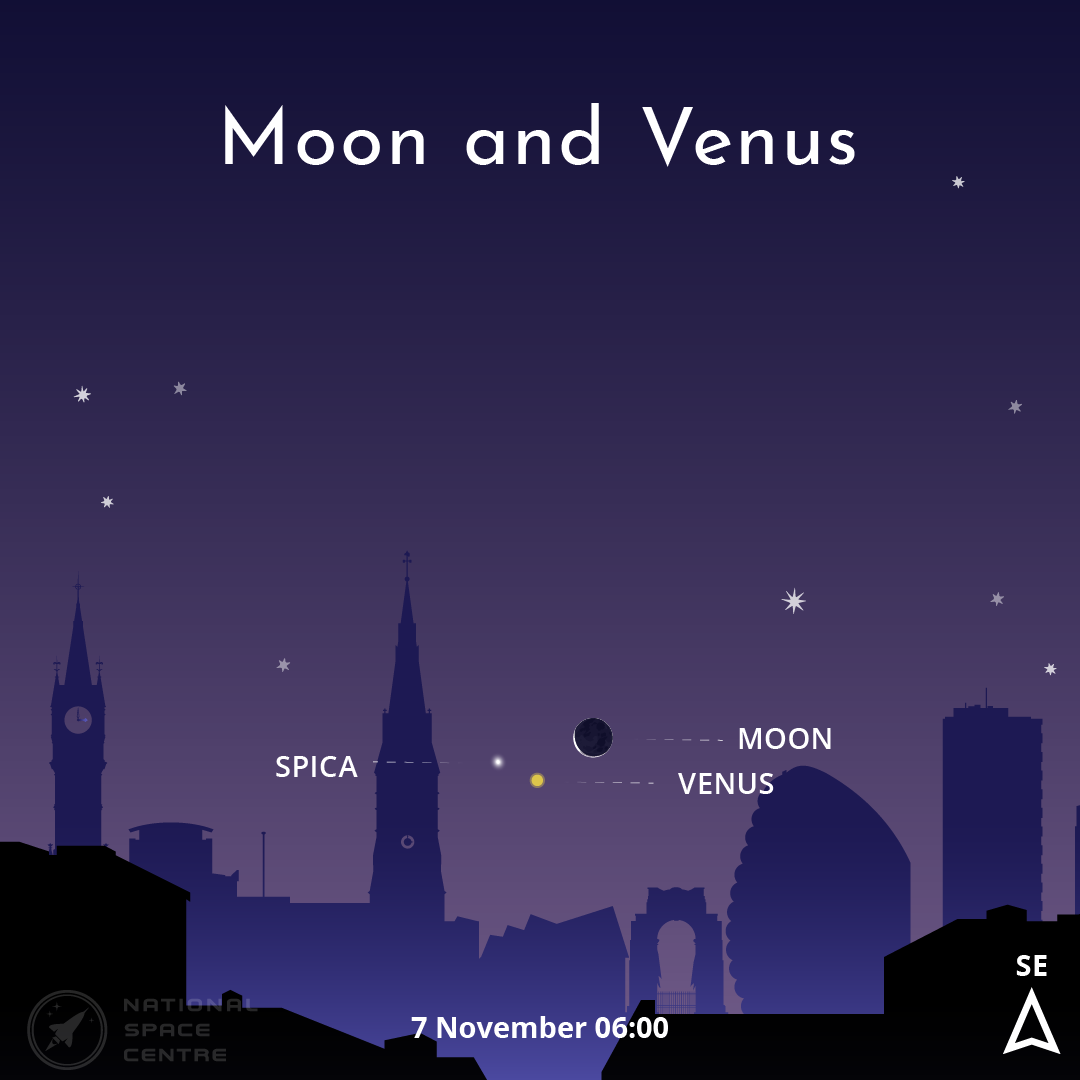
On 7 November, Venus and the Moon will appear close together in the morning sky. You'll have to get up early for this challenge, though, as only a couple of hours after appearing above the south-eastern horizon, the Sun will rise, making them much harder to spot.
Joining them we can see the star Spica, which is part of the constellation Virgo and one of the 20 brightest objects in the night sky. While it appears to be a single object, telescope observations show it to actually be a triple star system, where three stars are locked in an orbital dance.
If you want another planet-spotting challenge, around this date you can see Jupiter and Mars close together in the night sky, rising at around midnight and visible high in the sky until the Sun rises. Even with an amateur telescope, you may be able to make out the four Galilean moons. These are the four largest moons of Jupiter, and were first discovered in 1610 by Galileo Galilei. This discovery gave evidence for the Heliocentric model of the universe, where planets orbited the Sun and moons orbited planets, replacing geocentrism, where the Earth is the centre. We of course know now that the Sun is also not the centre of universe.
Challenge 3 - Full Moon
Take a look at November's full moon on 24 November
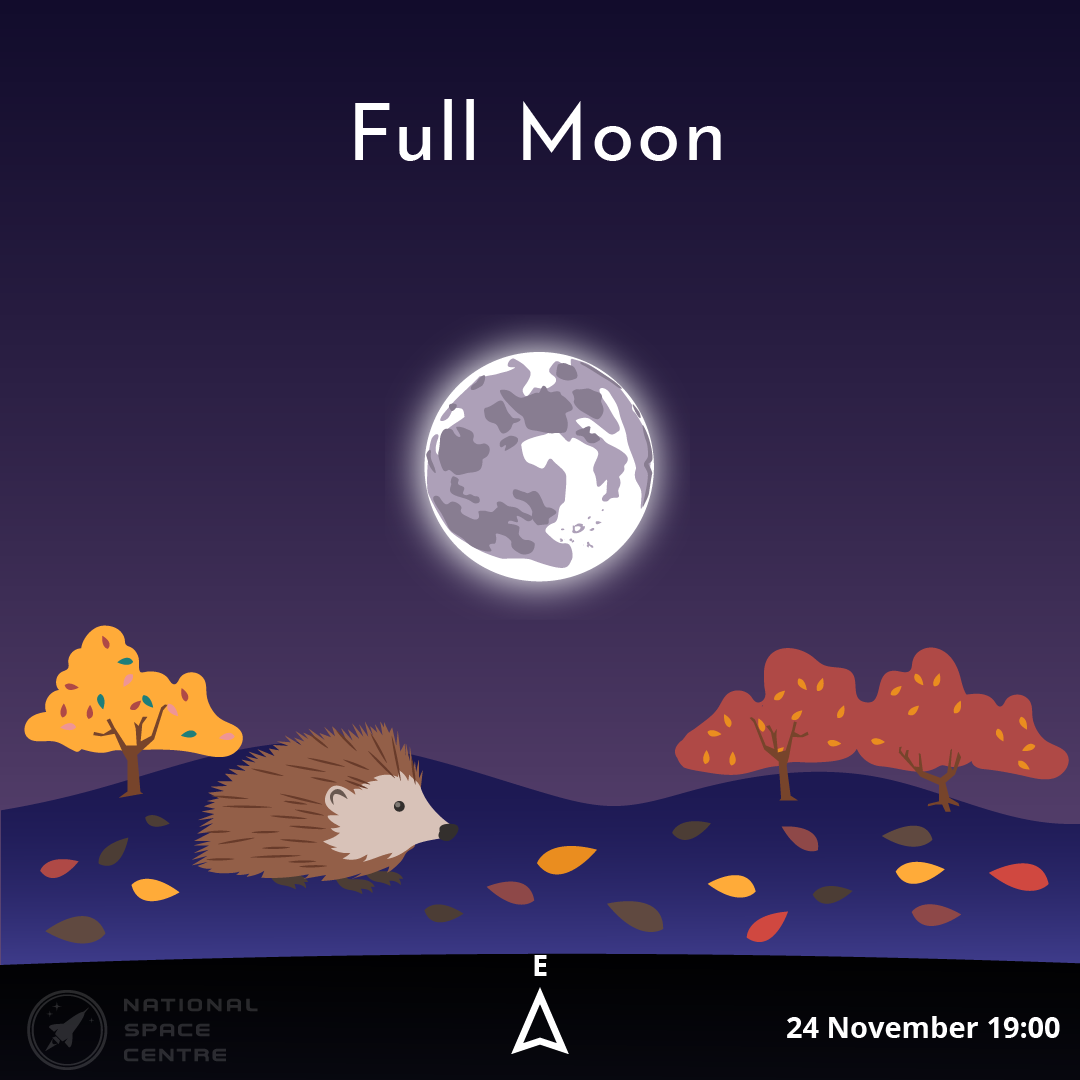
The full moon will be nicely visible above the eastern horizon at around 19:00 on 24 November, and will continue to rise higher in the sky as the night progresses. The full moon phase is a result of our natural satellite being positioned on the opposite side of Earth to the Sun, meaning its entire face is fully illuminated by sunlight.
Each month, the full moon is given a traditional name which reflects agricultural and seasonal changes. These are taken from native, colonial American and European cultures. This month’s full moon is called the Beaver Moon, named after the time that people would set beaver traps as beavers become much more active in the run up to winter. You can find our full moon calendar and more information on native full moon names in our Full Moons and Full Facts blog.
Full Moon FAQ - Can you moonwalk in real life?
In 1983, Michael Jackson debuted his most famous dance move: the moonwalk. While he didn't invent the move, he is certainly the most famous user. But can you moonwalk on the Moon? You may know that in 1969, Neil Armstrong became the first person to set foot on the Moon, and up to 1972, eleven more astronauts followed in his famous footsteps. To keep them safe, astronauts had to wear big, bulky spacesuits that severely restricted their movements and dexterity. To move across the Moon's surface, astronauts opted to 'kangaroo hop', which as it turned out was far faster and easier than normal walking. And as for the moonwalk dance move? No one has ever mimicked Michael on the Moon. Yet...
Full references / credits:
(Banner) Skyscape. Credit: © National Space Centre
(1) The Great Square of Pegasus. Credit: © National Space Centre
(2) Moon and Venus on 7 November. Credit: © National Space Centre
(3) Full Moon on 24 November. Credit: © National Space Centre
